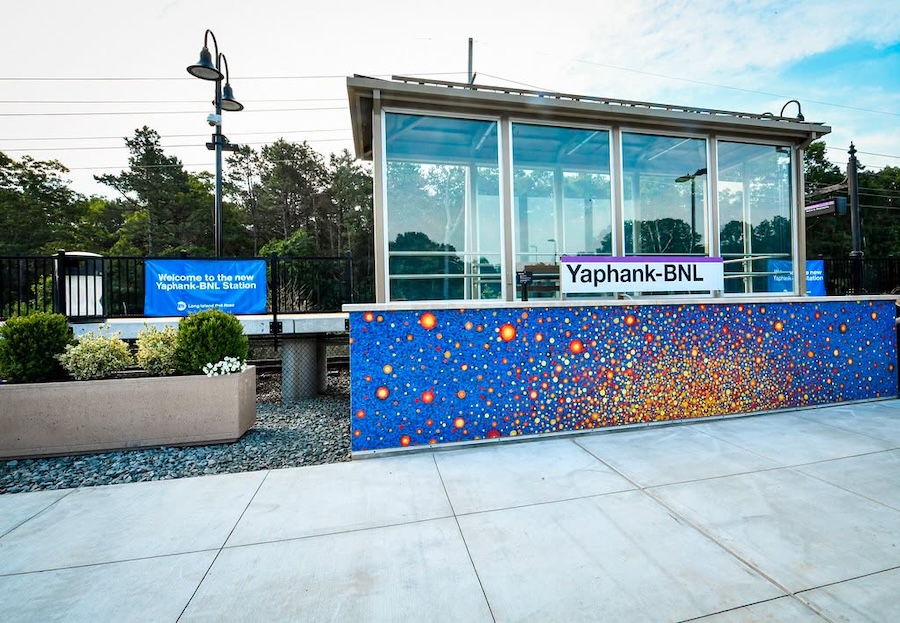
Long Island does not get a new train station very often. In fact, the newly opened Yaphank-BNL station is only the second new Long Island Rail Road station to open in 50 years.
But the more interesting story may be the station it replaced.
The former Yaphank stop had been serving the area in one form or another since the 1840s. During that time, it was known by another name, included a hotel, received an ornate Victorian station house, carried visitors to a pro-Nazi camp, supported traffic connected to Camp Upton and briefly served people headed to a failed Yaphank racetrack.
After approximately 181 years, regular service at the old Park Street location ended on July 18, 2026.
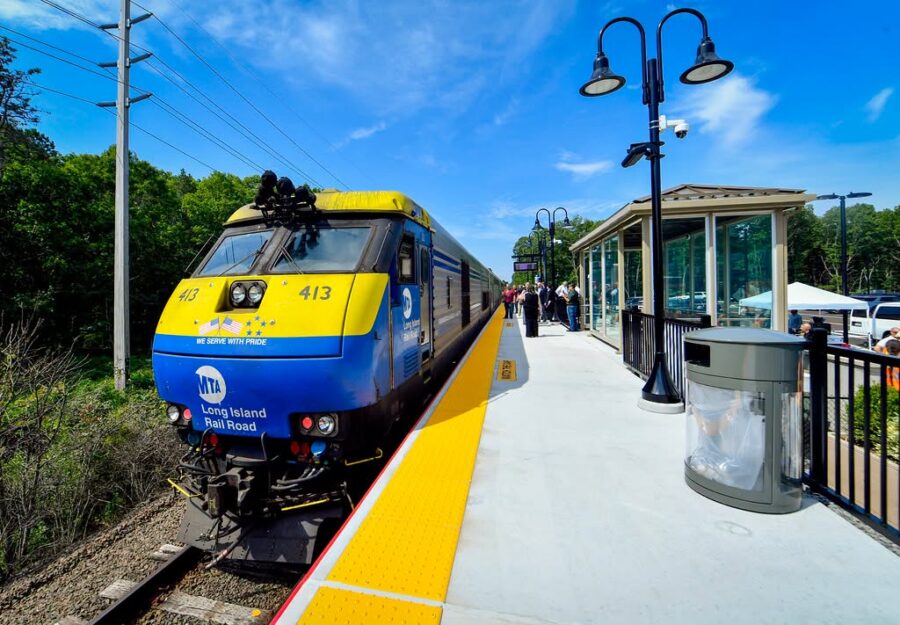
Long Island’s newest LIRR station
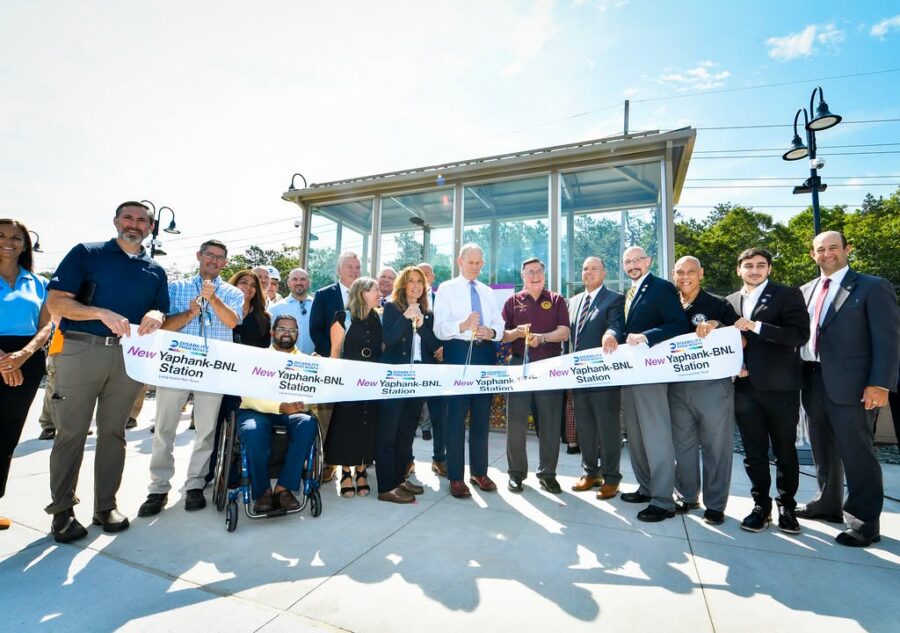
The Metropolitan Transportation Authority officially opened the $20 million Yaphank-BNL station following a ribbon-cutting ceremony on Friday, July 17.
Passenger service began the next morning, with the first scheduled trains departing at 5:36 a.m. for Greenport and 8:02 a.m. for Ronkonkoma.
The station was relocated about 3.5 miles east of the former Yaphank stop. Its new location provides easier access to Brookhaven National Laboratory, the William Floyd Parkway, the Long Island Expressway and nearby employment centers.
It is the first new LIRR station to open on Long Island since Elmont-UBS Arena station opened in 2021. It is also only the second new station added to the system on Long Island in half a century.
The new station includes:
- An Americans with Disabilities Act-compliant ramp leading to the platform
- A platform long enough to accommodate two train cars
- A 50-car parking lot
- An integrated bus loop for pickups and drop-offs
- A plaza with train schedules and bicycle racks
- A Help Point intercom on the platform
The two-car platform matches the length of the diesel trains generally operating between Ronkonkoma and Greenport. The project was designed to replace a station that had little room for expansion and historically low ridership.
MTA officials broke ground on the project on April 3, 2025. The original station was initially expected to close when the replacement opened on May 15, 2026, but the transition was postponed until July 18.
The old Yaphank station was not especially busy
By its final years, the old Yaphank station was among the LIRR system’s more modest stops.
Located on Park Street near Yaphank Avenue, it sat beneath the general vicinity of the Yaphank Avenue overpass on the railroad’s Main Line, commonly called the Greenport Branch east of Ronkonkoma.
The station had:
- The station code YPK
- A Zone 12 fare designation
- Free parking
- A single high-level platform on the north side of the track
- A platform long enough for only about one and a half train cars
An LIRR passenger study conducted between 2012 and 2014 counted approximately 30 weekday passengers at Yaphank.
The next stop to the east was Riverhead, 14.7 miles away. That was the longest distance between two stations anywhere on the LIRR.
The old station was surrounded less by a traditional downtown than by government, industrial and historic properties. Government buildings stood north of the tracks, while nearby sites included the Suffolk County Police Department’s vehicle maintenance facility, commonly called the Vector Center, and a railroad lumber yard associated with Georgia-Pacific.
The historic Suffolk County Almshouse Barn and the former Suffolk County Sanatorium property are northwest of the old station.
It was functional, but no one was likely to confuse it with Grand Central Madison.
Yaphank had a railroad stop before Yaphank station
The area’s railroad history actually begins before the permanent Yaphank station opened.
On June 26, 1844, the LIRR opened a temporary stop called Carman’s River in the Yaphank area. It served as the eastern end of the railroad until the tracks were extended to Manorville and Riverhead the following year.
Carman’s River disappeared from the timetable in June 1845.
A new station appeared on the June 14, 1845 timetable under the name Milleville, also spelled Millville on some railroad schedules. The station was renamed Yaphank in 1846.
That explains an apparent discrepancy in the historical record. State officials date LIRR service in Yaphank to 1844, while the permanent station generally recognized as the original Yaphank station opened in 1845.
The station once had a hotel and Victorian woodwork
The early Yaphank station was considerably more substantial than the simple platform familiar to recent riders.
A hotel operated as part of the station complex until December 1873. An ornate replacement station was constructed during the 1870s, featuring elaborate gingerbread-style woodwork and the picturesque architectural details commonly used on Victorian railroad depots.
One summary of the station lists 1871 as its rebuilding date, while the longer historical account dates the replacement station building to 1875.
Either way, the depot looked considerably different from what remained by the end of the 20th century. The decorative woodwork was significantly reduced in June 1941, removing much of the building’s earlier character.
The Camp Siegfried Special stopped in Yaphank
One of the darkest chapters in the station’s history occurred during the years before World War II.
Yaphank was home to Camp Siegfried, a summer camp and gathering place operated by organizations connected to the German-American Bund, a pro-Nazi movement active in the United States during the 1930s.
The LIRR operated excursion trains commonly called the “Camp Siegfried Special,” carrying visitors from New York City to Yaphank. Some passengers traveled from German-American neighborhoods in the city to attend events at the camp.
Camp Siegfried presented itself partly as a recreational retreat, but its grounds displayed Nazi imagery and hosted activities influenced by Nazi and Hitler Youth ideology.
The fact that Long Islanders could board a dedicated train connected to such a place remains one of the more disturbing episodes in the railroad’s history.
Yaphank station also served Camp Upton
The station had a very different role during World War II.
Its proximity to Camp Upton made Yaphank an important transportation point connected to the American war effort. Camp Upton had previously served as a World War I Army installation and was reactivated during World War II.
The camp property later became the site of Brookhaven National Laboratory.
That creates an unusual historical connection between the old and new stations. The former stop helped serve the military installation that preceded Brookhaven Lab, while the new station was deliberately placed closer to the laboratory itself.
Brookhaven Lab Director John Hill described the new station as a direct transportation connection for visiting scientists, students, employees and collaborators. The lab is also constructing the Electron-Ion Collider, a major research facility expected to attract scientists from around the world.
The station house closed and later burned
The Yaphank station building closed in 1958.
Three years later, in 1961, it burned down. What remained was largely a basic passenger platform surrounded by concrete rather than the gingerbread-trimmed depot that had stood there during the late 19th century.
High-level platforms were installed during the late 1990s, making it easier for passengers to board modern LIRR trains.
By then, the station’s days as a village railroad depot were long over.
For a brief time, it served a racetrack
During the late 1970s, Yaphank station acquired another unusual purpose.
Special trains carried passengers to the station, where they could transfer to buses traveling to Parr Meadows Racetrack.
The Yaphank track, later also known as Suffolk Meadows, opened in 1977 but quickly ran into financial problems. Its first version closed following a meet lasting only 113 days.
The racetrack did not last, but it gave the station another brief entry in Long Island transportation history: Victorian village depot, camp excursion stop, wartime station and racetrack connection.
That is a fairly varied résumé for a platform that eventually averaged around 30 weekday riders.
Why the station was moved
The former station’s location limited the MTA’s ability to expand it or attract substantially more passengers.
The replacement site is closer to Brookhaven National Laboratory, an industrial park, the William Floyd Parkway and the Long Island Expressway. Officials believe those connections give the station more potential to serve workers, visitors, students and nearby residents.
Gov. Kathy Hochul said the project was intended to place rail service closer to major employers and regional transportation routes.
MTA Chair and CEO Janno Lieber said relocating the station closer to employment and development was the practical choice for a growing area. Long Island Association Acting President and CEO Stacey Sikes described the station as an infrastructure investment that could produce broader economic benefits for the East End.
The old station is expected to be demolished following the opening of its replacement.
Could better East End train service follow?
The new station is opening as the MTA examines much larger changes east of Ronkonkoma.
That portion of the Main Line currently has only one track and is not electrified. Trains must use diesel power, and service is considerably less frequent than it is on the electrified portions of the LIRR.
The MTA study will examine:
- Signal and communications upgrades
- Other infrastructure improvements
- Adding a second track along some or all of the line between Ronkonkoma and Riverhead
- Electrifying part of the railroad east of Ronkonkoma
- Building supporting infrastructure such as electrical substations
- The potential costs and benefits of the proposed investments
A second track could allow more trains to operate in both directions, while electrification could provide faster and more frequent service with less dependence on diesel locomotives.
The study is expected to be completed in early 2027. It is being funded through the MTA’s $68 billion capital plan for 2025 through 2029.
None of that guarantees that double tracking or electrification will happen. On Long Island, a feasibility study is still several stations away from a construction project.
But the opening of Yaphank-BNL gives eastern Suffolk a modern and fully accessible station positioned for whatever comes next.
The old Yaphank stop survived for more than 180 years with relatively few passengers, a very short platform and an unusually complicated history. Its replacement begins with better highway access, closer ties to one of Long Island’s largest scientific institutions and the possibility of improved service farther east.
For a station that once consisted of little more than a platform beneath an overpass, it is quite an upgrade.
Photo: MTA