Long Island has plenty of places with ghost stories, but Mount Misery seems to have collected nearly every variety. For generations, this wooded corner of Melville and West Hills has accumulated tales about a hatchet-wielding woman, a burned asylum, phantom police officers, mysterious creatures, strange lights, UFOs and even Men in Black. In the 1960s, the stories attracted Long Island radio personality Jaye P. Paro. Before long, they’d also attracted John A. Keel, the paranormal writer who would make the area part of The Mothman Prophecies.
Even the Town of Huntington’s official trail guide acknowledges Mount Misery’s reputation, describing local legends involving ghosts, strange creatures and lights in the sky before recounting the particularly gruesome story of Hatchet Mary. What makes the Mount Misery myth so good isn’t simply whether any one of those stories can be proven but how so many completely different legends became attached to the same patch of Long Island woods.
First, the real Mount Misery
The Mt. Misery Nature Preserve is a 175-acre section of West Hills County Park in Melville, south of the Northern State Parkway and along Sweet Hollow and Mount Misery roads. The Town of Huntington describes it as the quieter and less visited portion of the park, with a 3.3-mile trail network crossing steep terrain through oak forest, lowbush blueberry, huckleberry and stands of pine. The town’s guide notes that a visitor can spend an entire morning there without encountering another person.
Unlike much of Long Island, the property was poorly suited for farming and remained relatively undeveloped. One long-repeated explanation for the name says early settlers found the rocky hills difficult to farm and miserable to cross with wagons, eventually giving the area its uninviting name. A contemporary-legend study published by the International Society for Contemporary Legend Research records that explanation as part of the area’s history and folklore.
There was still a small rural population nearby. In 1829, local residents organized the Sweet Hollow Presbyterian Church. According to the Town of Huntington, the oldest portion of the building originally stood at the northwest corner of Sweet Hollow Road and Old Country Road before being moved to its current location in the 1970s.
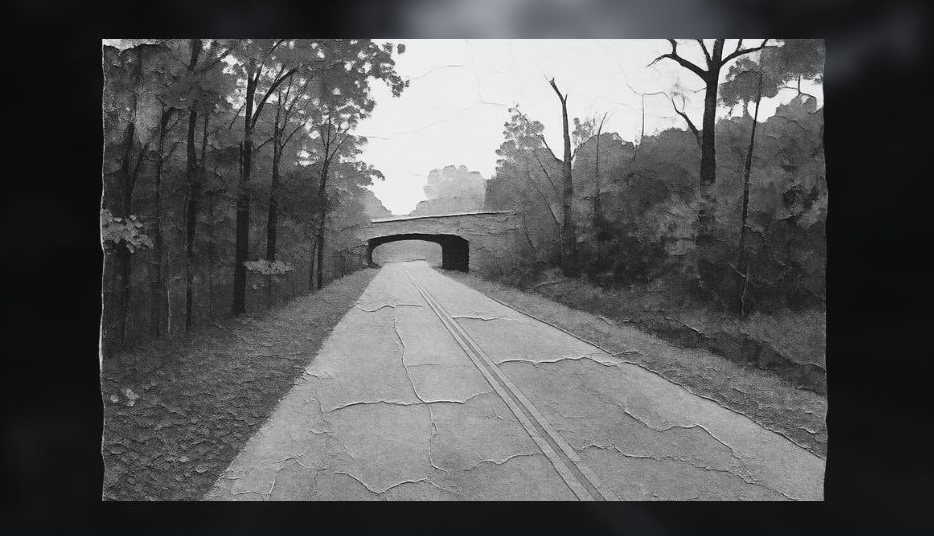
The setting itself helps explain why the legends found such fertile ground. The hills are steep by Long Island standards, the roads are narrow, and thick woods can make the suburban development surrounding West Hills seem farther away than it really is. At night, that geography becomes considerably more effective.
Hatchet Mary enters the story
If Mount Misery has a signature ghost, it’s probably Hatchet Mary, and the story has circulated widely enough to earn a place in the Town of Huntington’s own trail guide.
According to the version recounted there, Mary was a young woman who murdered her family with a hatchet and then killed herself. Afterward, her house supposedly sank into the ground, leaving nothing behind but the chimney. Her ghost is said to remain in the woods.
The story is deeply embedded in Mount Misery folklore, but researchers haven’t found evidence that the murders actually occurred. Heather Rivera, writing for FOAFTale News, reported finding no town records or contemporary newspaper accounts documenting a Mount Misery ax murder or a woman named Mary dying in the manner described by the legend.
Long Island author and historian Kerriann Flanagan Brosky told Rivera that stories involving various women named Mary appear to have become intertwined over time, particularly by the 1960s. For the Mount Misery legend itself, however, the clearest and most locally documented version remains Hatchet Mary: the young woman who supposedly killed her family, took her own life and left behind a house that vanished into the earth.
The asylum that supposedly burned in the woods
The Mount Misery asylum story is just as complicated. Depending on which version someone heard, an institution was built somewhere in the woods in the 1700s or 1800s, its patients were horribly mistreated and screams could supposedly be heard through the surrounding trees. Eventually the building burned.
Some versions blame a patient named Mary for starting the fire. Others say patients died inside and can still be heard crying out. Later retellings add a second hospital constructed for soldiers during World War II, followed by stories involving government experiments, brainwashing and a mysterious section sometimes called “Area 5.”
Rivera investigated the hospital story by searching local newspapers, town and county records, historical maps and government sources. She reported finding no evidence that such a hospital ever stood in the Mount Misery woods, and historical aerial photographs didn’t show the type of clearing a large institution would’ve required.
The investigation did, however, uncover a very real Long Island institution with some striking similarities to later versions of the legend.
A real military psychiatric hospital existed nearby
During World War II, the U.S. Army operated Mason General Hospital in Brentwood. Official Army histories identify Mason as one of only two Army general hospitals in the United States devoted entirely to psychiatric patients. The facility opened as a psychiatric center in 1943, eventually had an authorized capacity of more than 3,000 beds and became home to the Army’s School of Military Neuropsychiatry.
Army records describe psychiatric treatment, occupational therapy and specialized military training there, with the patient population exceeding 3,000 at its peak. The facility was associated with the sprawling Edgewood complex in the Brentwood-Deer Park area, several miles from Mount Misery.
Rivera suggested that stories involving Mason General and Edgewood may have migrated westward over time and become mixed into the Mount Misery legend, particularly the stories involving a wartime psychiatric hospital and the mysterious “Area 5.” There’s no way to prove that’s exactly what happened, but it offers a plausible explanation for why later versions of the Mount Misery story contain details resembling an institution that really did exist elsewhere on Long Island.
The asylum in the Mount Misery woods appears to be folklore. The enormous wartime psychiatric hospital in the Brentwood-Deer Park area was real. Somewhere over several decades of storytelling, the two may have become one story.
Mount Misery enters the UFO age
By the 1960s, Mount Misery’s reputation had expanded beyond ghosts and mysterious hospitals. Jaye P. Paro, a Long Island radio personality associated with WBAB in Babylon, became deeply involved in reports of unusual happenings around the area. John Keel would later describe her in The Mothman Prophecies as a local Mount Misery expert whose radio program explored historical and psychic subjects.
Paro’s involvement predates Keel’s famous book. In July 1969, she published an article about Mount Misery in Beyond magazine. Surviving material in the John Keel archive describes her article as a collection of Long Island reports involving hauntings, creatures, UFOs, mysterious buildings, disappearing cars, inexplicable silences and other strange occurrences.
That article is particularly useful because it provides a glimpse of the Mount Misery mythology while it was still developing. By the late 1960s, many of the themes still repeated today were already circulating, and Paro helped move those stories from local conversations and radio broadcasts into print.
John Keel brings Mount Misery into The Mothman Prophecies
Keel was already immersed in UFOs, strange creatures and the emerging mythology surrounding Men in Black. Mount Misery fit naturally into that world, and he incorporated several stories from the area into The Mothman Prophecies.
One concerned an elderly woman who supposedly received a visit from four unusual men shortly after a rainstorm. She described them as having red faces and high cheekbones and said they claimed her property belonged to their people. What particularly frightened her was their footwear: despite walking through muddy conditions, their shoes were reportedly spotless.
Keel wrote that another visitor appeared that same week, a woman with striking white hair who claimed to represent a local newspaper and asked personal questions about the resident’s family. He said that when he later checked with the newspaper, nobody matching her description worked there.
These remain Keel’s accounts rather than independently established events, but they became part of the Mount Misery mythology. Paro’s experiences grew stranger as well. Keel wrote about unusual telephone calls, metallic-sounding voices, UFO reports, mysterious cars and threatening encounters tied to her investigation of the area.
In Keel’s notes from September 1967, Paro supposedly encountered beings who warned that “the moth man” was coming to Long Island. Point Pleasant apparently didn’t have an exclusive franchise.
Men in Black on Long Island
The Men in Black associated with Mount Misery belong to an older and considerably stranger version of the concept than the one most people know from the movies. In early UFO lore, Men in Black were mysterious visitors who allegedly appeared after sightings, questioned witnesses and sometimes warned them not to discuss what they’d seen.
Keel helped popularize those stories, and Mount Misery became part of them through Paro. Accounts surrounding the area include mysterious men in dark clothing, unusual automobiles, unexplained visitors and intimidating telephone calls following UFO reports.
Those stories emerged at an ideal moment in American culture. Flying saucers had been a national fascination since the late 1940s, while science fiction television, the space race and Cold War secrecy gave people plenty of reasons to look toward the sky and wonder what the government might not be telling them. Mount Misery, already isolated and carrying a collection of ghost stories, supplied a suitably strange Long Island setting.
The UFO reports didn’t disappear with the 1960s
Reports of unusual objects around Mount Misery continued long after Paro and Keel. One later account published by Gothic Horror Stories describes a 2017 sighting by a woman who said she watched a silent triangular object with bright lights move toward Mount Misery before disappearing.
What she actually saw can’t be established from the report alone, but the account demonstrates how a location with a reputation can shape the way an unexplained experience is remembered. A strange light somewhere else might remain a strange light. Near Mount Misery, it becomes part of an existing story.
Ghost cops, phantom children and things with red eyes
While UFO lore expanded the Mount Misery mythology in one direction, the ghost stories continued multiplying in another. Mount Misery and neighboring Sweet Hollow Road have accumulated stories involving a phantom police officer who supposedly pulls motorists over, a woman said to push stalled cars away from danger near an underpass, children or teenagers hanging from a bridge, shadow figures, glowing orbs, disembodied cries, mysterious dogs and creatures with glowing red eyes.
Other visitors have reported foul or sulfur-like smells, strange voices and mysterious cars that appear to follow motorists before disappearing. LIHauntedHouses.com has collected accounts from visitors who claimed to encounter fog, unexplained lights and other strange phenomena, alongside reviews from people who spent years in the area without experiencing anything unusual.
The phantom police officer provides another example of how difficult it can be to separate old story from old event. Rivera reported finding no documentation supporting the commonly repeated claim that an officer was killed by a gunshot to the head at the location described in the legend. She suggested that the tale may function like other cautionary legends attached to dangerous roads, giving young drivers a memorable reason to slow down.
Considering the narrow curves of Sweet Hollow Road and the number of Long Islanders who remember driving it recklessly as teenagers, the ghost cop may have performed more public service as a legend than he ever could’ve in a patrol car.
For generations of Long Islanders, going there was part of the experience
Whether people completely believed the legends almost didn’t matter. For many Long Islanders, especially teenagers growing up around Huntington, going to Mount Misery became a ritual of its own.
Comments and recollections from people who knew the area describe remarkably similar experiences across several decades. Friends piled into cars after dark, drove Sweet Hollow Road or Mount Misery Road, told one another the stories and eventually dared somebody to get out. Some went looking for Mary. Others searched for UFOs or Men in Black. There were makeout trips, high-school drives, fraternity adventures and attempts to frighten passengers by switching off the headlights.
One woman who said she lived on Mount Misery Road for about 10 years remembered her brothers deliberately playing pranks on visitors who arrived hoping to be frightened. That alone probably accounts for at least a few unexplained encounters.
Other Long Islanders remember experiences they still can’t explain. People have described strange vehicles, noises coming from the woods, pebbles or other objects apparently striking cars, unexplained lights and the general feeling of being watched. One commenter recalled approaching what appeared to be a police vehicle and watching a car full of teenagers flee because they knew the legend of the ghostly officer.
Then there are the people who experienced nothing whatsoever. One former police officer said he regularly stopped at Mount Misery while working the area from 1970 to 1985 because it was a quiet place to complete paperwork. He remembered it as peaceful. Another commenter said she and her husband had hiked there many times, both during the day and at night, without encountering anything unusual.
The same woods managed to become a haunted landscape, a teenage proving ground, a makeout spot, a place to play practical jokes and a peaceful refuge depending entirely on who happened to be visiting.
Why Mount Misery works so well as a legend
Mount Misery’s geography gives storytellers a head start. The roads are narrow, the woods are thick and the hills create stretches that can feel surprisingly isolated despite being surrounded by modern Long Island. At night, familiar landmarks disappear and movement in the trees becomes much harder to identify.
Anyone arriving after already hearing about Hatchet Mary, a burned asylum, UFOs or a phantom police officer is also bringing something into the woods with them. A deer moving through brush sounds different when someone in the passenger seat has just finished explaining that a red-eyed creature lives nearby.
Over time, each generation contributed something new. Older ghost stories were joined by the asylum. The UFO era supplied strange lights and Men in Black. Teenagers supplied hundreds of personal experiences, pranks and retellings. The internet eventually gathered versions that might once have remained isolated in different neighborhoods and preserved nearly all of them.
Mount Misery’s real history may be stranger than simply calling it haunted
Some of the best-known Mount Misery stories don’t survive much historical scrutiny. Researchers haven’t found a documented asylum in the woods. The various versions of Mary’s life contradict one another. Several supposed deaths associated with the roads have proven difficult or impossible to document. Stories claiming Native people regarded the area as cursed are frequently repeated in modern accounts, but clear primary historical evidence for the more elaborate versions is difficult to find.
None of that makes Mount Misery uninteresting. The preserve really is unusually quiet and undeveloped for suburban Long Island. Ghost stories really have circulated around it for generations. Jaye Paro really published an article about Mount Misery in 1969. John Keel really incorporated the area into The Mothman Prophecies. A very real military psychiatric hospital operated elsewhere in central Suffolk County, potentially providing raw material for one of the area’s biggest legends. Most importantly, generations of Long Islanders really did grow up hearing these stories and then went to the woods themselves to see what they might find.
One generation had Hatchet Mary. Another added the asylum. The UFO era supplied strange lights and Men in Black. Teenagers supplied decades of firsthand stories. The internet made sure almost none of them disappeared.
Whatever is or isn’t hiding in the woods, Mount Misery has become something unquestionably real: one of Long Island’s great pieces of living folklore. And as long as somebody’s willing to tell the stories before a nighttime drive through West Hills, it probably isn’t finished collecting new ones.
Sources
- Town of Huntington, Mt. Misery Nature Preserve Trail Guide
Official information on the 175-acre preserve, trails, terrain, vegetation, Sweet Hollow Presbyterian Church and the Town’s account of the Hatchet Mary legend.
https://www.huntingtonny.gov/filestorage/13749/13843/15187/99828/153038/17956/Trails_Guide_Mt__Misery_Nature_Preserve.pdf - Heather Rivera, “The History Behind Some Long Island Urban Legends,” FOAFTale News, International Society for Contemporary Legend Research
Research into Mount Misery, Hatchet Mary, the supposed asylum, Area 5 and other local legends, including searches of historical records and discussion of how separate stories may have become intertwined.
https://www.folklore.ee/FOAFtale/ftn79.pdf - U.S. Army Medical Department, history of neuropsychiatry during World War II
Historical information on Mason General Hospital, its psychiatric mission, patient population and the Army’s School of Military Neuropsychiatry.
https://achh.army.mil/history/corps-medical-spec-chapterix/ - John A. Keel, The Mothman Prophecies
Keel’s accounts of Jaye P. Paro, Mount Misery, strange visitors, UFO reports, unusual telephone calls and other incidents that became part of the area’s paranormal lore. - John Keel archive
Archival material concerning Jaye P. Paro, her work at WBAB and her July 1969 Beyond magazine article about Mount Misery.
https://www.johnkeel.com/ - Gothic Horror Stories, “The Legends and Myths of Sweet Hollow and Mount Misery: Part IV, On UFOs and Men in Black on Mount Misery”
Collection and discussion of Mount Misery UFO lore, Keel and Paro material, later sightings and local recollections.
https://www.gothichorrorstories.com/gothic-travel/by-location/mid-atlantic/long-island/the-legends-and-myths-of-sweet-hollow-and-mount-misery-part-iv-on-ufos-and-men-in-black-on-mount-misery/ - LIHauntedHouses.com, Mount Misery
Collection of Mount Misery folklore and visitor accounts involving reported shadows, orbs, unusual sounds, smells and other alleged paranormal experiences.
https://www.lihauntedhouses.com/real-haunt/mount-misery.html - The Design Inspirationalist, “Historic Series: Mount Misery”
Local history and folklore account of Mount Misery, Sweet Hollow Road, the supposed hospital and the author’s visits to the area.
https://thedesigninspirationalist.com/2012/06/28/historic-series-mount-misery/ - Local recollections and community discussions
Facebook and Reddit comments supplied for this story were used as anecdotal evidence of how generations of Long Islanders remember Mount Misery and Sweet Hollow Road, including teenage drives, dares, pranks, paranormal claims and accounts from visitors who experienced nothing unusual.