In the late 1800s, the Surf Hotel was one of Fire Island’s most prominent summer destinations, attracting hundreds of vacationers to a sprawling seaside resort near the Fire Island Lighthouse. Established in the 1850s by businessman David S. S. Sammis, the hotel grew into an extensive complex featuring guest cottages, a ballroom, bathhouses and its own ferry service across the Great South Bay. Visitors arriving by railroad in Babylon could board a steamboat for the crossing to a resort that became one of Long Island’s best-known summer retreats.
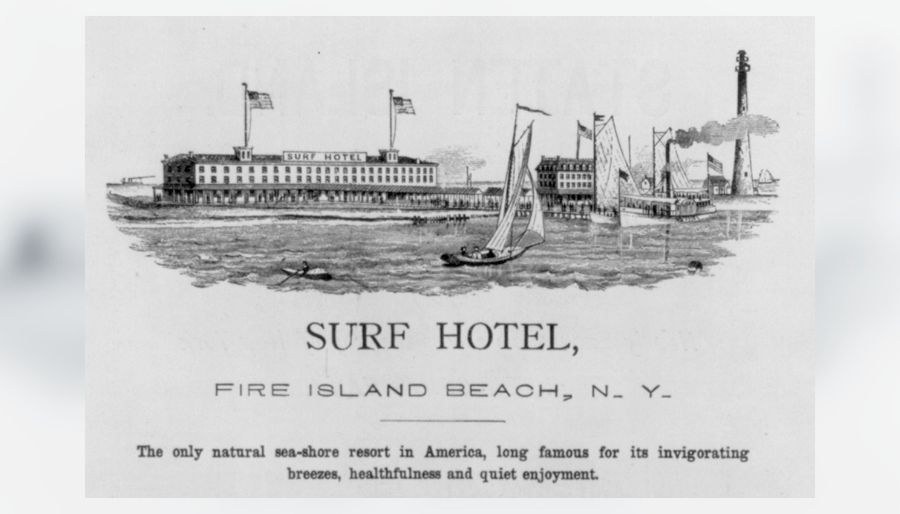
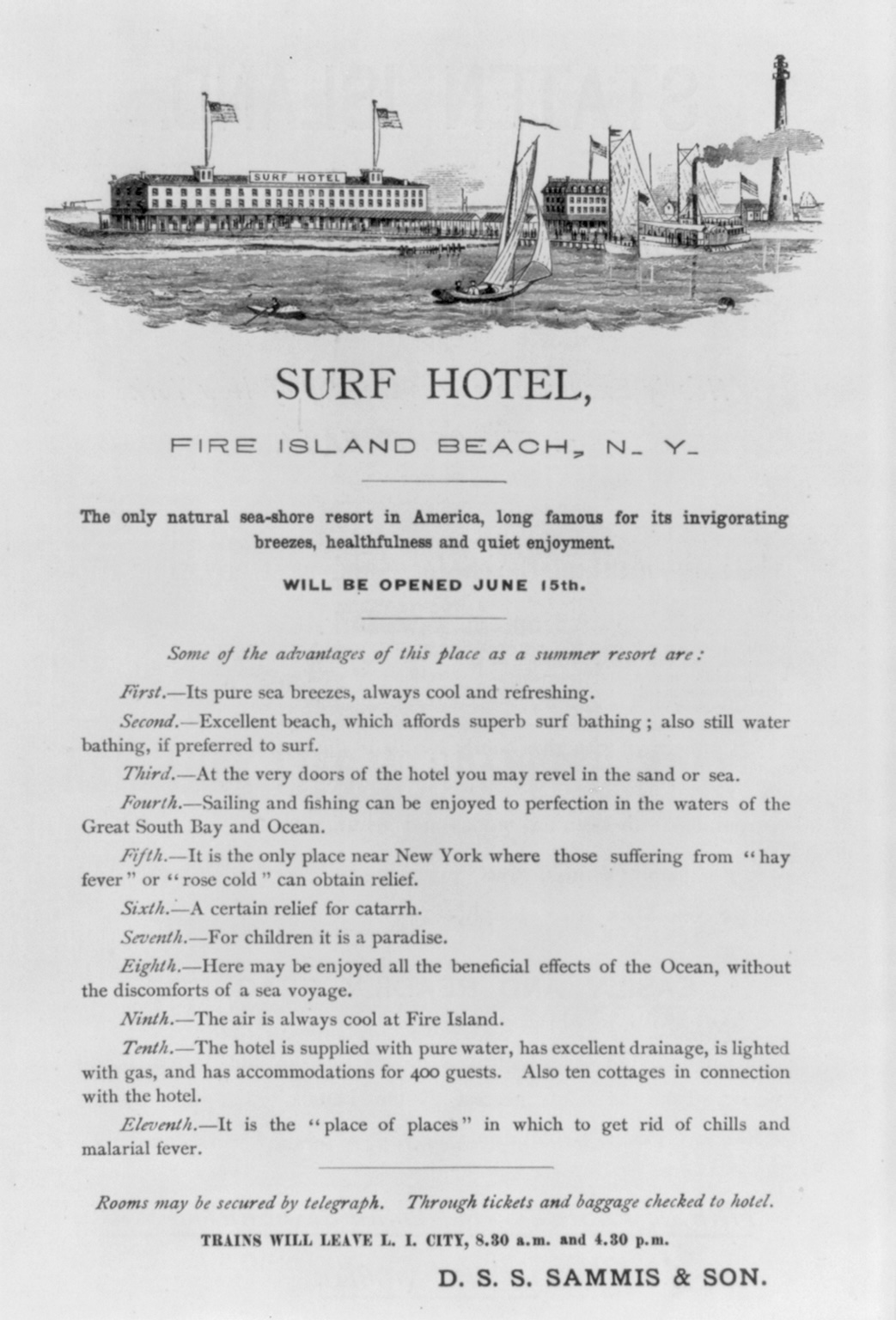
An illustration published in Long Island of Today in 1884 shows the scale of the resort, with its collection of buildings overlooking the waterfront. Preserved today by the Library of Congress, the image offers a glimpse of an earlier Fire Island, when visitors arrived by steamboat and the surrounding barrier beach was still largely undeveloped.
From a bayside chowder house to a grand hotel
The Surf Hotel was the creation of David Sturges Sprague Sammis, who was born in Huntington in 1818 and later established himself in the hotel business in New York City. In 1855, he acquired approximately 120 acres on Fire Island, east of the lighthouse, where he began developing what would become one of Long Island’s best-known seaside resorts.
According to a National Park Service cultural landscape study, Sammis was operating a chowder house near the bayside shoreline by 1856. The following year, he added a 100-foot extension and transformed the establishment into the Surf Hotel, initially capable of accommodating about 100 guests.
The business expanded considerably over the next two decades. By 1870, the hotel could accommodate approximately 400 guests, and its grounds continued to develop into a substantial resort complex. Historical accounts differ on its eventual capacity, with the Suffolk County Historical Society reporting that the property could accommodate as many as 830 guests at its peak.
The resort’s growth was not without difficulties. According to the Suffolk County Historical Society, the hotel struggled financially in its early years, closed in 1860 and reopened after the Civil War. Improvements in transportation between New York City, Babylon and Fire Island helped make the business more successful during the following decades.
Getting to Fire Island was part of the experience
Reaching the Surf Hotel required considerably more planning than a modern trip to the beach. Visitors traveling from New York City could take the railroad to Babylon, continue to the waterfront and board a ferry for the crossing to Fire Island.
Sammis recognized that dependable transportation was essential to the hotel’s success. During the late 1850s, he chartered the steamer Bonita to carry passengers between Babylon and Fire Island. In 1859, the steamer Wave, owned by Sammis and Henry Southard, also began carrying passengers across the bay.
As business increased, additional vessels entered service. The National Park Service identifies the Minnie Warren, Wilmington and the side-wheeler Ripple among the boats that transported visitors to the island.
The ferry business was important enough to produce disputes with local baymen who also wanted to transport passengers and use the hotel’s landing facilities. In 1873, Sammis secured a legislative franchise granting him exclusive ferry privileges across the bay, strengthening his control over transportation to the resort.
By the hotel’s later years, horse-drawn trolleys helped carry arriving passengers between the Babylon railroad station and the ferry docks. The combination of rail service, local transportation and steamboats made an isolated stretch of Fire Island accessible to a growing summer vacation industry.
A fashionable resort with ocean breezes and seaside amusements
By the 1880s, the Surf Hotel offered the amenities expected of a major summer resort. Its grounds included guest cottages, a large ballroom, bathing facilities, balconies and wooden walkways connecting buildings and recreational areas.
The Suffolk County Historical Society describes a complex with nine guest houses, a 30-foot balcony and numerous boats available for guests. Sailing, fishing and bathing were among the principal attractions, with the Atlantic Ocean on one side of the barrier island and the calmer waters of the Great South Bay on the other.
An 1884 advertisement described accommodations for 400 guests, along with ten cottages associated with the hotel. It also emphasized the property’s gas lighting, drinking water, drainage and bathing facilities, features intended to reassure visitors accustomed to the conveniences of city hotels.
Health was another important part of the resort’s appeal. The hotel’s advertisements promoted the benefits of fresh ocean air and claimed that visitors suffering from hay fever, catarrh and other ailments could find relief at Fire Island. These were promotional claims typical of 19th-century seaside resorts, rather than medically established treatments.
The hotel attracted an affluent clientele that included writers, artists, politicians and prominent businesspeople. According to a National Park Service historical study, author Herman Melville and his wife were among its guests, visiting in connection with her hay fever.
One of the hotel’s neighboring buildings became known as Albany Cottage because of its association with political figures and state officials. The resort had developed a reputation that extended well beyond the South Shore.
More than a vacation hotel
The Surf Hotel also played an unusual role in the maritime history of New York Harbor. Before the construction of a dedicated Western Union marine observatory nearby, workers used the hotel’s cupola to watch for approaching ships and report their movements.
Western Union later established a signal tower between the hotel and the ocean. The elevated observation station allowed personnel to identify incoming vessels and send information to New York through the telegraph network, helping port officials track ships before they reached the harbor.
By 1890, the Surf Hotel had more than a mile of plank walkways extending around its grounds, according to the National Park Service. These wooden paths allowed vacationers to move between buildings and enjoy the surrounding shoreline without constantly walking through deep sand.
A contemporary description published in the Home Journal on August 6, 1890, portrayed the hotel as a long, low collection of buildings surrounded by broad wooden walkways. The description emphasized the ocean breezes, nearby lighthouse and panoramic views that distinguished the resort from traditional city accommodations.
The cholera scare that changed the hotel’s fortunes
The Surf Hotel’s popularity was disrupted in September 1892, when New York officials sought a location to quarantine passengers arriving from Europe during a cholera scare. Governor Roswell P. Flower selected the hotel, whose isolated location and substantial accommodations made it suitable for temporarily housing travelers.
The decision produced fierce opposition from South Shore residents, particularly in Babylon and Islip, who feared that bringing potentially infected passengers to Fire Island would endanger nearby communities. Local officials sought legal action to block the quarantine, while groups of baymen gathered to prevent passengers from landing.
The confrontation eventually required military intervention, and passengers were housed at the hotel. New York State acquired the property from Sammis in a transaction valued at $210,000, which included approximately 120 acres, hotel buildings, docking facilities and related transportation property.
The hotel’s future changed considerably after the quarantine episode. Although the state leased the property for resort operations again in 1894, the Surf Hotel never regained the popularity it had enjoyed during the preceding decades.
What happened to the Surf Hotel?
The once-fashionable resort continued into the early 20th century but eventually closed. According to a National Park Service historic resource study, the hotel was destroyed by fire sometime before World War I, although the exact date and circumstances of the blaze remain unclear.
The study cites historical accounts describing a tall chimney that survived the destruction and remained a recognizable landmark for years afterward. The extensive resort complex that had once welcomed hundreds of summer guests gradually disappeared from the Fire Island landscape.
The property’s next chapter would have a lasting effect on public recreation on Long Island. In 1908, Governor Charles Evans Hughes signed legislation establishing Fire Island State Park on land that included the former Surf Hotel property, creating Long Island’s first state park.
The park expanded in 1924 and was eventually renamed Robert Moses State Park. In 1978, the portion east of the Fire Island Lighthouse was transferred to Fire Island National Seashore, placing part of the old hotel grounds under federal protection.
Today, visitors walking near the Fire Island Lighthouse encounter a landscape very different from the one depicted in the 1884 illustration. The hotel buildings, cottages, ballroom and ferry landing are gone, but the property remains part of the island’s public shoreline, preserving the location of one of Long Island’s grandest early seaside resorts.
Sources:
- Library of Congress – Original 1884 illustration of the Surf Hotel published in Long Island of Today. The collection record indicates no known restrictions on publication. https://www.loc.gov/item/2006683413/
- National Park Service, Fire Island Light Station Cultural Landscapes Inventory – Documents the hotel’s early development, initial capacity, expansions, plank walkways, Western Union activities and later history. https://npshistory.com/publications/fiis/cli-fire-island-ls.pdf
- National Park Service, Historic Resource Study of Fire Island National Seashore – Provides detailed history of the resort, contemporary descriptions, 1884 advertising, notable guests, ferry operations, quarantine, state purchase and eventual destruction. https://npshistory.com/publications/fiis/hrs.pdf
- Suffolk County Historical Society, Surf Hotel, Fire Island – Documents David Sammis, the hotel’s development, transportation arrangements, peak capacity, amenities and eventual decline. https://aaqeastend.com/bulletins/update-schs-photo-of-wk-3-16-24-surf-hotel-fire-island-1860-closed-re-opened-1865/
- National Park Service, History of Fire Island National Seashore – Confirms establishment of Fire Island State Park in 1908, its subsequent expansion and the 1978 transfer of land east of the lighthouse to the National Park Service. https://www.nps.gov/fiis/learn/historyculture/history-of-fire-island-national-seashore.htm
- Babylon Fire Department, Historical Commemorative Publication – Documents the early ferry service from Babylon to the Surf Hotel and the development of horse-drawn transportation connecting railroad passengers to the waterfront. https://www.babylonfd.com/misc_content/BabylonFDHistoryBook1981.pdf
- George Glazer Gallery, Historic Fire Island Surf Hotel Promotional Guide – Describes a surviving resort advertising guide with views of the hotel, transportation information and historical promotional material. https://www.georgeglazer.com/archives/maps/archive-nyc/fireislesurfhotel.html
Photo: An 1884 illustration of the Surf Hotel on Fire Island, once one of Long Island’s largest seaside resorts. (Library of Congress, Prints and Photographs Division, LC-USZ62-50715)