On Sam’s Path near Hallock Landing Road in Rocky Point stands an enormous boulder known as Indian Rock, a geological landmark with an estimated age of 450 million years. The rock, which rises roughly three stories above the surrounding ground, has been associated with Native American traditions, generations of the Hallock family and a local legend that it inspired the name Rocky Point.
Indian Rock is a glacial erratic, a massive stone transported to Long Island by the glaciers that shaped the region during the last Ice Age. Its remarkable size attracted attention long before the surrounding farmland became a residential neighborhood, and historical photographs and newspaper accounts document its presence more than a century ago.
A giant left behind by the Ice Age
The origins of Indian Rock date to a period when much of the northeastern United States was covered by enormous sheets of glacial ice. During the last major glaciation, ice carried rocks, soil and other geological material southward, depositing them as the glaciers retreated approximately 18,000 to 20,000 years ago.
The process helped create Long Island’s distinctive geological landscape, including its north shore bluffs, hills and concentrations of large boulders. Indian Rock is an especially substantial example of a glacial erratic, a rock transported from its original geological surroundings and deposited somewhere else.
The Rocky Point Historical Society describes Indian Rock as a colossal boulder, while preservation advocates have identified it as one of the largest such rocks on Long Island. In a 2017 conservation campaign, geologists were cited as estimating the stone itself to be approximately 450 million years old, although it arrived at its present location much more recently.
The rock’s exact place of origin has not been established. A newspaper account published in 1905 suggested that it may have originated in Connecticut or Vermont, reflecting an early understanding of the geological forces responsible for transporting enormous stones across the region.
A Native American landmark and the legends surrounding it
Indian Rock also has a place in the Native American traditions associated with Rocky Point. According to the Rocky Point Historical Society, local legend holds that Indigenous people regarded the boulder as sacred and that numerous arrowheads were discovered in its vicinity.
Another historical account, published by WSHU in 2017, described a tradition that Native Americans gathered around the boulder and that English settlers consequently called it Indian Rock. Although these accounts preserve longstanding local beliefs, the specific claim that the rock served as a sacred ceremonial site has not been independently established through archaeological documentation.
Click here for more stories about Long Island’s historic landmarks.
The surrounding area has a documented Indigenous history. The Setalcott people inhabited the region before English settlement, and the Rocky Point Historical Society records a June 10, 1664, transaction in which Sachem Maynew conveyed rights involving land between Mount Sinai and Wading River to the Town of Brookhaven.
Archaeological investigations by Stony Brook researchers have also documented evidence of Indigenous activity along Rocky Point’s north shore. While that broader history supports the longstanding Native American presence in the area, it does not independently verify the particular traditions associated with Indian Rock.
The accounts of arrowheads and sacred significance remain an important part of the landmark’s local folklore. They also explain why the boulder has acquired a historical identity extending well beyond its geological importance.
Did Indian Rock give Rocky Point its name?
Perhaps the best-known legend associated with Indian Rock is that the enormous boulder inspired the name Rocky Point itself. The Rocky Point Historical Society preserves this explanation as a local tradition, although no historical document has been identified proving the connection.
The name Rocky Point has deep roots in Brookhaven Town’s colonial records. According to the historical society, the name appeared as “Rocky poynt hollow” in 1755, when a road was laid out at the request of Thomas Robinson.
The region’s rocky shoreline, glacial deposits and prominent boulders could all have contributed to its geographical identity. Whether the name was specifically inspired by Indian Rock or by the generally rocky terrain remains uncertain.
Nevertheless, the tradition has survived for generations and remains closely associated with one of the community’s most recognizable natural landmarks.
The Hallock family’s enormous backyard boulder
By the early 18th century, Indian Rock stood on land associated with one of Rocky Point’s earliest English families. Noah Hallock and his wife, Bethia, established their homestead in the area around 1721, beginning a family presence that continued for generations.
The Hallocks became prominent farmers and landowners in Rocky Point. Their original homestead, which survives on Hallock Landing Road, remained in the family for seven generations and is now owned by the Rocky Point Historical Society.
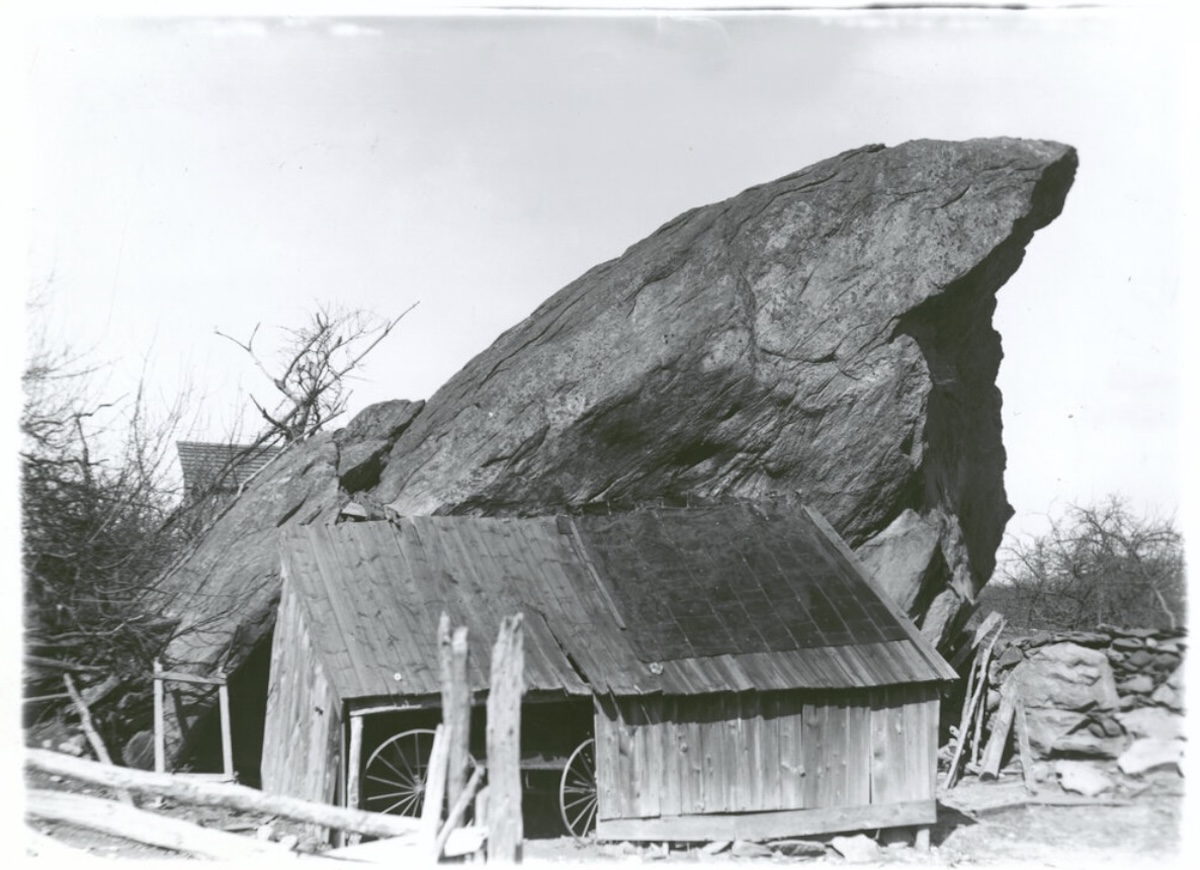
The family’s agricultural property also included land surrounding Indian Rock. At one time, a barn stood immediately beside the massive boulder, an unusual arrangement documented in an early photograph.
On February 27, 1901, photographer Hal B. Fullerton photographed the enormous rock alongside a barn on Sylvester Hallock’s farm. The photograph, preserved in the Queens Public Library Digital Archives, provides an important historical record of the boulder’s appearance and its relationship to Rocky Point’s agricultural past.
The rock attracted newspaper attention several years later. In February 1905, the Brooklyn Standard Union described Indian Rock near the home of Merritt Hallock, emphasizing its enormous dimensions and the lengthy history of the surrounding family property.
The newspaper gave the boulder’s approximate dimensions as 50 feet long, 40 feet thick and 35 feet above the ground. It also described the large shadow the rock cast as the sun moved across the sky, a detail that helps convey its imposing size.
The article contrasted the generations of Hallock family history with the far greater geological age of the boulder. Even in 1905, Indian Rock was recognized as a remarkable feature of the local landscape.
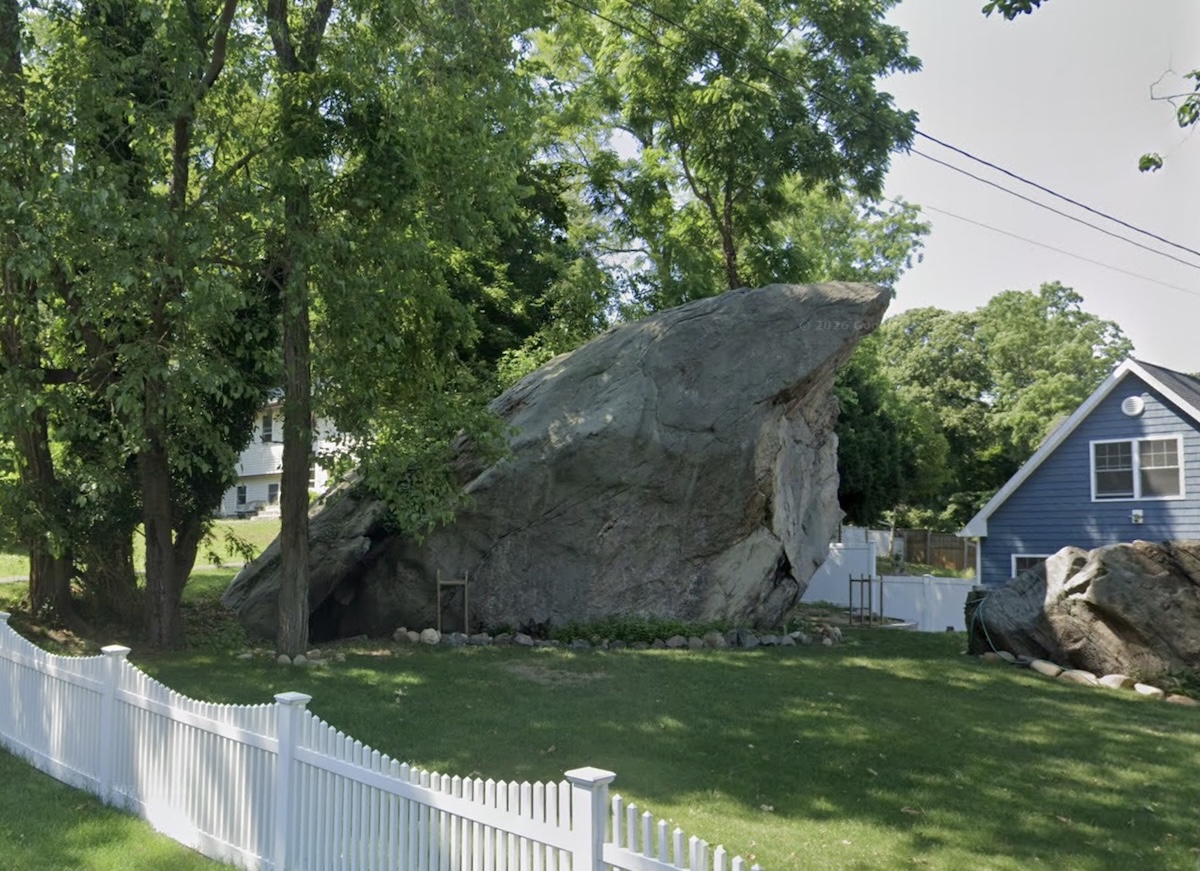
Photo: Google Maps / Google Street View. A modern Google Maps view of Indian Rock, an enormous glacial erratic located on Sam’s Path near Hallock Landing Road in Rocky Point. Estimated to be approximately 450 million years old, the boulder is associated with Native American legends and local traditions suggesting it inspired the name Rocky Point.
The effort to preserve Indian Rock
As Rocky Point developed during the 20th century, the former Hallock farmland was gradually divided and redeveloped. The property containing Indian Rock was eventually separated from the historic Hallock homestead, placing the boulder within a residential neighborhood.
In 2017, the Peconic Land Trust joined with the Rocky Point Historical Society, Rocky Point Civic Association and Seatuck Environmental Association in a campaign to preserve the landmark and its surrounding property.
At the time, a deteriorating house stood on the parcel, which had been offered for sale. The conservation organizations sought to raise $330,000 to acquire and restore the site, remove the house and transform the property into publicly accessible green space.
The proposed project would also have included educational opportunities explaining the boulder’s geology, Indigenous associations and connection to Rocky Point’s colonial history. Preservation advocates viewed Indian Rock as an unusual outdoor classroom that could illustrate hundreds of millions of years of geological history in a single location.
The effort attracted regional news coverage, with supporters emphasizing the importance of protecting a landmark that had survived centuries of settlement and development. New York State records show that a 2017 grant application for Indian Rock’s acquisition and restoration was not awarded funding.
The campaign’s ultimate outcome and the property’s current ownership have not been conclusively established in the available public records. The documented preservation effort nevertheless illustrates the significance that local historical and environmental organizations have attached to Indian Rock.
A landmark of Rocky Point’s earliest history
Indian Rock brings together several distinct periods of Long Island history. Its geological origins predate human settlement by hundreds of millions of years, while its arrival during the Ice Age connects it directly to the forces that shaped the Island’s north shore.
The legends surrounding its sacred significance and possible role in naming Rocky Point remain part of the community’s historical traditions, even though their precise origins cannot be confirmed. The Hallock family records, Fullerton’s 1901 photograph and the 1905 newspaper account provide a much firmer record of the boulder’s place in the community’s past.
The rock’s dimensions and unusual setting also help explain why preservation advocates considered it worthy of protection. Long after the surrounding farmland disappeared, Indian Rock remained an identifiable piece of the landscape that existed before Rocky Point’s roads, homes and farms.
Photo: Indian Rock, a massive glacial boulder beside a barn on Sylvester Hallock’s farm in Rocky Point, photographed on February 27, 1901. Local legends associate the rock with Native American sacred traditions and the naming of Rocky Point. Photo: Hal B. Fullerton, Queens Public Library Digital Archives, Hal B. Fullerton Photographs (hbf-001174).
Sources:
- Rocky Point Historical Society, Indian Rock https://rockypointhistoricalsociety.org/historic-sites/
- Rocky Point Historical Society, Rocky Point History https://rockypointhistoricalsociety.org/rocky-point-history/
- Queens Public Library Digital Archives, Hal B. Fullerton Photographs https://digitalarchives.queenslibrary.org/nodes/view/7582
- Peconic Land Trust, Fall 2017 Newsletter, Indian Rock Preservation Campaign https://stage.peconiclandtrust.org/assets/resources/publications/2017_Fall_Newsletter_Final_web.pdf
- Peconic Land Trust, 2017 Conservation Campaign Announcement https://www.peconiclandtrust.org/press
- WSHU, Peconic Land Trust Works to Preserve Indian Rock, November 6, 2017 https://www.wshu.org/news/2017-11-06/peconic-land-trust-works-to-preserve-indian-rock
- CBS New York, Rocky Point Indian Rock Preservation Controversy, 2016 https://www.cbsnews.com/newyork/news/rocky-point-ancient-rock/
- Suffolk County Archaeological Association, 2017 Publication https://img1.wsimg.com/blobby/go/12517e2b-c716-41dd-aafd-e26e329b0a9d/downloads/2017%20Vol.%2043-3.pdf?ver=1732630922590
- Historical newspaper: Brooklyn Standard Union, February 1905. Excerpt reproduced by the Rocky Point Historical Society on its Indian Rock page.