A nearly 50-acre wooded property in Kings Park with roots in a 160-year-old charitable community is under contract to be purchased by Suffolk County for $8.8 million. According to the November 5, 2026, edition of The Smithtown News, the agreement would preserve environmentally sensitive land owned by the Society of St. Johnland and potentially create a continuous parkland connection between Nissequogue River State Park and Sunken Meadow State Park. County Executive Edward Romaine confirmed the agreement, with the sale expected to close in the first quarter of 2027.
The proposed acquisition has a history stretching back 160 years. St. Johnland was established in 1866, decades before the surrounding community became known as Kings Park, and its land played a significant role in the town’s development. The same property has also been the subject of development proposals and preservation efforts for approximately two decades.
A 500-acre community called St. Johnland
In 1866, Episcopal minister William Augustus Muhlenberg established St. Johnland on approximately 500 acres of farmland and woodland overlooking Long Island Sound. Muhlenberg, who had previously helped establish St. Luke’s Hospital in Manhattan, envisioned a rural community where impoverished families, orphaned children, elderly residents and people recovering from illness could live and receive care.
Muhlenberg had outlined his plans as early as 1864, publishing a proposal for a rural community where impoverished New Yorkers could live, work and receive care. According to an 1876 account in Harper’s New Monthly Magazine, the North Shore property was purchased in October 1865, and the settlement developed over the following years.
The project grew out of Muhlenberg’s experience working with New York City’s poor. He believed that housing, employment, education, religious instruction and access to the countryside could provide a better alternative to the overcrowded living conditions many families faced in the city.
An early account published by Muhlenberg in 1870 identifies several prominent New York businessmen who helped finance the original land purchase, including William H. Aspinwall, Robert B. Minturn, Adam Norrie and Percy R. Pyne. Rather than constructing a single large institution, Muhlenberg developed a collection of buildings intended to function as a small, largely self-sufficient community.
St. Johnland included housing for children and elderly residents, a church, workshops, gardens and agricultural operations. The Society of St. Johnland was formally incorporated in 1870, giving the institution an organizational structure that would continue long after its founder’s death.
A working village with its own church, shops and orchards
An 1896 report published by the Society of St. Johnland provides a detailed description of the community during its early decades. The estate still encompassed more than 500 acres, much of it consisting of wooded hills covered with oak, chestnut, cedar and pine trees.
Near the center of the settlement stood the Church of the Testimony of Jesus, built in 1869. The church could accommodate approximately 300 people and had been financed by Adam Norrie, one of the original supporters of the St. Johnland project. Its furnishings included a marble baptismal font donated by Mrs. S. W. Roosevelt and a pipe organ provided through the generosity of Hilborne L. Roosevelt and other benefactors.
Surrounding the church were residences for children and elderly men, along with workshops that helped support the community. The 1896 report describes a blacksmith, carpenter, painter, baker and cobbler, as well as an administrative building containing storerooms and medical supplies. St. Johnland also operated a printing office and stereotype foundry, which produced printing plates used to reproduce books and other printed materials. These operations were documented by writer Samuel Osgood, who visited the community in June 1876 for an article published in Harper’s New Monthly Magazine.
Agriculture was another important part of daily life. Two orchards and a garden of approximately three acres supplied fruit and vegetables, while the farm maintained a substantial dairy operation. Osgood reported that St. Johnland had produced 16,600 quarts of milk during the previous year, helping supply approximately 150 children living at the institution.
The original property also extended toward Smithtown Bay. Osgood described cliffs overlooking the water and a stairway descending to the shore, where children and other residents enjoyed walks after Sunday services. Elsewhere on the grounds, woodland paths wound through the trees, including a grove near the cemetery that the Society’s 1896 report described as a natural park.
Muhlenberg died in 1877 and was buried in the St. Johnland cemetery. His longtime associate Anne Ayres, who played an important role in the institution’s early development, was also buried there following her death in 1896.
St. Johnland was an organized community with its own infrastructure, agricultural operations, tradesmen and residential institutions. Its extensive grounds occupied a substantial portion of the landscape that would eventually become modern Kings Park, while its woodlands and waterfront provided a setting that remained an important part of the property’s history.
How St. Johnland became Kings Park
The settlement’s influence extended well beyond its original property. When railroad service reached the area in 1872, a station was established under the name St. Johnland, reflecting the importance of the nearby institution.
For a time, the surrounding community was also known as St. Johnland. That began to change after Kings County established a psychiatric institution on a large tract of adjoining land in 1885.
In 1885, Kings County, which then administered Brooklyn’s public institutions, acquired approximately 874 acres in the area to establish a farm and asylum for people transferred from overcrowded facilities in Brooklyn. The institution eventually developed into Kings Park State Hospital, later known as Kings Park Psychiatric Center.
As the hospital expanded, it became an increasingly important employer and influence on the surrounding community. In 1891, the Long Island Rail Road renamed the St. Johnland station Kings Park, completing a significant change in the area’s public identity.
The railroad station’s history is still recognized by a William G. Pomeroy Foundation historical marker, which identifies its original 1872 name and the 1891 change to Kings Park.
The psychiatric center would operate until 1996, eventually leaving behind the extensive grounds and historic buildings now associated with Nissequogue River State Park. Its history is closely connected to St. Johnland’s, but the two institutions followed separate paths.
Related reading: Kings Park Psychiatric Center: The 111-Year History Behind Long Island’s Abandoned Landmark
St. Johnland changes with the times
While the neighboring psychiatric hospital expanded, St. Johnland continued operating as a charitable institution serving children and elderly residents. Its mission gradually evolved as approaches to residential care changed during the 20th century.
Among the children who lived at St. Johnland were three siblings from Roslyn Heights: King Pedlar, 10, his brother Dean, 8, and their sister Lynne, 5. The children arrived in 1945 and spent four years at the institution, which also operated a summer camp. Decades later, King Pedlar recalled his experiences in a 2011 account published by Kings Park Patch, describing St. Johnland as a beautiful place and remembering the relationships he maintained with other former residents.
Pedlar later became a local historian and collaborated with Smithtown historian Bradley Harris on the book St. Johnland, A Forgotten Utopia, documenting the community’s history. His recollections offer a personal perspective on an institution whose original purpose had been to provide a rural home and supportive community for children and elderly residents.
The children’s residential program ended in 1954. According to a 2011 account by former resident King Pedlar, financial difficulties and increasingly stringent state regulations contributed to the orphanage’s closure. St. Johnland’s trustees subsequently concentrated the organization’s work on caring for the elderly, gradually shifting toward nursing and long-term care.
By the early 1970s, the Society’s trustees had concluded that its collection of separate buildings was no longer suitable for modern nursing care. A larger facility was constructed, and residents moved into it shortly after Christmas in 1975.
That building became the foundation of the modern St. Johnland Nursing Center at 395 Sunken Meadow Road. The organization continued expanding its services, completing a two-story, 68,000-square-foot assisted-living facility at neighboring 393 Sunken Meadow Road in 2022. The new building contains 80 residential units with accommodations for up to 100 residents.
Although St. Johnland continued its longstanding work in residential care, its original 500-acre property had changed considerably as portions were sold or transferred over the decades. One substantial tract of remaining woodland would eventually become the subject of a lengthy debate over development and preservation.
The proposed retirement community and a fight over 50 acres
In the mid-2000s, St. Johnland pursued plans for a continuing-care retirement community that would provide several levels of senior housing and care alongside its existing facilities. Early plans involved a substantially larger development, but the proposal was later scaled back to approximately 50 acres of wooded property near Sunken Meadow Road and Old Dock Road.
The proposal prompted concern among residents and public officials who favored protecting the woodland. In December 2006, State Senator John Flanagan suggested a land exchange in which St. Johnland could develop on a previously disturbed portion of the former Kings Park Psychiatric Center property while preserving its woodland as an extension of nearby state parkland.
The proposal did not advance. Representatives of St. Johnland expressed concerns about separating the organization’s operations, and the development proposal continued through Smithtown’s review process.
In 2007, the Society filed a zoning application for a project known as The Uplands at St. Johnland. The revised proposal called for a continuing-care retirement community containing up to 199 age-restricted residences, including independent living apartments, assisted living units and townhouses.
The environmental review identified the project site as a 49.69-acre surveyed parcel, listed as 49.40 acres in county tax records. Located southwest of Sunken Meadow Road and Old Dock Road, the property contained state-mapped freshwater wetlands, with a portion falling within the protected Nissequogue River corridor.
Opposition continued as the proposal moved through local review. At a December 2012 public hearing, residents raised concerns about the scale of development, environmental impacts and the loss of wooded open space. Several suggested that the project be relocated to previously developed land.
Smithtown announced completion of the project’s final environmental impact statement in February 2017, a decade after the zoning petition was filed. The environmental review documented the land’s significance but did not itself constitute approval for construction.
A park connection that has been discussed for years
The idea of incorporating St. Johnland’s remaining woodland into a larger park system continued long after the original land-swap proposal.
New York State’s planning process for Nissequogue River State Park specifically identified the approximately 50-acre St. Johnland parcel along the park’s northwestern boundary. The land’s location made it particularly valuable because of its proximity to Sunken Meadow State Park and the potential for a more continuous recreational corridor.
During an October 2021 public presentation on the park’s master plan, state planners described the acquisition of the St. Johnland property as a way to extend the park’s perimeter and establish a connection with Sunken Meadow.
Suffolk County also included St. Johnland properties in its comprehensive open-space acquisition master list. Among the parcels identified for possible preservation was a 49.40-acre tract matching the tax-map acreage of the former Uplands proposal.
Taken together, these documents show that preserving St. Johnland’s woodland has been a recurring objective in local and state planning for approximately 20 years.
Suffolk County moves toward purchasing the property
The preservation effort reached a significant milestone in November 2026 when Suffolk County entered into an $8.8 million contract to purchase approximately 49 acres of St. Johnland property. County Executive Edward Romaine confirmed the agreement in a November 3 interview with The Smithtown News, explaining that the county and St. Johnland had agreed on the terms of the acquisition. The sale is expected to close during the first quarter of 2027.
The newspaper describes plans to connect the land with Nissequogue River State Park and Sunken Meadow State Park, potentially allowing walkers and bicyclists to travel through a more extensive network of protected parkland. Local officials and representatives of the Nissequogue River State Park Foundation welcomed the proposed acquisition as an opportunity to protect additional open space and improve recreational access.
The property includes dense woodland and a pond that were central features of the earlier development controversy. The Smithtown News reported that St. Johnland had withdrawn its plans to develop the 49-acre site and subsequently constructed a new assisted-living facility elsewhere on its campus. The acquisition would preserve the wooded tract that had been the subject of development proposals and community opposition for approximately two decades.
The proposal also remains distinct from the construction of any future trail. The completion of a land purchase would be an important preservation step, but trail alignments, improvements and public access arrangements would still depend on subsequent planning.
A new purpose for part of the original St. Johnland landscape
The proposed acquisition would mark another change in the history of the land assembled for William Augustus Muhlenberg’s St. Johnland community in the mid-1860s. Over the following 160 years, St. Johnland developed from a charitable community into a modern nursing care institution, while its name and presence helped shape the identity of the surrounding Kings Park hamlet.
Much of the original estate has long since passed into other uses, but the remaining woodland retains a connection to the landscape described in the Society’s 19th-century records. Those early accounts emphasize the wooded hills, gardens, groves and walking paths that formed part of Muhlenberg’s rural community.
If the purchase is completed and the planned park connection is developed, land associated with the original St. Johnland could become part of a public recreational corridor between two established state parks. The institution would continue its modern role in nursing care, while another portion of its historic grounds would take on a new purpose within Kings Park.
Sources:
- The Smithtown News, David Ambro, November 5, 2026, pages 3 and 10 – Reports Suffolk County’s $8.8 million contract to purchase 49 acres of St. Johnland property, including confirmation from County Executive Edward Romaine, the anticipated first-quarter 2027 closing, and plans to connect Nissequogue River and Sunken Meadow state parks.
- Society of St. Johnland, An Account of St. Johnland, 1870 – Original report by William Augustus Muhlenberg documenting the institution’s founding, early financing, charitable goals and incorporation. https://anglicanhistory.org/usa/muhlenberg/johnland1870.pdf
- Society of St. Johnland, Twenty-Sixth Annual Report, 1896 – Contemporary descriptions of the estate, church, workshops, orchards, gardens, woodland and residential buildings. https://anglicanhistory.org/usa/muhlenberg/johnland1896.pdf
- William G. Pomeroy Foundation, St. Johnland Historical Marker – Confirms Muhlenberg’s founding of St. Johnland in 1866 and its original charitable purpose. https://www.wgpfoundation.org/historic-markers/st-johnland/
- William G. Pomeroy Foundation, Kings Park Train Station Historical Marker – Documents the establishment of St. Johnland station in 1872 and its renaming as Kings Park in 1891. https://www.wgpfoundation.org/historic-markers/train-station-3/
- St. Johnland Nursing Center, Historical Overview – Documents the transition to elder care and the opening of the modern nursing facility in 1975. https://stjohnland.org/wp-content/uploads/2022/04/stjohn2020.pdf
- Smithtown Town Government, The Uplands at St. Johnland Final Environmental Impact Statement – Documents the 2007 zoning petition, proposed 199-unit continuing-care community, environmental conditions and project review. https://www.smithtownny.gov/535/Final-EIS-The-Uplands-at-St-Johnland
- Smithtown Town Government, 2017 Notice of Completion – Identifies the proposed 50-acre development site, zoning application and environmental review. https://www.smithtownny.gov/m/newsflash/Archive/Item/786?arcId=1076
- Newsday, December 8, 2006, archived by Meyer Suozzi – Describes State Senator John Flanagan’s proposed land exchange to preserve St. Johnland woodland. https://www.msek.com/news/kings-park-land-swap-may-save-woodland
- New York State Parks, Nissequogue River State Park Master Plan Public Presentation, October 27, 2021 – Identifies acquisition of the St. Johnland parcel as a possible connection between Nissequogue River State Park and Sunken Meadow State Park. https://parks.ny.gov/documents/inside-our-agency/Masterplans/NSRP/NSRPVirtualOutreachPresentation2021.pdf
- Suffolk County Division of Planning, Open Space Master List – Identifies St. Johnland properties recommended for potential preservation, including a 49.40-acre parcel. https://www.suffolkcountyny.gov/Portals/0/formsdocs/planning/OpenSpaceFarmland/OpenSpace/Master%20List%20PDF%20for%20website.pdf
- Long Island Business News, November 21, 2022 – Reports the completion of St. Johnland’s 68,000-square-foot assisted-living facility at 393 Sunken Meadow Road in Kings Park, including its 80 residential units and 100-bed capacity. https://libn.com/2022/11/21/work-completed-on-kings-park-assisted-living-facility/
- Kings Park Patch, March 6, 2011, A Boy’s St. Johnland Memories – Former resident King Pedlar recounts living at St. Johnland with his siblings beginning in 1945, the institution’s summer camp, the orphanage’s closure in 1954 and his later work documenting its history. https://patch.com/new-york/kingspark/a-boys-st-johnland-memories
- Harper’s New Monthly Magazine, Samuel Osgood, “St. Johnland,” 1876, pages 675–681 – Contemporary firsthand account of the original St. Johnland community, including its 1865 land purchase, buildings, printing operation, dairy farm, residents, religious services and Smithtown Bay waterfront. https://www.victorianvoices.net/ARTICLES/Harpers/H1876A/H1876A-StJohnland.pdf
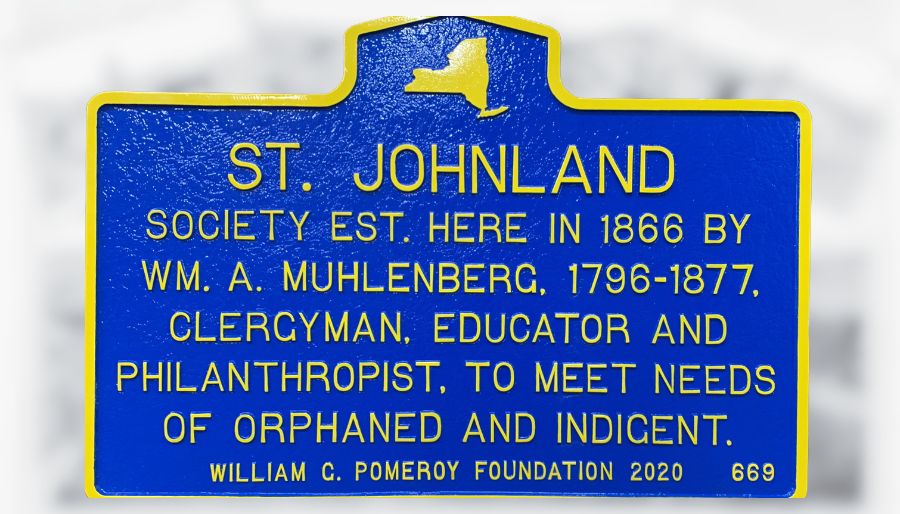
Photo: St. Johnland historical marker commemorating the charitable community established in Kings Park in 1866 by clergyman and philanthropist William Augustus Muhlenberg. (William G. Pomeroy Foundation)