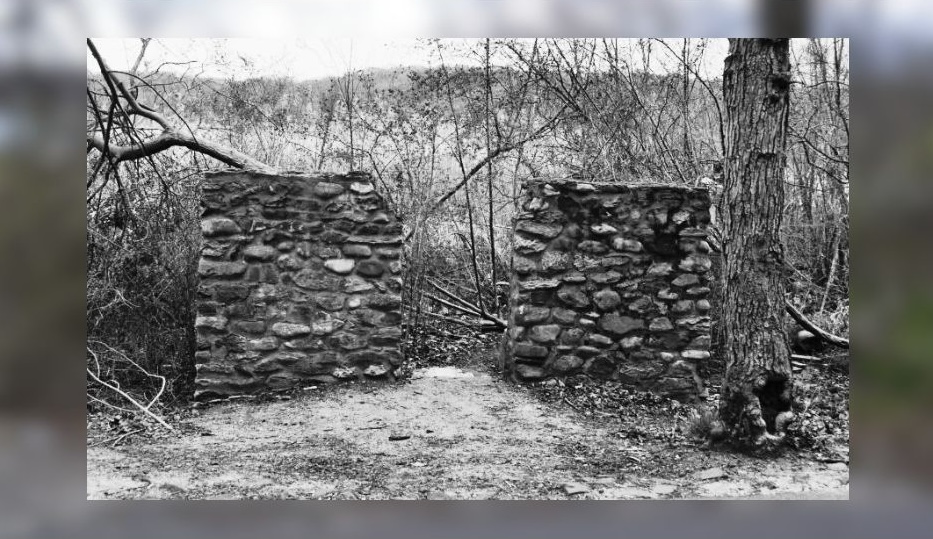
Long Island has a famous grave that nobody can reliably locate, belonging to a woman nobody can conclusively identify, who died in several completely incompatible ways. Welcome to the mystery of Mary’s Grave.
Ask someone who grew up on Long Island in the 1960s, ’70s or ’80s and there is a decent chance they heard some version of it. Mary’s grave was down a dark road. Mary lived in the big old house. Mary was buried in the woods. Mary hung from a tree. Mary carried a hatchet. Mary appeared in a white dress. Your car might stall if you bothered her.
The only problem was figuring out where any of this supposedly happened.
Depending on the storyteller, Mary could be found in Head of the Harbor, St. James, Stony Brook, Mount Sinai, West Hills, Melville, Lindenhurst, Amityville or somewhere else entirely. Published versions have been circulating for years, while Long Islanders continue to supply additional locations from memory.
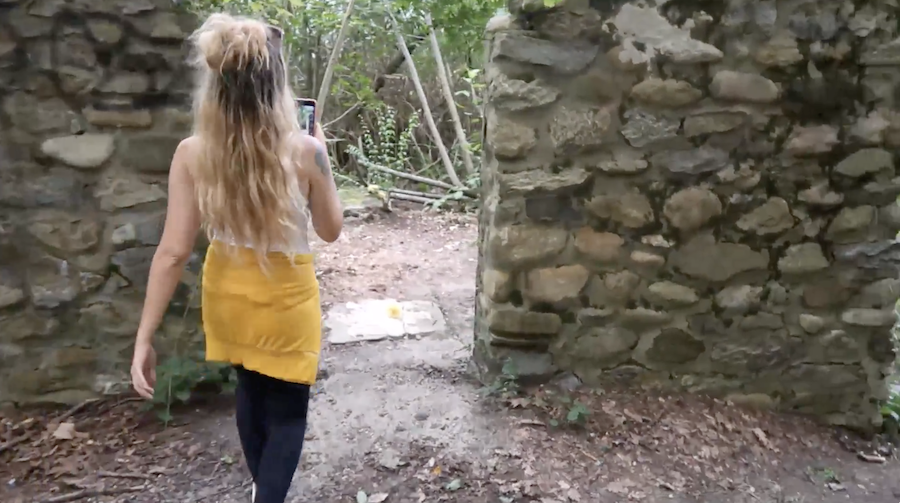
Photo: Video still from YouTuber heading out to find Mary’s Grave. VISITING MARY’S GRAVE AND HOUSE| HEAD of the HARBOR NEW YORK
The Mary most Long Islanders remember
The version most closely associated with the Stony Brook and Head of the Harbor area is particularly grim. In one telling, Mary was the lonely daughter of a wealthy landowner who lived near Stony Brook Harbor. With few friends nearby, she supposedly spent much of her childhood wandering through the woods, along the water and around a small stone building variously described as a clubhouse, springhouse or playhouse. Then the story takes several different roads.
One version says Mary became possessed and began killing the animals she once loved. She eventually took an axe or hatchet to members of her own family. Another makes Mary a much more sympathetic figure. In that story, her father abused her, sometimes in the little stone building. After becoming pregnant by him, Mary finally killed him with a hatchet.
The particularly gruesome variation says she continued living in the house afterward and slept beside her father’s decomposing body until neighbors finally investigated. Then, according to the legend, townspeople dragged Mary outside and hanged her from a nearby tree. No trial. Just old-fashioned mob justice, which should probably be the first warning that we have moved well outside documented history.
Except that isn’t the only Mary
There are so many versions of the legend that trying to write Mary’s biography would require several mutually exclusive obituaries.
Among the stories that have circulated:
- Mary murdered her husband and two children and is unable to rest because of her crimes.
- Mary killed her abusive father with an axe or hatchet and was subsequently hanged.
- Mary was abused by her father and eventually took her own life by hanging herself.
- Mary was murdered by two boys outside her home.
- Mary was killed by her own mother and buried behind a house.
- Mary was a witch who kidnapped or killed children before townspeople burned her and buried her remains.
And those are just the violent versions. Other Long Island storytellers turned Mary into a grieving woman who killed herself after losing someone she loved (like the Lady of Lake Ronkonkoma), a teenager who died in an automobile crash, or a woman who was stabbed or drowned.
One Head of the Harbor variation even gives Mary a grave marked by an angel statue said to appear as though it is crying for abused girls.
The more stories you collect, the less Mary resembles a historical person and the more she begins to look like a character who could be inserted into whatever lonely road, old estate or forgotten cemetery happened to be nearby. That is how folklore tends to travel.
Then there was the Mount Sinai Mary
Mount Sinai developed a Mary of its own. According to that version, a woman named Mrs. Chandler turned her home into a boarding house. One of the boarders was a woman named Mary who reportedly had previously been a patient at Kings Park Psychiatric Center. Mary suddenly vanished.
Her belongings remained behind and her rent went unpaid, but she was never seen again. Then lights allegedly began turning themselves on inside her empty room and strange noises could be heard at night. It bears little resemblance to the axe-wielding Mary of Head of the Harbor. It nevertheless became another “Mary’s Grave” story.
Locals were not simply arguing about the location of one grave. Different communities appear to have absorbed different legends into a shared Mary mythology.
The real Long Island tradition may have been looking for her
For plenty of Long Islanders, the history that can actually be documented is not Mary’s life. It is the search. Going to find Mary’s Grave became a nighttime rite of passage, particularly for teenagers.
The basic recipe was simple: pile several friends into a car, drive along a poorly lit North Shore road, locate whatever abandoned-looking structure or tree somebody’s older brother had identified as Mary’s, and attempt to frighten each other. The challenges became part of the legend.
Depending on the decade and storyteller, visitors were told:
- Urinating near Mary’s grave or stone structure would cause your car to break down.
- Honking the horn or flashing the headlights near Mary’s house could prevent the car from restarting.
- A woman in white might suddenly run across the road as you drove away, causing a crash.
- A light could appear in an upper window of the supposedly haunted house.
- Mary might be seen standing near the tree where she was hanged.
- A photograph of her gravestone might mysteriously come out blank.
One variation even instructed visitors to approach a small stone structure with a cross and knock three times to awaken the dead. It is difficult to imagine a more effective system for convincing teenagers to scare themselves.
Long Islanders still remember exactly that
A discussion on Facebook provides a remarkably good snapshot of how the legend lived outside books and newspaper articles. People immediately remembered trips to Head of the Harbor and St. James. Some pointed toward Rhododendron Road, Harbor Road or Harbor Hill Road. Others remembered Seven Sisters Road, the “Hangman’s Tree” or a small stone structure. Several simply described going there as a teenage rite of passage.
One woman recalled a group of girls walking around the area until lights appeared in the house, sending everyone running into the woods, where the group promptly became separated. Another commenter remembered the old dare involving urinating at the site. One man recalled visiting with two carloads of friends when both vehicles inexplicably stopped running. About five minutes later, both started normally, and he said a mechanic later found nothing wrong.
That is not proof of paranormal activity, obviously. It is exactly the sort of incident that ensures a ghost story survives another generation.
Perhaps the best recollection came from a man who said he had worked part time for the Head of the Harbor Police since 1980. He remembered dealing with so many people searching for Mary’s Grave that, in his words, he developed “writer’s cramp” from enforcement activity. He even recalled responding to two groups arguing loudly over where Mary’s Grave was located. According to him, both groups were wrong.
He also said there was a local rumor that a Suffolk Community College professor had started the Mary’s Grave yarn. That recollection is interesting, but we have found no documentation establishing the professor story as the actual origin of the legend, so it should remain exactly what it is: another piece of the folklore.
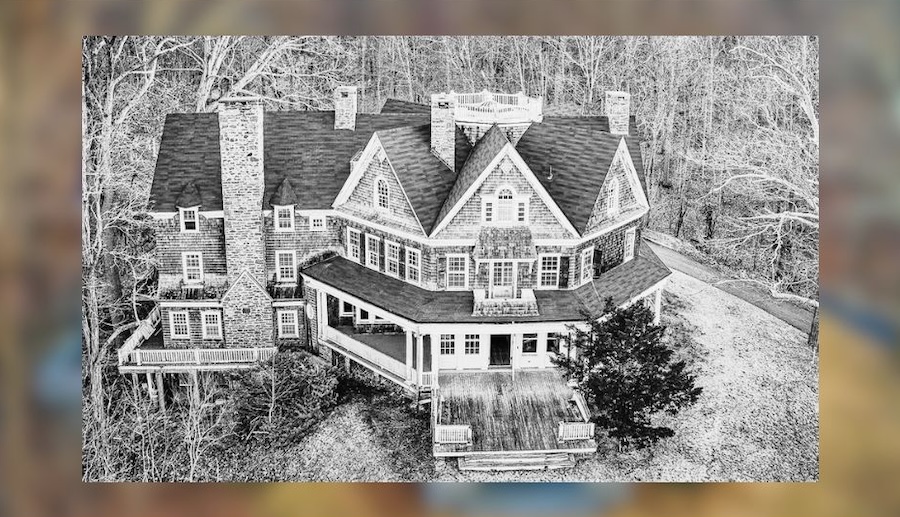
The house on the hill is real. Its history causes a problem.
This is where the legend collides with something much less flexible than folklore: dates. One of the properties most frequently connected to the Head of the Harbor version is the Kate Annette Wetherill Estate, the large historic house overlooking Stony Brook Harbor. The house is very real. So is its history.
The National Register of Historic Places documentation says architect Stanford White designed the estate for his sister-in-law Kate Annette Wetherill and it was built in 1895. The property was later added to the National Register in 1993.
That presents an obvious problem for versions claiming Mary lived in that house in the early 1800s. The house did not exist yet. There is another interesting detail.
The National Register nomination describes an octagonal pump house constructed from local glacial stones on the Wetherill property. It also documents stone entrance piers, an iron gate, a rose garden, carriage house and superintendent’s cottage. That matters because a little stone building is central to many Mary stories.
Patch photographed a small stone structure on Harbor Road in 2012 and noted that, despite being called Mary’s Grave in local lore, it looked more like a piece of old infrastructure than a cottage. The article also found little verified historical information connecting the site with any Mary. Suddenly “Mary’s mysterious stone playhouse” begins sounding considerably more like “old estate plumbing.” Admittedly, plumbing rarely survives three generations of teenage ghost stories.
The real history of the “haunted” house is strange enough on its own
The mansion most commonly tied to the Head of the Harbor version of Mary’s Grave already had an unusual history before anyone added a ghost story.
Newsday identified the octagonal Wetherill house overlooking Stony Brook Harbor as the work of famed architect Stanford White. White was not simply an architect working in the area. In 1884, he married Bessie Smith, a descendant of Smithtown founder Richard “Bull” Smith, and two years later the couple bought Box Hill in nearby St. James as a summer home.
By the late 1800s, White had become one of the architects most closely associated with Long Island’s Gilded Age estates. Newsday reported that he designed about 40 structures on Long Island as wealthy New Yorkers increasingly built large, secluded country homes behind gates and on sprawling private properties.
White’s own life eventually ended in a story almost as sensational as the legends later attached to the area. In 1906, while still married to Bessie, he was shot and killed on the rooftop theater of Madison Square Garden by millionaire Harry Thaw, the husband of White’s former lover, actress and model Evelyn Nesbit. The murder and subsequent trials became one of the biggest scandals of the era.
None of that has any documented connection to Mary’s Grave, but it adds another layer of real history to a landscape already unusually well suited to folklore.
By the time later generations encountered the Wetherill property, they were looking at exactly the kind of setting ghost stories thrive on: an unusual mansion on a secluded estate, old stonework, gated grounds, woods and a dark road overlooking Stony Brook Harbor.
There is just one major problem for the Mary story. The Wetherill estate dates to the 1890s. That means versions claiming Mary lived in that house in the early 1800s cannot be historically accurate. The house is real. The setting is real. The documented history is fascinating. Mary, at least as the legend describes her, is another matter.
So was there actually a Mary?
At this point, there is no convincing historical evidence in these sources for a woman matching the complete Mary’s Grave story. No verified Mary who lived at the famous Head of the Harbor estate. No documented hatchet murder matching the tale. No established lynching or hanging beneath the legendary tree. No single confirmed grave. And the Wetherill house so often attached to the story was not even constructed until 1895.
What about “Mary Hatchet”?
The name Mary Hatchet frequently gets mixed into the story.
One Long Island folklore writer has proposed that Mary Hatchet originated as a fictional temperance figure associated with the Woman’s Christian Temperance Union, and that houses where temperance meetings occurred became known as “Mary Hatchet houses.” It’s an intriguing explanation but I would not treat it as established history.
What is well documented is Carry Nation, the famous temperance activist who began attacking saloons around 1900 and became nationally associated with the hatchet. The Smithsonian records her use of a hatchet against a Wichita saloon in December 1900, while the Library of Congress documents her subsequent lectures and sale of hatchet souvenirs.
I could not find comparable historical documentation establishing “Mary Hatchet” as an actual WCTU character or showing that WCTU meeting houses were routinely known by that name. It is possible that genuine temperance imagery surrounding Carry Nation eventually influenced later Mary Hatchet stories. But that remains a theory, not a settled explanation.
The story may contain much older ingredients
There is one especially interesting reason Mary’s story can feel older than the Long Island version actually is. Its ingredients are old. Consider the combination of a woman, a well, incest, murdered children and supernatural punishment.
Those themes appear in the traditional ballad “The Well Below the Valley,” also known as “The Maid and the Palmer.” Versions of the ballad involve a woman confronted at a well about incestuous relationships and dead children. The song belongs to an old European folk tradition, with related versions in Britain, Ireland and Scandinavia. An Irish version collected from singer John Reilly in the 1960s helped return the nearly forgotten song to wider attention.
There was even an actual Black Mary’s Hole, or Black Mary’s Well, in Clerkenwell, London. Historical sources place a well there centuries ago and connect its name with a Black woman named Mary Woolaston, although details of her life remain uncertain.
None of that proves Long Island’s Mary descended directly from these stories.
It does demonstrate something more useful: wells, mysterious women, family crimes and restless spirits have been traveling together through folklore for a very long time.
And that address kept moving
The Facebook memories may provide the best evidence of what Mary eventually became. Some Long Islanders insist she belonged in Head of the Harbor. Others remember Mary around Sweet Hollow Road or Mount Misery. Others name Melville, Lindenhurst, Farmingdale, Amityville or Nissequogue. One commenter summed it up better than almost any historian could: “Mary’s grave is in almost every town.”
Every generation inherited a frightening story, attached it to a road or ruin that already looked sufficiently suspicious, changed a few details and handed it to the next group of teenagers. Mary could survive indefinitely because nobody owned the definitive version.
Maybe the real mystery has finally been solved
So where is Mary’s Grave? There probably is no single answer.
The Head of the Harbor version has become one of the best-known, helped enormously by the old roads, Stony Brook Harbor, the stone structure and a spectacular 1895 Stanford White estate looming nearby. But the historical record does not support the grisly biography usually attached to it. And perhaps that makes Mary’s Grave more interesting rather than less. The real piece of Long Island history is not necessarily a murdered woman named Mary, it’s the generations of Long Islanders who went looking for her.
They drove down the dark roads, argued about the location, dared each other to get out of the car, frightened themselves, occasionally attracted the attention of local police, and eventually told the same story to someone younger.
If you grew up here and somebody once told you they knew the real location of Mary’s Grave, congratulations, you were already part of the legend!
Research and verification notes
- The strongest historical anchor is the National Register documentation for the Kate Annette Wetherill Estate, which establishes its 1895 construction and documents the property’s stone pump house.
- Patch documented the Head of the Harbor stone structure and noted both its association with Mary’s Grave and the lack of verified information connecting it with the legend.
- Kerriann Flanagan Brosky collected several of the competing Long Island Mary traditions, including Head of the Harbor, Stony Brook, Mount Sinai and West Hills versions.
- Todd Atteberry’s extensive writings are useful for documenting how the legend has been told and for exploring possible folklore origins, but some historical theories, particularly the WCTU “Mary Hatchet” explanation, should be treated as hypotheses rather than established fact.