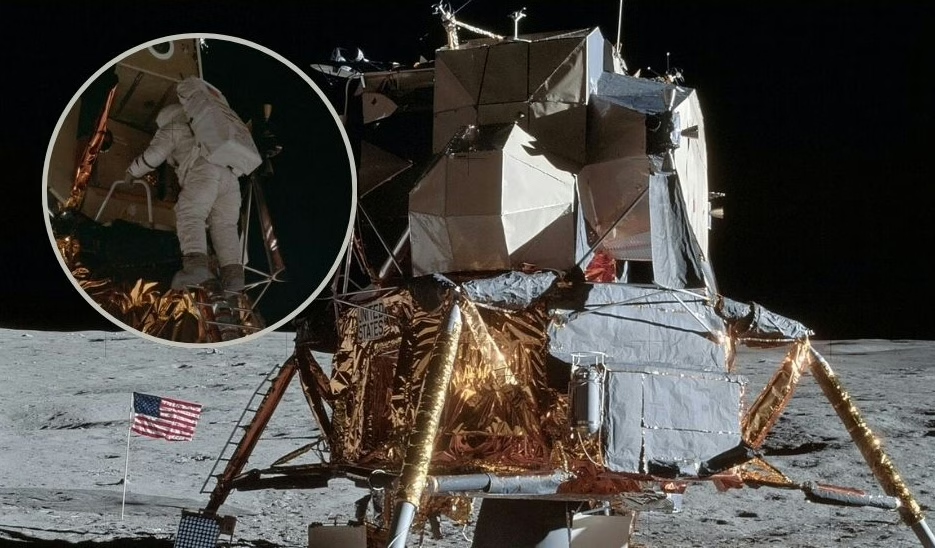
Long Island played a direct role in one of the biggest achievements in human history. The Lunar Module that landed the first astronauts on the moon was designed and built by Grumman Aerospace in Bethpage. At the height of the space race, this locally built spacecraft carried astronauts from orbit to the lunar surface and safely back again.
The Spacecraft Built on Long Island
Grumman Aerospace Corporation, based right here on Long Island, was tasked with building the vehicle that would ferry astronauts from orbit down to the lunar surface and back.
That vehicle became the Lunar Module. Or, as everyone called it, the “LEM.”
And this is where things get wild.
• In 1962, NASA invited 11 companies to submit proposals for a lunar excursion module
• The proposal process was described by Grumman VP Joseph G. Gavin Jr. as “a game of Twenty Questions”
• Grumman Aircraft won the contract on November 7, 1962
• Every single Lunar Module was built on Long Island by Long Islanders
The name itself evolved over time:
• Originally called the “Lunar Excursion Module (LEM)” until 1966
• NASA dropped “excursion” because it implied mobility the craft didn’t have
• It became simply “Lunar Module (LM)” but everyone still called it “LEM” anyway
And yes, later Apollo missions added a rover for actual movement on the moon.

Designed by Long Islanders, Built for the Impossible
The man leading the effort was Thomas J. Kelly, often called the “father of the lunar module.”
He once said:
“Remember, there are six descent stages today sitting on the moon with a ‘Made in Bethpage, New York’ nameplate on them.”
He also wrote a book about it called Moon Lander: How We Developed the Apollo Lunar Module.
The engineering itself was unlike anything before it:
• The LM carried two astronauts to the lunar surface while one stayed in orbit in the Command and Service Module (CSM)
• It was a two-stage spacecraft with ascent and descent sections
• It was covered in gold, silver, and black thermal shielding, giving it that fragile, foil-like look
• It had no aerodynamic design because it was never meant to fly in Earth’s atmosphere
• That made it the first true spacecraft built only for space
Click here for more stories about Long Island’s space & aviation history.
And here’s a key detail:
• It was built with extremely thin, lightweight metal to conserve fuel while searching for a landing spot
Its job was simple in theory, terrifying in reality:
• Land two astronauts on the moon
• Keep them alive
• Launch them back into orbit to rejoin the CSM
Training for Something You Can’t Test
One of the craziest parts of the whole program is that the Lunar Module was never flight tested in a real lunar environment.
Because you can’t exactly recreate the moon.
So Grumman built a simulator.
• The Lunar Module Simulator operated at Kennedy Space Center from 1968 to 1972
• Every Apollo astronaut trained on it before their mission
• It included an early form of virtual reality to simulate landing
• Astronauts even slept inside it to prepare for multi-day stays
• Only one simulator was built
• It still exists today at the Cradle of Aviation Museum

The Moment Long Island Landed on the Moon
NASA named its missions after Greek gods, continuing a tradition from earlier programs. Apollo, the god of the sun, felt appropriate for a mission reaching beyond Earth.
The timeline gets interesting:
• In March 1969, the first crewed mission of the LM took place
• In May 1962, the LM entered lunar orbit for the first time
• On July 20, 1969, the LM made history
During Apollo 11 Moon Landing:
• The LM carried Commander Neil Armstrong and pilot Buzz Aldrin to the surface
• They became the first humans to walk on the Moon
• About 22 hours later, they returned to orbit to head home
And yes, the LM is still unique:
• It remains the only crewed vehicle to land anywhere other than Earth
The Phrase Everyone Knows Came From This
When the LM touched down, Armstrong radioed back:
“Houston, Tranquility Base here. The Eagle has landed.”
That phrase? It stuck.
It’s now what people say when they pull off something big.
Moments later, Armstrong stepped onto the surface and said:
“That’s one small step for man, one giant leap for mankind.”

Stats That Still Feel Unreal
According to NASA data:
• The LM was about 31 feet wide and 23 feet high
• It weighed between 32,000 and 36,000 pounds
• It could reach speeds of about 17,500 mph
• It handled landing, abort, launch, rendezvous, and docking functions
• Grumman built 13 Lunar Modules
• 10 went to space
• 6 landed humans on the moon
• Each LM had its own callsign
The Art Museum on the Moon
• It is rumored that artwork by Andy Warhol and other artists was etched onto a tiny ceramic chip
• The chip was secretly attached to a Lunar Module leg
• If true, that artwork is still sitting on the moon today
• Which technically makes it the only human art museum in outer space
The Lifeboat That Saved Apollo 13
The LM wasn’t just built to land people on the moon. It also saved lives.
During Apollo 13 mission:
• An explosion damaged the Service Module two days after launch
• The crew used the LM, named Aquarius, as a lifeboat
• It was designed for two astronauts for 45 hours
• It supported three astronauts for 90 hours instead
The crew:
• James A. Lovell Jr.
• John L. Swigert Jr.
• Fred W. Haise Jr.
More incredible details:
• The mission still looped around the Moon
• The LM descent engine was used to slingshot them back to Earth
• The LM was jettisoned before reentry
• It burned up in Earth’s atmosphere, with debris falling near New Zealand
What Happened to the Lunar Modules
Not all of them came home.
• Most LM crash sites are known
• The ascent stages of Apollo 11’s Eagle and Apollo 16’s Orion are still missing
And locally:
• The 13th and final LM was never flown
• It is on permanent loan from the Smithsonian to the Cradle of Aviation Museum
Other surviving modules:
• One is at the Smithsonian National Air and Space Museum in Washington, D.C.
• Another is at Kennedy Space Center Visitor Complex in Florida
• Two unfinished LMs were scrapped after the Apollo program ended
What Happened to Each Lunar Module
According to NASA:
| Mission | LM Callsign | Lunar Landing Site | Fate of Ascent Stage |
|---|---|---|---|
| Apollo 5 | Unnamed | None | Burned up in Earth’s atmosphere |
| Apollo 9 | Spider | None | Burned up in Earth’s atmosphere |
| Apollo 10 | Snoopy | Sea of Tranquillity | In orbit around the sun |
| Apollo 11 | Eagle | Sea of Tranquillity | Crash site unknown |
| Apollo 12 | Intrepid | Ocean of Storms | Crash-landed on moon |
| Apollo 13 | Aquarius | Planned: Fra Mauro | Used as a lifeboat |
| Apollo 14 | Antares | Fra Mauro | Crash-landed on moon |
| Apollo 15 | Falcon | Hadley-Apennine | Crash landed on moon |
| Apollo 16 | Orion | Plain of Descartes | Crash site unknown |
| Apollo 17 | Challenger | Taurus-Littrow | Crash landed on moon |
WATCH: Apollo Landing Sites with Moon Phases
The Part That Still Hits
Long Island didn’t just contribute to the space race. It helped finish it.
There are still pieces of these machines sitting on the moon right now. Built in Bethpage. By people who probably went home at night and had dinner like anyone else on the Island.
And somewhere up there, there may even be a tiny piece of art quietly proving that Long Islanders didn’t just reach the moon.
Photos/Videos: NASA