Long Island is often called the “cradle of aviation,” and Belmont Park offers an early example of why. In October 1910, less than seven years after the Wright brothers made their first powered flight at Kitty Hawk, the Long Island racetrack became the site of an international aviation tournament that brought leading pilots, experimental aircraft and record-setting competition to Belmont.
The International Aviation Tournament ran for nine days, from Oct. 22 through Oct. 30. Pilots competed in events involving speed, altitude, distance and time in the air, while about $75,000 in prize money helped attract competitors from around the world. Belmont Park itself was still relatively new, having opened on May 4, 1905, only about five years before the aviation meet.
Airplanes were still new enough to require an explanation
A surviving souvenir program for the tournament provides a sense of how unfamiliar aviation remained to the public in 1910. In addition to photographs of aviators and airplanes, a schedule of events, race details, prizes and a list of entrants, the booklet included an essay titled “How an Aeroplane is Controlled” and a glossary of “Terms Used by Aviators.”
Smithsonian archival material documenting the meet includes aircraft made by Curtiss, Wright, Blériot, Antoinette, Santos-Dumont, Clément-Bayard, Farman and other early manufacturers. The range of aircraft represented at Belmont reflected a period when airplane design was still developing rapidly and several competing configurations remained in use.
Click here for more stories about Long Island’s aviation history.
The Library of Congress preserves a collection of 33 photographs from the tournament showing airplanes in flight, aircraft on the ground and rows of hangars at Belmont. Signs visible on the hangars include Curtiss, Latham, LeBlanc and Wright Bros., among others. Charles E. Taylor, the Wright brothers’ mechanic who built the engine used in their 1903 Flyer, was also photographed examining an engine at the meet.
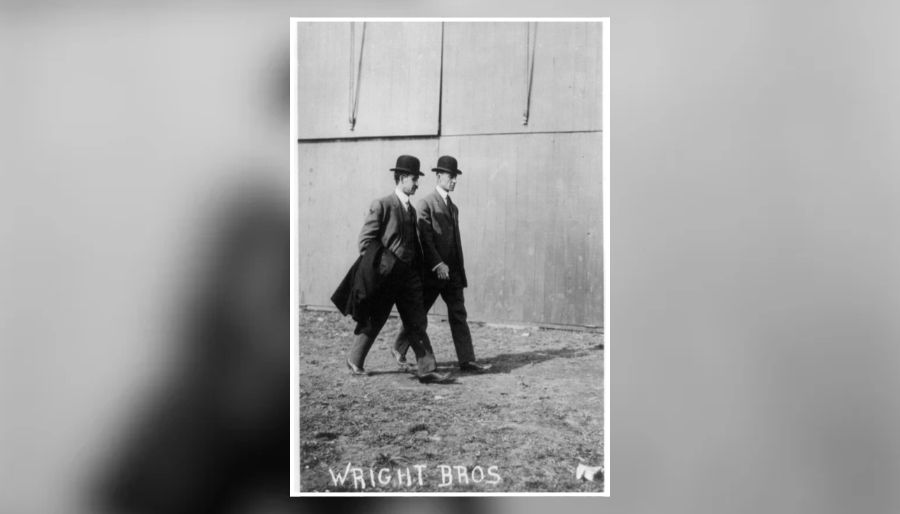
Wilbur and Orville Wright were present as well. A separate Library of Congress photograph identifies the brothers at the International Aviation Tournament at Belmont Park in October 1910, placing them at the Long Island racetrack less than seven years after their first successful powered flight.
Belmont hosted the Gordon Bennett aviation race
The tournament was built around competitive flying rather than simple exhibition flights. On Oct. 29, Belmont hosted the Gordon Bennett International Aviation Trophy race, a 100-kilometer competition covering about 62 miles.
British aviator Claude Grahame-White won the race in 61 minutes and 47.10 seconds, averaging about 61 miles per hour. French aviator Alfred LeBlanc had been flying faster and was on his final lap when he struck a telegraph pole and crashed. A contemporary New-York Tribune account calculated that LeBlanc would have completed the race in 55 minutes and 35 seconds had he finished, nearly six minutes faster than Grahame-White.
The race illustrated how rapidly aviation had developed in the seven years since Kitty Hawk. The Wright brothers’ first powered flight in December 1903 lasted only seconds, while competitors at Belmont in 1910 were racing aircraft over a course of more than 60 miles at speeds exceeding 60 miles per hour.
The tournament produced an American altitude record
Altitude was another major part of the competition. During the tournament, Wright exhibition pilots Ralph Johnstone and Arch Hoxsey climbed into winds so strong that contemporary reports described their airplanes being blown backward for miles across the interior of Long Island while flying at an altitude of more than a mile.
Both pilots eventually returned to Belmont. Johnstone carried a sealed barograph, an instrument used to record altitude, and when officials examined it they determined that he had reached 8,471 feet. The height was accepted as a new official American altitude record, surpassing Johnstone’s own previous mark of 7,500 feet.
The episode was one example of the experimental nature of the Belmont tournament. Pilots were not simply displaying airplanes for spectators but competing in events that tested speed, endurance, altitude and distance at a time when many of the limits of powered flight were still being established.
Pilots also flew from Belmont to the Statue of Liberty
One of the tournament’s most prominent events took competitors beyond the racetrack. A $10,000 prize was offered for a round-trip flight from Belmont Park to the Statue of Liberty and back.
The route required pilots to leave Belmont, fly toward New York Harbor, circle the Statue of Liberty and return to Long Island. The Henry Ford estimates that about 75,000 spectators watched the start and finish of the event at Belmont Park.
The size of the crowd demonstrated how quickly aviation had become a major public attraction. Less than seven years after the Wright brothers’ first powered flight, tens of thousands of spectators were gathering at a Long Island racetrack to watch aviators undertake a long-distance race through the skies over the New York metropolitan area.
Harriet Quimby was among the spectators
Harriet Quimby, then a journalist, attended the 1910 Belmont Park aviation meet. According to the Smithsonian’s National Air and Space Museum, she was particularly impressed by aviator John Moisant’s performance and asked him to teach her how to fly.
On Aug. 1, 1911, less than a year after the Belmont tournament, Quimby received a Fédération Aéronautique Internationale pilot certificate and became the first American woman to earn a pilot’s license. On April 16, 1912, she became the first woman to fly solo across the English Channel.
Her presence adds another connection between the Belmont tournament and the early development of American aviation. Quimby attended the meet as a spectator, became interested in flying after watching Moisant and soon became one of the best-known women in early aviation.
Belmont Park became part of early aviation history
The International Aviation Tournament lasted only nine days, but surviving photographs, programs and contemporary accounts document an unusually concentrated period of early aviation activity at Belmont Park. The racetrack, which had opened only five years earlier, hosted hangars, mechanics, experimental aircraft and pilots from several countries during the October 1910 meet.
The Wright brothers attended, the Gordon Bennett Trophy was contested over a 100-kilometer course, Johnstone established an official American altitude record of 8,471 feet, and an estimated 75,000 spectators watched the start and finish of the Statue of Liberty flight. Harriet Quimby was also in the crowd before beginning the flying career that made her the first American woman to earn a pilot’s license.
All of it took place before powered flight was seven years old, making Belmont Park an early Long Island setting for the rapid development of aviation in the United States.
Photo: Wilbur and Orville Wright at the International Aviation Tournament at Belmont Park, October 1910. Photo: Library of Congress, Prints and Photographs Division. No known restrictions on publication.
Sources
- Library of Congress, “The Wright brothers at the International Aviation Tournament, Belmont Park, Long Island, N.Y., Oct. 1910”
https://www.loc.gov/item/2002721781/ - Library of Congress, “International aviation tournament at the Belmont Park racetrack, Long Island, New York, October 22-30, 1910”
https://www.loc.gov/item/2005682299/ - Smithsonian National Air and Space Museum, “Early Aviation in 1910 and 1911 Scrapbook”
https://airandspace.si.edu/collection-archive/early-aviation-1910-and-1911-scrapbook/sova-nasm-xxxx-0299 - Smithsonian National Air and Space Museum, “First American Women in Flight,” Harriet Quimby section
https://airandspace.si.edu/stories/editorial/first-american-women-flight - The Henry Ford, “Official Programme of the International Aviation Tournament at Belmont Park, October 22 to 30, 1910”
https://www.thehenryford.org/collections/explore/artifact/317441 - New York Racing Association, Belmont Park history, 2016 Media Guide
https://www.nyra.com/uploads/wysiwyg/assets/uploads/2016_MG_History_1.pdf - Library of Congress, Wright Brothers Papers, contemporary account documenting Ralph Johnstone’s 8,471-foot altitude record and the Belmont flights of Johnstone and Arch Hoxsey
https://tile.loc.gov/storage-services/service/mss/mss46706/mss46706-05003443/mss46706-05003443.pdf