Before the Long Island Rail Road began carrying passengers directly into Manhattan, a trip into the city generally required both a train and a ferry. Manhattan-bound passengers traveled by rail to the waterfront at Hunter’s Point, now part of Long Island City, where they transferred to ferries for the final portion of the trip across the East River.
The connection between the railroad and the ferries dated to the early development of rail service in Queens. Railroad historian Vincent F. Seyfried wrote that when the Flushing Railroad established its terminus at Hunter’s Point in the 1850s, there was no existing ferry at Borden or Jackson avenues. To provide its passengers with transportation to Manhattan, the railroad acquired two small steam ferryboats, Enoch Dean and Island City. One operated between Hunter’s Point and Fulton Market Wharf, while the other could serve as a substitute or operate between Flushing and New York.
Seyfried described the early Hunter’s Point terminus as essentially a transfer station from rail to boat. Trains arrived at the waterfront, where passengers transferred at the railroad’s wharf to ferries bound for Manhattan. An 1854 test run provides an unusually detailed example of the trip. A train traveled nonstop from Flushing to the Hunter’s Point dock in 11 minutes, passengers spent 4½ minutes transferring to the boat, and the ferry trip to Fulton Ferry took another 12 minutes. The total journey was 27½ minutes.
The ferry connections changed as the railroads and communities of Queens developed. By 1860, Flushing Railroad service included trains connecting with ferries serving both Fulton Market Slip and East 34th Street. After the Flushing Railroad began using the Long Island Rail Road’s terminal in 1862, its passengers could use the James Slip or East 34th Street ferries.
Click here for more stories about the LIRR and Long Island railroads.
The Borden Avenue waterfront developed into an increasingly busy transportation center. The East River Ferry Company operated between Borden Avenue and James Slip, and in 1869 introduced Southampton, described by Seyfried as the first large double-deck ferryboat on the river. The company enlarged its Manhattan terminal at James Slip in 1871 and built a new slip at Borden Avenue the following year to accommodate increasing railroad travel. Seyfried recorded a typical crossing time of about 30 minutes between Hunter’s Point and James Slip, compared with about 15 minutes between Hunter’s Point and East 34th Street.
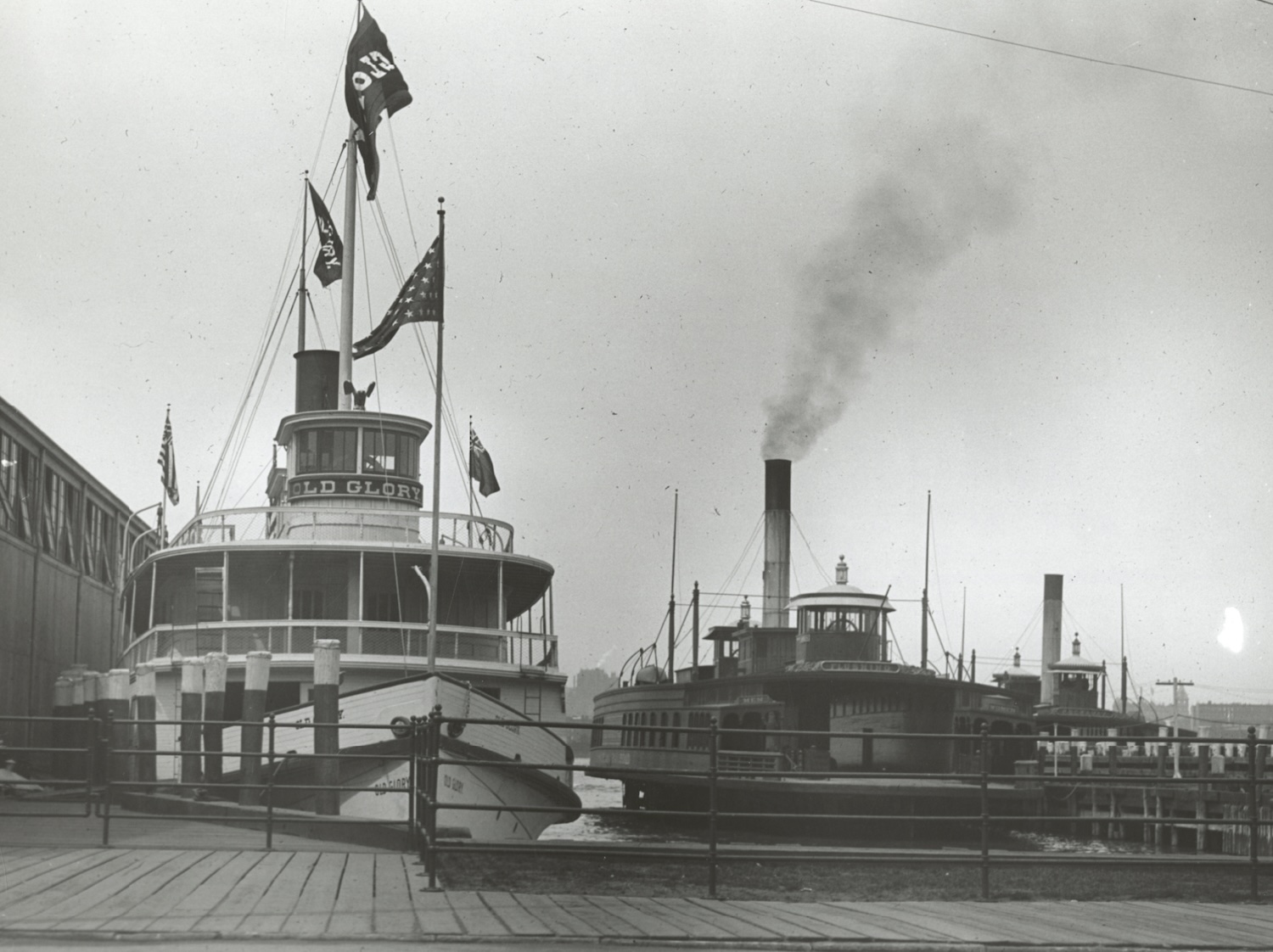
By the late 19th century, Long Island City had developed into a substantial rail and ferry terminal. Railroad facilities included numerous tracks, freight connections and passenger accommodations, while covered passageways connected the railroad facilities with the ferries. A May 1899 photograph by Hal B. Fullerton shows the steamship Old Glory and the ferries Flushing and Rockaway at the Long Island Rail Road ferry terminal.
The reliance on ferries began to change after the Pennsylvania Railroad acquired control of the LIRR in 1900. The Pennsylvania Railroad undertook a major project to provide direct rail access to Manhattan, including the construction of four railroad tunnels beneath the East River.
Construction of the East River tunnels proceeded during the first decade of the 20th century. The first tunnel connection was completed in February 1908, and the last of the four tunnels was completed that May. Test trains subsequently operated through the new tunnels in preparation for regular passenger service.
On Sept. 8, 1910, the LIRR began regular passenger service through the East River tunnels and into the new Pennsylvania Station. Passengers using the new service could remain aboard the train as it traveled beneath the river into Midtown Manhattan rather than transferring to a ferry in Long Island City.
LIRR passengers began using Penn Station before the station was fully open. Regular LIRR service started on Sept. 8, while Pennsylvania Station officially opened in full on Nov. 27, 1910. The new connection simplified travel between Long Island and Manhattan and became an important factor in the continued development of Long Island’s commuter suburbs.
The basic route established in 1910 remains part of the LIRR system more than a century later. What is now an ordinary train ride beneath the East River replaced a transportation system in which the Long Island City waterfront and its ferries were an integral part of a railroad trip to Manhattan.
PHOTO: The steamship Old Glory and the ferries Flushing and Rockaway at the Long Island Rail Road ferry terminal in Long Island City in May 1899. Before direct LIRR service to Penn Station began in 1910, Manhattan-bound passengers transferred in Long Island City to ferries across the East River. Photo by Hal B. Fullerton, May 1899. Public domain.
SOURCES:
- Vincent F. Seyfried, The Long Island Rail Road: A Comprehensive History, Part Two: The Flushing, North Shore & Central Railroad, 1963.
- PBS American Experience, The Construction of Penn Station
https://www.pbs.org/wgbh/americanexperience/features/the-rise-and-fall-of-penn-station-construction-penn-station/ - Long Island Historical Journal, The Long Island Rail Road and Its Promotion of Long Island, 1900-1930
https://www.trainsarefun.com/lirr/lirrpaper/lihistoricaljournal/LIHJ-LIRR.htm - Electric Railroaders’ Association, New York Division Bulletin
https://erausa.org/pdf/bulletin/2010s/2010/2010-09-bulletin.pdf - Queens Public Library Digital Archives, Hal B. Fullerton Photographs
https://digitalarchives.queenslibrary.org/nodes/view/33721