You’ve probably spent countless hours sitting on the Long Island Expressway wondering why traffic suddenly stopped for absolutely no reason. But long before the brake lights, potholes, and bumper-to-bumper backups became part of daily life, the LIE was considered one of the biggest infrastructure projects in Long Island history.
And believe it or not, parts of the highway almost looked very different.
Below are some strange, historical, and very Long Island facts about the road locals love to complain about most.
- Back in 1940, what would eventually become the LIE was only a one-mile stretch of six-lane roadway connecting the Midtown Tunnel to the Brooklyn-Queens Expressway.
- At the time, it wasn’t even called the Long Island Expressway. The original name was the “Midtown Highway.”
- By 1953, Newsday was reporting on plans for a massive 70-mile highway stretching from Manhattan all the way toward eastern Long Island.
- In 1954, the projected construction cost was estimated at $500 million.
- Early planners referred to the project as the “Central Motor Expressway.”
- Original plans called for the speed limit to be just 35 miles per hour, with a maximum of 40 mph in some sections.
- The highway was initially expected to be completed by 1957.
- That projected completion date later slipped to 1958 and eventually to 1961.
- In October 1958, the first Long Island section opened between Exit 32 and Exit 39 near Glen Cove Road.
- In 1960, the roadway extended through Jericho between Exits 39 and 41 near Routes 106 and 107.
- By 1962, the LIE crossed into Suffolk County and reached Exit 49 in Melville near Route 110.
- In 1963, it expanded farther east to Exit 52 at Commack Road in Dix Hills.
- In 1964, another section opened through Islandia near Veterans Memorial Highway.
- By 1966, drivers could travel as far east as Exit 61 near Patchogue-Holbrook Road in Holbrook.
- The Riverhead terminus was finally completed in 1972.
- Planners originally estimated the LIE would handle roughly 80,000 vehicles daily by 1970.
- But by 1962, traffic volume had already exploded to between 125,000 and 150,000 vehicles per day.
- In 1964, The New York Times reported discussions about building an upper deck above the highway in Queens to ease congestion.
- Officials were already proposing widening the road from six lanes to ten lanes by 1968.
- That same year, the Times reported that motorists were calling the LIE “the longest parking lot in the world.”
- In 1967, newspaper headlines were already warning that the “LI Expressway” would remain snarled with traffic for years.
- According to Newsday, original construction of the expressway required 500 billion pounds of cement and 5 billion pounds of gravel.
- The full length of the LIE measures 66.38 miles.
- HOV lanes were added gradually between 1994 and 2005.
- The HOV system began as a short stretch in western Suffolk County before expanding east and west over time.
- The lanes officially reached completion on June 30, 2005.
- Today, the HOV lanes run from Exit 31 near the Cross Island Parkway to Exit 64 in Medford.
- There is one HOV lane in each direction positioned in the highway median.
- For decades, much of the expressway operated without lighting at night.
- Street lighting installation did not begin until 1981.
- At the time, the lighting project carried a $6.1 million price tag.
- The federal government covered 75% of the installation costs while New York State paid the remaining 25%.
- Nassau and Suffolk counties were responsible for the electric bills afterward.
- Nassau County’s annual electric costs were estimated at $58,000 in 1978.
- Suffolk County’s estimated yearly cost reached $90,000.
- By 1981, rising energy prices had already doubled costs.
- According to The New York Times, the aluminum light poles stood 40 feet tall and were designed to withstand wind gusts up to 117 miles per hour.
- Technically, the road is only officially called the “Long Island Expressway” in Nassau and Suffolk counties.
- In Queens, portions are officially named the Horace Harding Expressway and Queens-Midtown Expressway east of the Brooklyn-Queens Expressway.
- Almost nobody actually uses those names in everyday conversation.
- The “Queens Giant,” considered the oldest and tallest tree in the New York metropolitan area, stands near the expressway in northeastern Queens close to the Douglaston Plaza area and can be seen while driving westbound.
- In 1962, a traffic commissioner proposed studying construction of a second deck above the LIE.
- That same proposal also suggested building a bridge connecting Orient Point to Connecticut.
- Over the years, plenty of frustrated motorists joked that the acronym “LIE” was fitting because the road was rarely “express.”
- The expressway has also been the site of numerous fatal crashes over the decades, including several involving well-known public figures.
- Singer-songwriter Harry Chapin died on the LIE after a tractor trailer struck his vehicle while he was on the way to perform at a free concert.
- Film director Alan Pakula, known for movies including Sophie’s Choice and All the President’s Men, died after a metal pipe smashed through his windshield while driving on the highway.
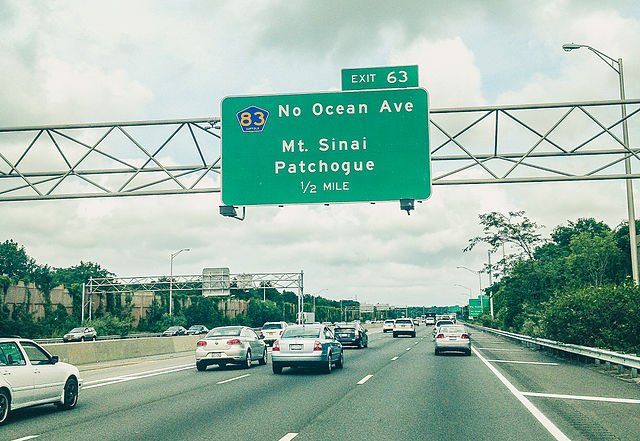
Photo: Tony Webster from San Diego, California, CC BY-SA 2.0, via Wikimedia Commons