
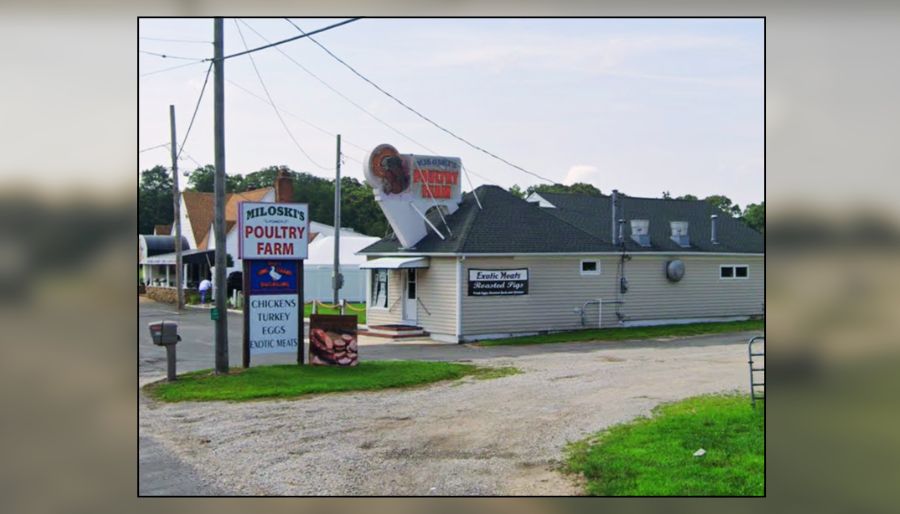
For generations, the Miloski family has raised poultry on a 30-acre farm along Middle Country Road in Calverton, supplying fresh turkeys for Long Island Thanksgiving dinners. Established in 1946, Miloski’s Poultry Farm has survived the disappearance of many of the Island’s poultry operations, increasing development pressures and the challenges of keeping a family farm in business.
In 2026, the farm marked its 80th year in business, a milestone acknowledged on its official website. By then, the operation had passed through three generations while remaining on the same Calverton property where William “Will” Miloski established the business.
Its history includes a property transfer for just $1, a founder who worried that turkey farming was disappearing from Long Island and a Thanksgiving operation that once processed as many as 500 birds a day. Today, the farm continues to provide a connection to an earlier era of Suffolk County agriculture.
From Long Island ducks to Thanksgiving turkeys
William Miloski was born in 1924, when agriculture was still a substantial part of Suffolk County’s economy. Poultry farming was particularly important on the East End, where Long Island ducks had become a nationally recognized product.
The Miloski family’s agricultural roots included duck farming. According to a 2024 Southforker interview with the family, Will bought out his mother Molly’s interest in a duck-farming operation in 1946 and developed the business into a turkey and chicken farm.
The farm’s official history describes 1946 as the year Will purchased a 30-acre property along Route 25 in Calverton to raise poultry. A 2016 Suffolk Times report also identifies Will and Molly as the founders of the business, which initially raised turkeys, chickens, geese and ducks.
Although these accounts describe the precise beginnings somewhat differently, they agree that the Miloski poultry business dates to 1946. They also establish the family’s involvement in an agricultural industry that was once an important part of Long Island’s economy.
Will married Ann in 1948, and the farm became the center of their family’s life and work. Over the following decades, the business increasingly concentrated on turkeys and chickens while maintaining its connection to Long Island’s poultry-farming traditions.
The original farm store, built in 1946, remains in use. According to the family’s website, many of its approaches to raising poultry have also remained consistent with practices established during Will’s lifetime.
A 30-acre farm sold for one dollar
One of the most unusual episodes in the family’s history occurred in 1987, when Will transferred the farm to his son, Mark Miloski Sr., for just $1.
In a November 2024 Southforker interview, Mark Sr. recalled that his father insisted he actually pay the dollar. Will also expected his son to continue living on the property, maintaining the close relationship between the family’s home and its business.
Mark Sr. had already spent years working on the farm. He recalled beginning with chores such as shoveling manure as a teenager before learning the various responsibilities involved in raising and processing poultry.
His own son, Mark Jr., grew up on the same property. In a 2021 Northforker interview, he recalled collecting eggs when he was only five years old and later becoming involved in other farm work.
Mark Jr. earned a college degree in business but returned to farming full-time. By 2024, he and his father were carrying on an operation that had employed three generations of Miloskis.
The family continued living on the property while maintaining its agricultural use. That arrangement became increasingly significant as farmland across Suffolk County was developed for residential and commercial purposes.
Thousands of turkeys for Thanksgiving
Thanksgiving has long been the busiest season at Miloski’s Poultry Farm, when the family’s year-round work culminates in the sale of thousands of birds.
In November 2016, The Suffolk Times reported that the farm expected to raise approximately 3,500 turkeys that season, with about 3,000 expected to be sold before Thanksgiving. During much of the year, the family processed only around three turkeys a week.
That figure could increase to approximately 500 birds a day as the holiday approached. The difference reflected the enormous seasonal demand placed on a relatively small family operation.
The demanding schedule was still part of the business five years later. In a 2021 Northforker interview marking the farm’s 75th anniversary, Mark Jr. described working approximately 14 hours a day during the busiest turkey-processing period, sometimes getting only an hour or two of sleep.
The family continued handling much of the processing work itself. According to its 2024 Southforker profile, Mark Sr. and Mark Jr. remained closely involved in preparing the birds for customers, continuing methods developed over decades of family experience.
The turkeys are raised on the Calverton property, where they have access to outdoor areas and shelters. In the 2016 report, the farm was described as having five poultry pens, along with homes occupied by members of the family.
The Thanksgiving rush also produced some unusual family routines. In a 2021 interview, Mark Jr. said he planned to spend the holiday sleeping after weeks of demanding work preparing turkeys for customers. His Thanksgiving schedule was understandably different from that of the families buying the birds.
Some of those customers had maintained relationships with the farm for decades. In the 2024 Southforker interview, Mark Jr. described people who had been purchasing their Thanksgiving turkeys from Miloski’s for 50 or 60 years.
The uncertain future of Long Island poultry farming
The survival of Miloski’s Poultry Farm is particularly notable because Will himself had expressed concerns about the industry’s future.
In a November 2024 Southforker profile, the publication revisited a 1977 New York Times article titled “Turkey Farms: A Vanishing Breed.” According to Southforker’s account, Will acknowledged that his business was doing well but feared that turkey farming was gradually disappearing from Long Island.
He also questioned what would happen to the family business after he was no longer able to operate it. His concerns reflected the difficulties facing smaller poultry farms as Long Island’s agricultural economy changed.
Rising land values, operating expenses, property taxes and competition from farms in less expensive regions placed increasing pressure on local agricultural businesses. Many poultry operations disappeared as their owners retired, sold their land or found it difficult to compete with larger producers.
The Miloskis encountered some of those same pressures. In the 2024 interview, Mark Sr. discussed the cost of maintaining the property and explained that the business’s continuation depended heavily on his son’s willingness to remain a farmer.
Mark Jr. expressed little interest in selling the property, despite its potential development value. He spoke instead about his ambition to keep the business operating until its 100th anniversary in 2046.
That goal reflected a family commitment extending well beyond the annual Thanksgiving rush. Maintaining the farm also meant preserving the work of earlier generations and the land on which the business had operated since the immediate postwar years.
A surviving piece of Long Island’s agricultural history
Miloski’s Poultry Farm remains at 4418 Middle Country Road in Calverton, where the original store continues serving customers purchasing poultry and other meats. Although the family’s offerings have expanded over the decades, Thanksgiving turkeys remain central to its business.
The farm’s history illustrates how much Long Island agriculture has changed since the middle of the twentieth century. Poultry operations that were once common across Suffolk County became increasingly difficult to maintain as land values increased and the region developed.
Will Miloski was already concerned about the future of turkey farming in 1977, but the business continued through another two generations. His son and grandson carried on the operation, preserving the original property and the family’s connection to local agriculture.
For customers who return each Thanksgiving, Miloski’s offers something that has become increasingly uncommon on Long Island: a holiday turkey purchased directly from a family farm with decades of history on the land where its poultry is raised.
Sources:
Cover photo: The farm store at Miloski’s Poultry Farm in Calverton, where three generations of the family have raised and sold poultry since 1946.


