In 1921, RCA opened Radio Central at Rocky Point as part of an international communications system linking the transmitting station there with a receiving facility at Riverhead and a central traffic office in New York City. Construction had begun the previous year, and the Rocky Point complex included an administration and transmission building, a powerhouse and a research laboratory.
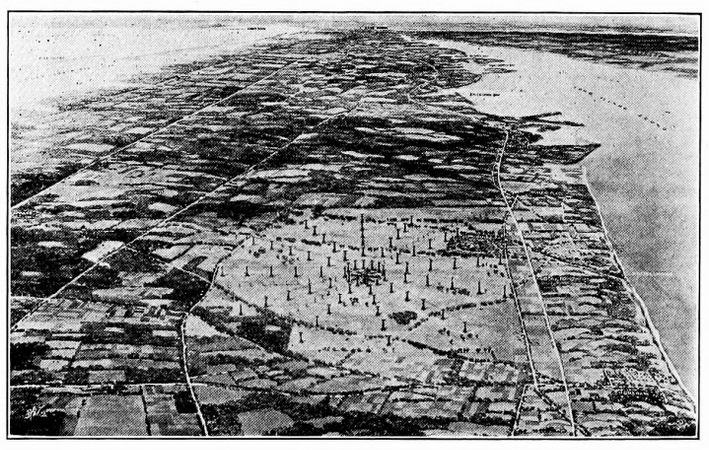
Photo: Artist’s illustration of the proposed RCA Radio Central facility at Rocky Point, showing how the complex would have appeared if all 12 antenna spokes had been completed. Only two of the planned spokes were ultimately built. Illustration from The Book of Radio by Charles William Taussig, 1922.
The Radio Central system occupied thousands of acres at its two Long Island locations, with the much larger transmitting operation at Rocky Point and the receiving station at Riverhead. IEEE identifies Radio Central as the world’s most powerful transoceanic radio facility at the time of its inauguration.
The station officially opened on Nov. 5, 1921, when President Warren G. Harding pressed a button at the White House and sent a telegraphic message through RCA’s international network. Acknowledgments were received at Riverhead from 17 countries, including Japan and Australia.
By 1922, IEEE describes Radio Central as the world’s largest and most powerful communications station. Its network reached California, Hawaii, Wales, East Asia, Europe and South and Central America.
The scale of the Rocky Point operation was substantial. RCA installed two Alexanderson alternators, each weighing about 50 tons, to generate the low-frequency radio signals used for long-distance communications. The machines had been built by General Electric in Schenectady and remained in operation until 1948.
RCA originally planned to install 10 additional alternators, but advances in vacuum-tube transmitters made the expensive expansion unnecessary before it was completed. The decision illustrated how rapidly radio technology was changing even during Radio Central’s early years.
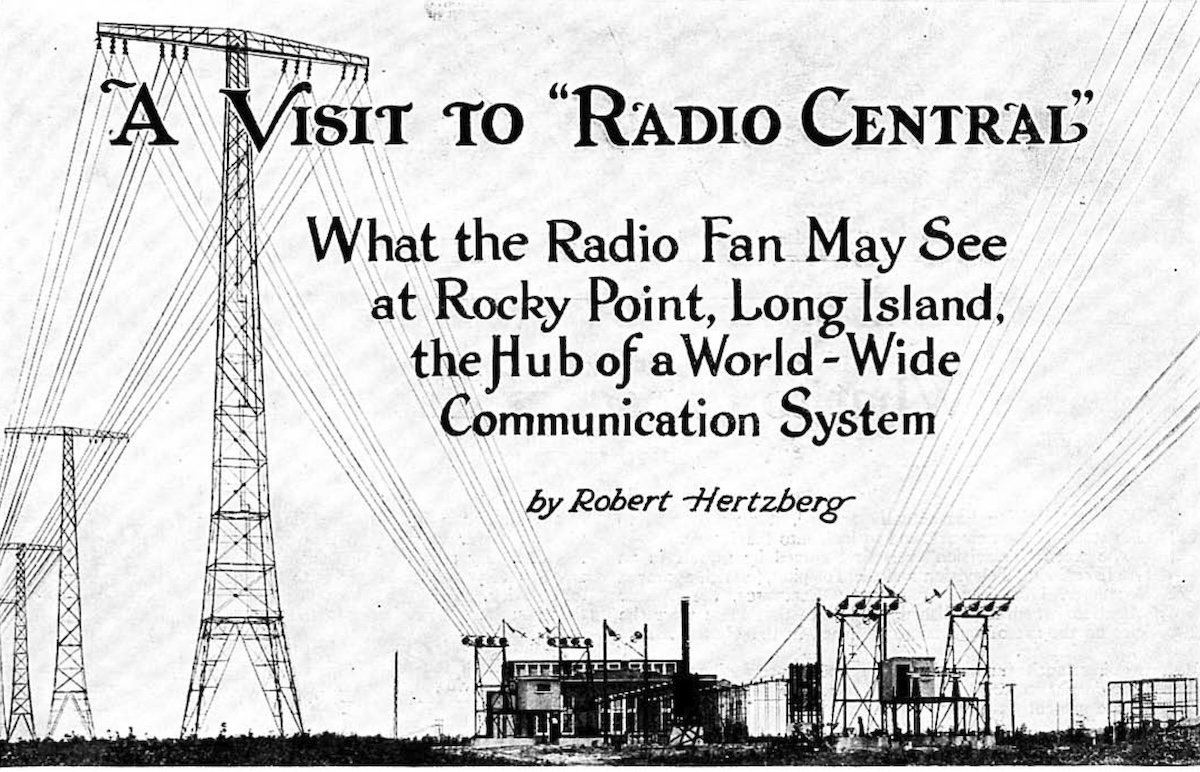
Photo: The main transmitter house at RCA Radio Central in Rocky Point, photographed in 1928 with the station’s 410-foot antenna towers and transmission lines visible around the facility. Radio News, August 1928, via durenberger.com.
The original antenna system included steel towers more than 400 feet high supporting wires that extended for more than a mile across the property. New York State and the Town of Brookhaven have also described towers at the station as reaching 450 feet during its history.
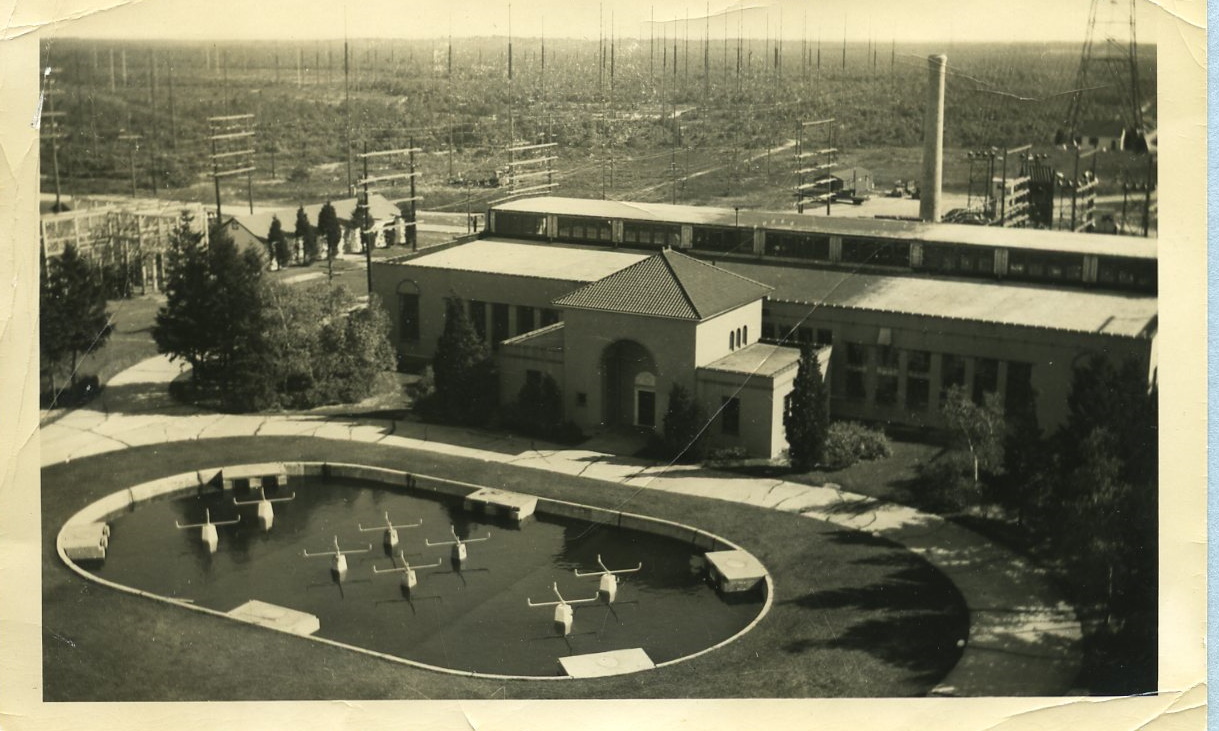
Even some of the landscaping had a practical purpose. A pond with eight water jets outside the administration building formed part of the cooling system for the Alexanderson alternators. As technology changed, the building was later equipped with dozens of high-frequency transmitters.
For a contemporary look at RCA Radio Central, read the November 1925 Radio Broadcast article “Radio Central: Conqueror of Time and Distance,” which includes photographs and a firsthand account of the Rocky Point facility.
Rocky Point also became an important research center. In the early 1920s, engineers used Radio Central to experiment with new methods of long-distance communication, including single-sideband transmission and new antenna designs.
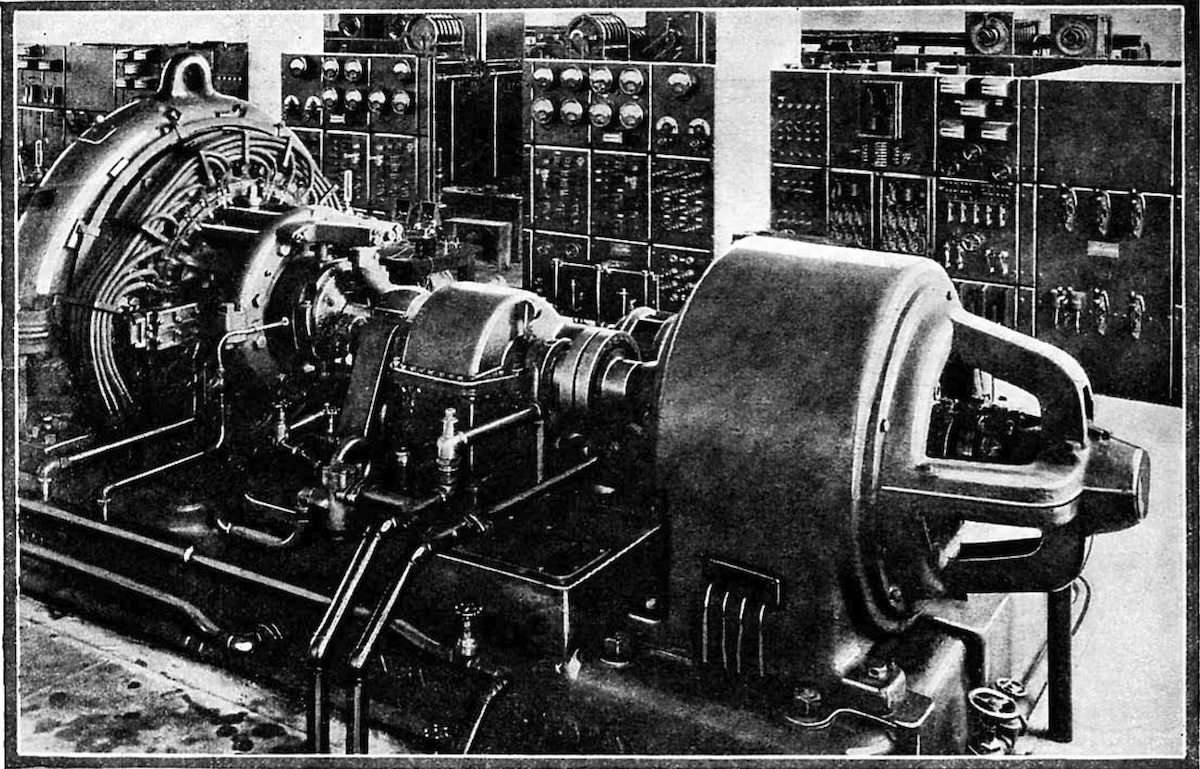
Photo: One of the two 200-kilowatt Alexanderson alternators used at RCA Radio Central in Rocky Point. The massive machines generated the high-frequency currents used by the station’s early transatlantic radio system. Radio News, August 1928, via durenberger.com.
The station was associated with another unexpected piece of broadcasting history. IEEE reports that work at Radio Central included the original National Broadcasting Company television antenna installed atop the Empire State Building, along with the development of high-frequency vacuum tubes and several new antenna designs.
One of Radio Central’s best-known milestones came in November 1924, when RCA transmitted a photograph of President Calvin Coolidge from New York through Rocky Point to London. IEEE identifies it as the first transoceanic facsimile transmission. Two years later, RCA began commercial transmission of photographs for newspapers and weather maps for ships at sea.
Rocky Point played another important role in international communications on Jan. 7, 1927, when commercial telephone service between New York and London officially opened.
See Radio Central as it operated in 1928 in this illustrated Radio News feature, “A Visit to ‘Radio Central,’” which takes readers inside the Rocky Point transmitting station and the separate receiving station at Riverhead.
Because a transatlantic telephone cable did not yet exist, the service depended partly on radio. During tests of the circuit, a caller’s voice traveled by wire from New York City to the transmitter at Rocky Point, then crossed the Atlantic by radio to Rugby, England, before continuing by wire to London.
The return conversation followed a different route. It traveled from London to Cupar, Scotland, crossed the Atlantic by radio to Houlton, Maine, and continued by wire to New York. The Library of Congress identifies the system inaugurated in January 1927 as the first commercially available transatlantic telephone service.
The facility also attracted many of the best-known names in early radio and electrical engineering. According to the New York State Department of Environmental Conservation, visitors to Rocky Point included Guglielmo Marconi, Edwin H. Armstrong, Lee DeForest, Charles P. Steinmetz and Nikola Tesla.
Radio Central remained in operation for decades as communications technology continued to change. By the late 1960s, satellite communications were reducing the importance of large terrestrial radio facilities such as Rocky Point.
RCA ceased operations there in 1978 and donated 5,016 acres of its Rocky Point property to New York State. At the formal transfer ceremony involving the Rocky Point and Riverhead properties, Gov. Hugh Carey presented RCA with a silver dollar as a token payment. That same silver dollar was later given to the Rocky Point Historical Society.
Much of the former station property is now part of Rocky Point Pine Barrens State Forest. An IEEE Milestone commemorating Radio Central is displayed at Rocky Point High School, which stands on former Radio Central property.
Today, much of the former site is known for its woods and trails, but for much of the 20th century it was part of a communications system that connected Long Island with countries around the world.
Sources:
- IEEE Engineering and Technology History Wiki, “RCA Radio Central, 1921-1978”
https://ethw.org/Milestones:RCA_Central,_1921 - IEEE Spectrum, “100 Years Ago RCA Inaugurated Its Global Wireless System”
https://spectrum.ieee.org/history-of-rca-radio-central - Library of Congress, “First Official Transatlantic Telephone Call”
https://www.loc.gov/static/programs/national-recording-preservation-board/documents/FirstTransatlanticTelephoneCall.pdf - New York State Department of Environmental Conservation, “Rocky Point Historical Society and Suffolk County Commemorate Historic Role of DEC’s Rocky Point Pine Barrens”
https://dec.ny.gov/news/press-releases/2021/9/rocky-point-historical-society-and-suffolk-county-commemorate-historic-role-of-decs-rocky-point-pine-barrens - Town of Brookhaven, “Romaine and Bonner Celebrate Unveiling of Sign Commemorating Rocky Point Pine Barrens”
https://www.brookhavenny.gov/m/newsflash/home/detail/2913
Cover photo: “Aerial view of Building #1 at the RCA Radio Central facility.,” Hofstra University Library Special Collections: Digital Collections, accessed October 18, 2026, https://omeka.hofstra.edu/items/show/4201.