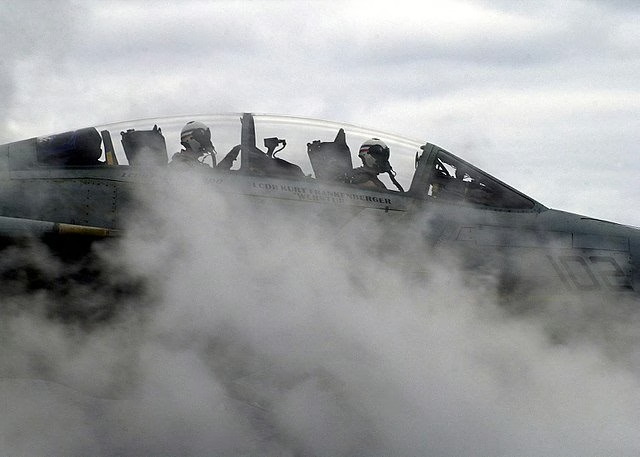
Long before it became a Hollywood icon in Top Gun, the F-14 Tomcat was doing something far more Long Island: being designed, built, and tested right here. From Calverton runways to the skies over the Long Island Sound, this jet wasn’t just famous, it was local.
Here’s where things get interesting.
Specs
The F-14 wasn’t just another fighter jet. It was built to stand out in just about every way.
- The aircraft featured two seats and two engines
- It became the first U.S. jet fighter designed with twin tails
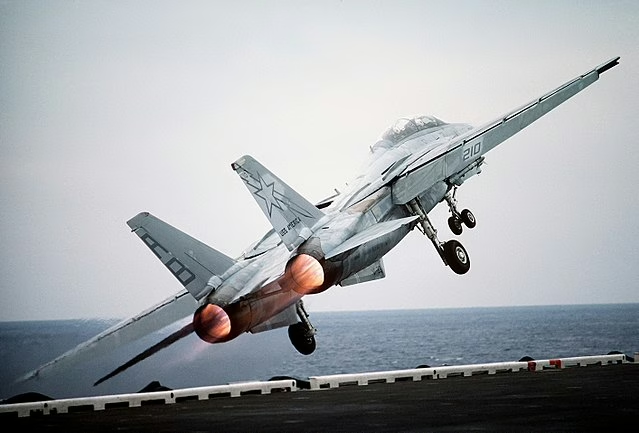
- Its wings could sweep back and forth depending on speed and altitude
- With wings fully extended, the span reached 64 feet, shrinking to 38 feet when swept
- The total length of the aircraft exceeded 62 feet
- It could climb to altitudes above 56,000 feet
- Its onboard systems could track up to 24 enemy aircraft from nearly 195 miles away
- The original operational lifespan was set at 6,000 flight hours and later increased to 7,200
- Each unit cost around $38 million for the airframe and engines alone
- It was capable of flying at speeds beyond Mach 2
- The jet could carry six Phoenix missiles, or a mix of six Sparrow and two Sidewinder missiles
- A full load of six Phoenix missiles earned the nickname “The John Wayne Loadout”
- The aircraft was equipped for mid-air refueling
- It was produced in three variants: F-14A, F-14B, and F-14D
- The A model was the original version, with B and D representing upgraded designs
History
This is where Long Island really comes into play.
- The F-14 was created in the 1960s as a replacement for the F-4 Phantom
- Before it, Grumman worked on the F-111B, a Navy version of the General Dynamics F-111A, which ultimately fell short
- Grumman proposed a new design, leading the Navy to approve 12 preproduction aircraft
- Development included roughly 9,000 hours of wind tunnel testing across about 2,000 configurations
- The first flight took place on December 21, 1970, at Grumman’s Calverton facility
- Early testing flights were conducted over the Long Island Sound
- Grumman’s chief test pilot Robert Smythe flew the aircraft, with William Miller in the rear seat
- A second test flight on December 30 ended in a crash caused by hydraulic pump failure and loss of control
- Both crew members successfully ejected before the crash
- The jet officially entered service in 1974 aboard the USS Enterprise
- It provided air cover during the evacuation of Saigon and was used in conflicts involving Libya, Bosnia, Iraq, Afghanistan, and throughout the Cold War
- Iran ordered 80 aircraft in the late 1970s but received 79 before the 1979 revolution
- F-14s were used to intercept Soviet bombers approaching U.S. carrier groups
- During the 1981 Gulf of Sidra incident, F-14s shot down two Libyan Su-22 aircraft
- In 1989, two more Libyan aircraft, MiG-23s, were downed by F-14s
- A total of 712 Tomcats were built, including 632 for the U.S. Navy and 80 for Iran
- After retirement, the U.S. destroyed most remaining F-14s to prevent spare parts from reaching Iran
- A small number of aircraft were preserved in museums
- The F-14 was eventually replaced by the Boeing F/A-18E/F Super Hornet and the Lockheed Martin F-35C
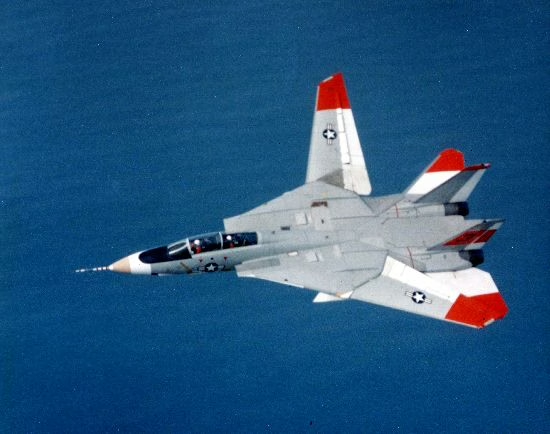
The nickname – Tomcat
Even the name has a story.
- Grumman had a tradition of naming its fighter planes after cats, like the Wildcat and Hellcat
- The name “Tomcat” honored two key supporters of the program: Admiral Thomas H. Moorer and Admiral Thomas F. Connolly
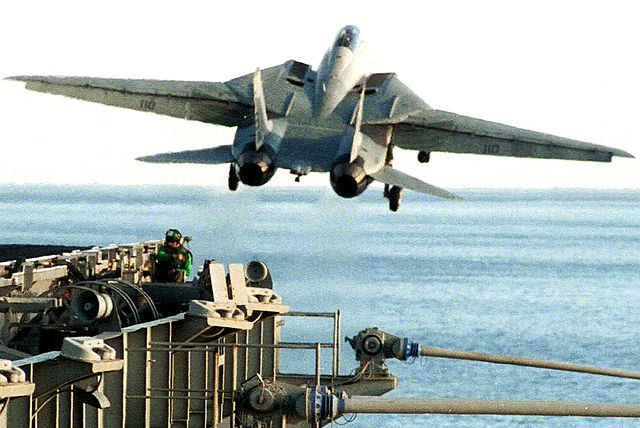
- During landings, the aircraft’s many moving parts, including flaps, rudders, spoilers, and stabilizers, gave it a second nickname, “Turkey,” due to the flapping motion
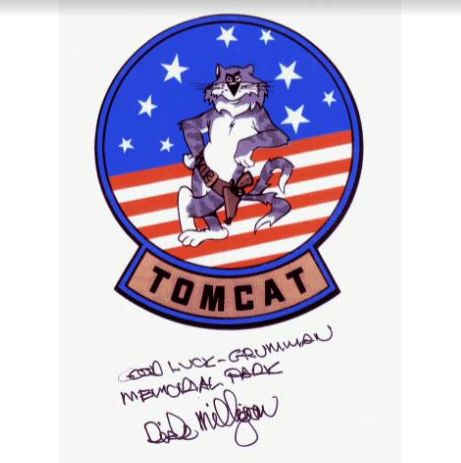
F-14 Tomcat logo created by Dick Milligan. Signed by Milligan. Photo: Provided by Willian Barto.
If you like this story then click here to read “Crazy Facts About the Grumman Apollo Lunar Module Built by Long Islanders”
The famous Tomcat logo
Yes, even that iconic logo has Long Island roots.
- Jim Rodriguez from Grumman searched for a real cat to model the logo
- He eventually photographed a mackerel tabby found at a Bay Shore animal shelter
- After several attempts, the final design still wasn’t quite right
- Fellow employee Dick Milligan created the finished cartoon logo
- Milligan aimed for a simple tomcat with a slightly mischievous expression
- The slogan “Anytime Baby” was developed as a challenge to the U.S. Air Force’s F-15 Eagle
Cool stuff
And then there are the details that make this whole story even better.
- An interactive map exists showing where F-14 aircraft ended up
- May 13 is celebrated as Top Gun Day
- The final American F-14 is expected to be displayed at the Cradle of Aviation Museum on Long Island
- The jet became a pop culture icon thanks to Top Gun starring Tom Cruise
- It later appeared in multiple video games
- Tom Cruise returned to the F-14 for the sequel film
- A dedicated webpage tracks every U.S. squadron that operated the F-14 from 1970 to its retirement in 2006
- There are lists available showing where surviving F-14s are displayed around the world
- The aircraft’s variable-sweep wings were inspired by the way birds fly
- One Tomcat even featured a Playboy Bunny logo on its tail
- Engineers once believed asymmetric wing sweep, where one wing moves independently of the other, was impossible until test pilots proved otherwise
For something that flew faster than sound and fought around the world, the F-14 Tomcat has a surprisingly local origin story. And chances are, you’ve driven past the place where it all began without even realizing it.
Photos: Unless noted, all photos public domain.