In the summer of 1983, television executives looked at the success of Dallas, Dynasty, Falcon Crest, and Knots Landing and came to what seemed like a perfectly reasonable conclusion: America couldn’t get enough wealthy families behaving badly.
Viewers were tuning in by the millions to watch oil barons, business tycoons, and socialites scheme, betray one another, and occasionally commit crimes while wearing expensive clothes. So ABC decided it needed another prime-time soap opera. This one would have power struggles, secret affairs, family rivalries, murder accusations, and enough melodrama to fill a Southampton mansion. It would also have something none of the others had.
It was set in the Hamptons.
At least, that was the plan. For five weeks during the summer of 1983, Long Island was home to its very own prime-time soap opera called The Hamptons. Network executives hoped it would become television’s next big hit. Instead, it became one of the shortest-lived dramas of the era, disappearing almost as quickly as it arrived.
When the Hamptons Became Prime-Time Television
To understand why The Hamptons existed at all, you have to remember what television looked like in the early 1980s.
Prime-time soaps were everywhere. Networks were eager to duplicate the success of shows like Dallas and Dynasty, which attracted massive audiences with stories centered on wealthy families battling over money, influence, and romance. ABC believed Long Island’s East End offered the perfect setting.
The series focused on two wealthy families, the Chadways and the Duncan-Mortimers, who jointly owned a luxury Manhattan department store chain known as Duncan-Chadway. While much of the business drama unfolded in New York City, the families spent their summers in East Hampton, giving the show both its title and its Long Island connection.
The cast featured several familiar television faces, including Leigh Taylor-Young, Bibi Besch, John Reilly, Michael Goodwin, Holly Roberts, and a young Craig Sheffer.
Behind the scenes was Gloria Monty, who had recently transformed General Hospital into a cultural phenomenon. ABC hoped she could bring that same soap-opera magic to prime time.
There was also another unusual choice. Rather than filming the series like a typical prime-time drama, producers shot it on videotape, giving it the visual style of a daytime soap opera. It was an intentional decision, but one that immediately made the show feel different from its competitors.
A Real Long Island Production
Despite what some viewers may assume today, The Hamptons wasn’t just a title. Parts of the series were actually filmed on Long Island’s East End, with scenes shot in and around the Hamptons. Additional filming took place elsewhere on Long Island and in Westchester County.
The premiere aired on July 27, 1983, at 9 p.m., and ABC hoped a limited five-episode run would generate enough interest to justify expanding the series into a regular show. The strategy wasn’t entirely unreasonable.
CBS had successfully used a similar limited-run approach with Dallas several years earlier before that show exploded into a television phenomenon. ABC was hoping lightning might strike twice.
Watch the Original Opening Sequence
One of the few surviving pieces of The Hamptons is its original opening sequence.
Watch the opening intro below:
Long Islanders Weren’t Buying It
The problem was that many viewers felt the show didn’t actually resemble the Hamptons they knew. On premiere night, Newsday sent reporters to the East End to gauge local reaction. The responses were not exactly enthusiastic.
One viewer watching with a group at J.G. Melon in Bridgehampton reportedly dismissed the show as “the worst thing I saw in my life,” arguing that it seemed more interested in hospitals than the Hamptons.
Even Newsday’s own reporters couldn’t resist a little sarcasm.
They noted that viewers enjoyed the opening shots featuring familiar East End scenery, including a Water Mill windmill and Southampton beaches. But they also pointed out that some locations supposedly representing Southampton were actually somewhere else entirely. That criticism would become a recurring theme. Many viewers felt the show captured the appearance of the Hamptons without really capturing its character.
Critics Were Even Less Impressed
Local viewers weren’t alone. Professional television critics were downright ruthless. Newsday television critic Marvin Kitman described the series as a “festival of bad acting” and criticized what he saw as a watered-down imitation of Dallas. In his view, the show simply transplanted the familiar prime-time soap formula from oil fields to department stores while keeping the same cast of scheming, self-interested characters.
And then there was The Washington Post. Its review was so harsh that it almost deserves recognition as performance art. The newspaper described the series as “totally, irredeemably, amateurishly and idiotically worthless.”
The Storylines Only Got More Dramatic
As the series progressed, viewers were treated to exactly the kind of increasingly outrageous storylines that had made other prime-time soaps successful. There were family feuds, boardroom power struggles, secret romances, and clashes between old money and ambitious newcomers. By the fifth and final episode, the drama had escalated considerably.
Peter Chadway found himself accused of murder after the death of department store executive Penny Drake. Meanwhile, family tensions intensified, rival businessman Nick Atwater inserted himself into the Chadway family’s affairs, and one of the show’s most controversial storylines reached a breaking point when Jay Mortimer’s incestuous relationship with his stepdaughter Tracy was finally exposed.
The producers clearly expected viewers to return for answers. Instead, the show ended.
Five Episodes and Gone
Although ratings fluctuated during the show’s brief run, they never generated the kind of momentum ABC needed to justify ordering additional episodes. The fifth installment aired on August 24, 1983. Then the series disappeared.
The murder accusation remained unresolved. The family conflicts were left hanging. The cliffhangers stayed cliffhangers. Unlike modern television shows that often find second lives through streaming services, reruns, or DVD releases, The Hamptons largely faded from view.
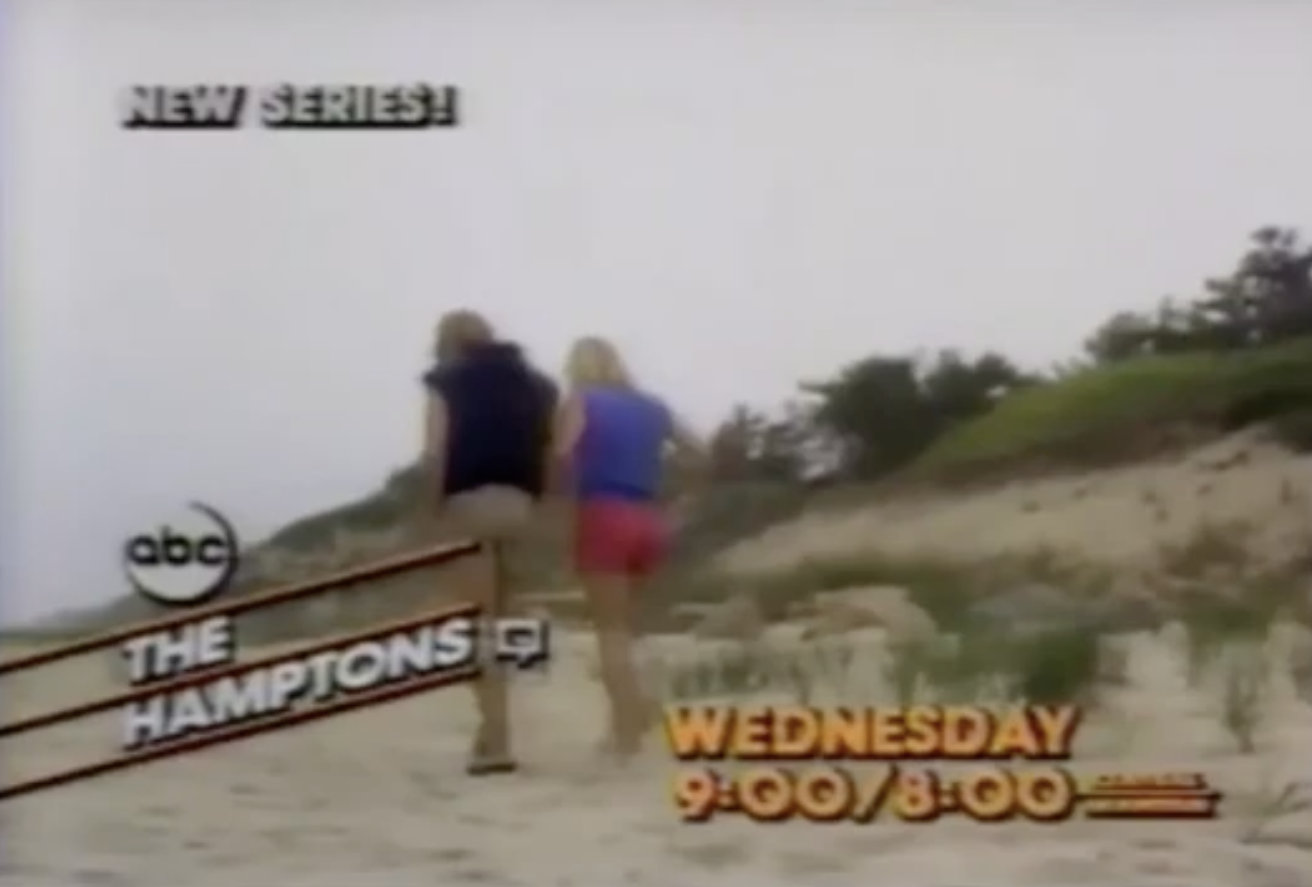
Watch the Original Promo
One of the other surviving pieces of the series is an original promotional trailer.
Watch the promo below:
For most Long Islanders, the existence of The Hamptons comes as a surprise. For one brief summer in 1983, ABC was convinced the Hamptons could become television’s next great battleground of wealth, power, and scandal.
Photo: Screenshot.