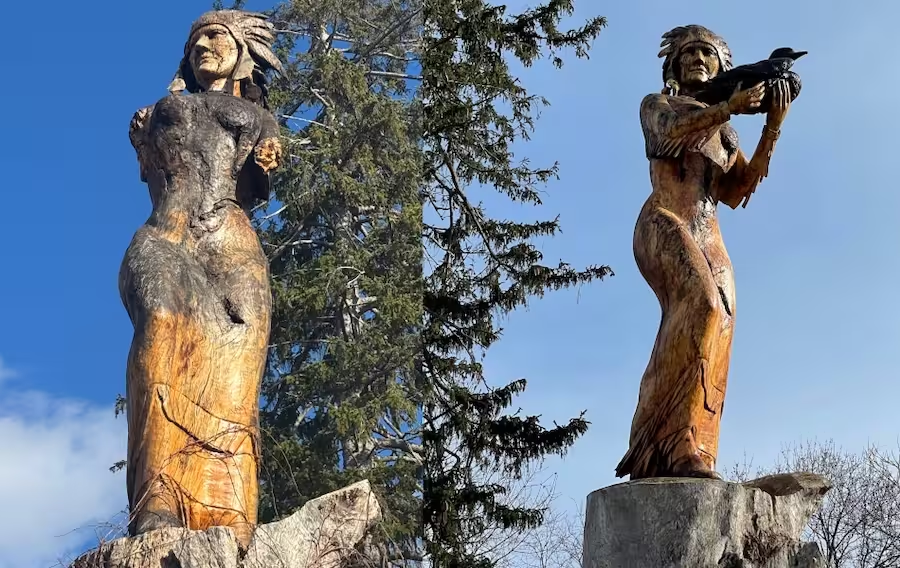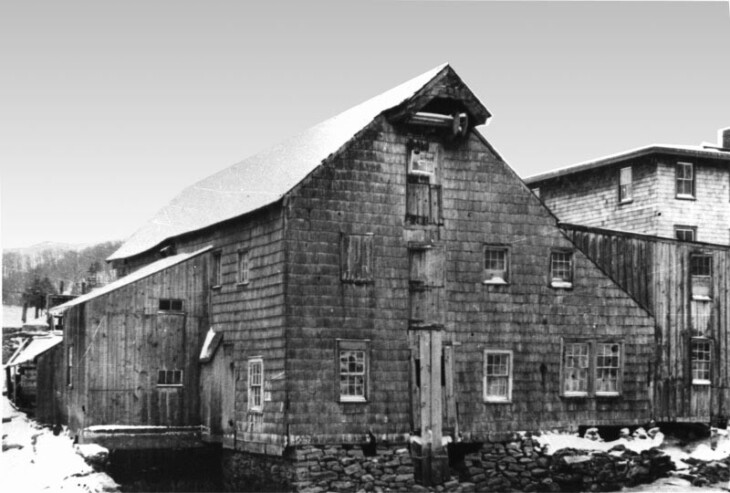
At the head of Hempstead Harbor in Roslyn, a wooden structure has has remained in place through centuries of conflict, changing economies and repeated rebuilding. The Roslyn Grist Mill was not simply part of the village’s history. For long stretches, it was the center of it.
The structure is a rare example of Old World Dutch construction, using traditional Dutch building methods that have largely disappeared from Europe. It is one of the last surviving Dutch-type water mills in the United States and was built as a commercial milling operation rather than an agricultural structure.
Click here for more stories about Long Island’s historic landmarks.
Its origins trace back to April 2, 1698, when John Robinson received permission from the Town of Hempstead to build a grist and fulling mill on the stream at the harbor’s edge. The agreement required that he complete construction within two years and process grain for local residents as payment for a fixed portion of what was milled. When Robinson failed to meet that deadline, the town voided the grant in 1701.
The project did not end there. By 1709, a mill had been built and was operating. Robinson and his wife transferred the property, including the dam and mill, to Charles Mott for 100 pounds. The early structure was likely constructed from heavy timber likely sourced locally and transported to the site using animal labor. Accounts describe Robinson as a skilled woodworker, possibly even a shipbuilder, and the interior of the mill has long been noted for its resemblance to the frame of an old vessel.
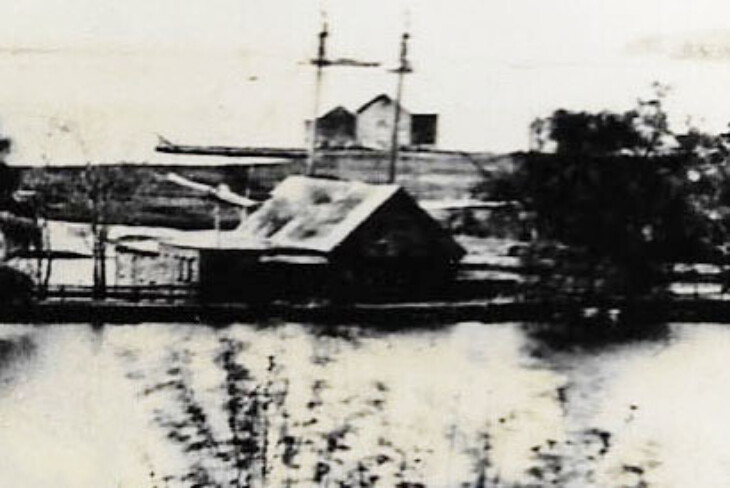
From Roslyn Landmark Society: This photo of Silver Lake was taken from the backyard of Henry Western Eastman House at 75 Main Street dated 1870. A close-up shows the Roslyn Grist Mill with a very narrow Mill Dam Road. A two-mast schooner was docked behind the mill.
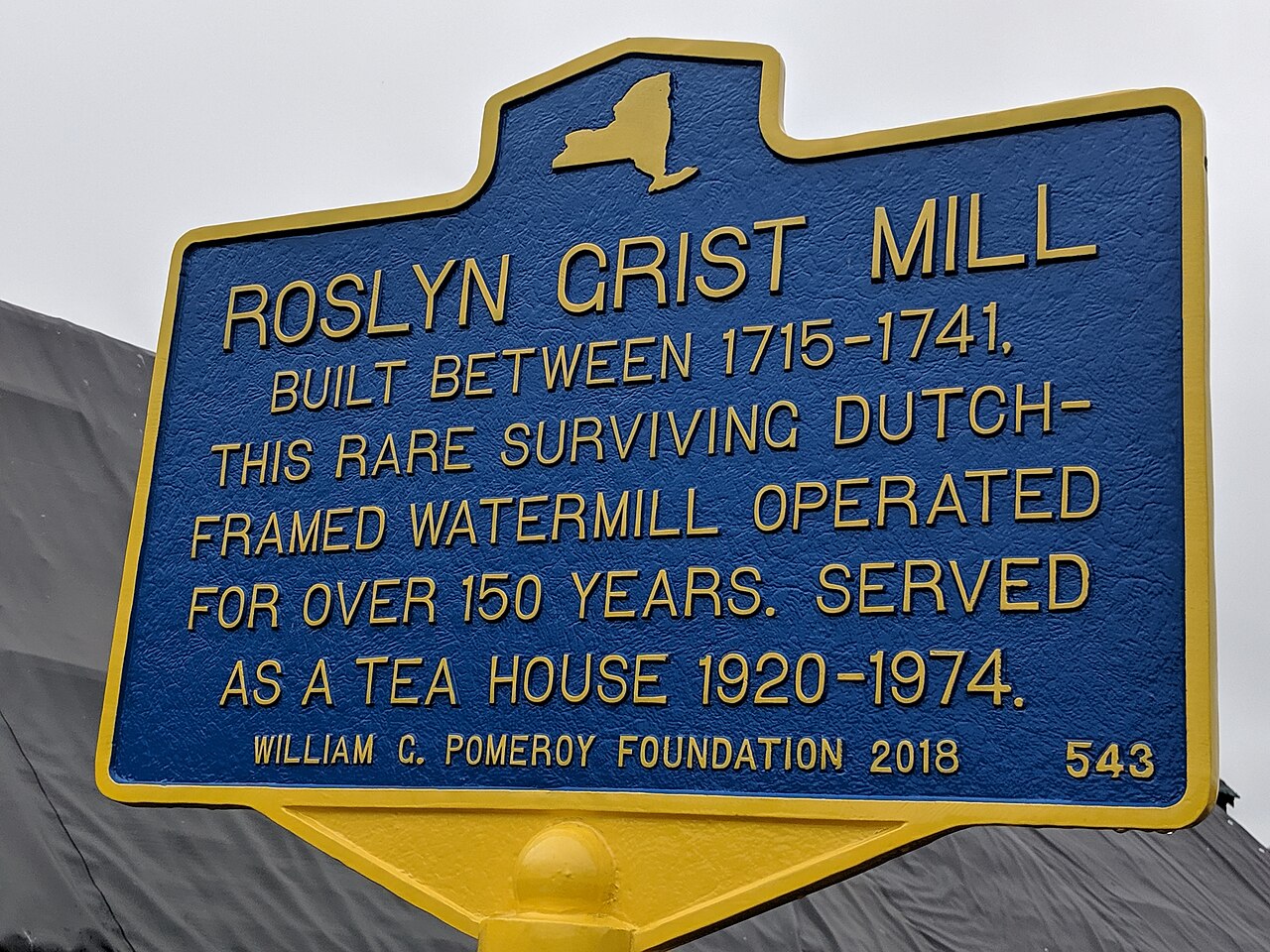
The mill quickly became central to daily life in the area. Farmers brought grain to be ground into flour, lifting grain to storage above before feeding it downward through fabric chutes into the grinding system. The machinery included millstones made from buhrstone, a porous material imported from France, and required periodic maintenance by traveling specialists known as “chippers,” who shaped the stones for different grinding needs. Winnowing was done by hand, and some of those original tools were preserved in the building. The mill would continue operating as a working watermill for more than 150 years.
Video of the Roslyn Grist mill through the years:
Its position along the harbor made it more than a local operation. Ships began delivering grain from across Long Island Sound, tying up at an iron ring still visible on the harbor side of the structure. The mill was part of a larger network of transport and trade, connecting Roslyn to New York and beyond.
Ownership passed through several hands in the 18th century, including Charles Mott, Jeremiah Williams, Thomas Pearsall and John Pine. Williams made significant improvements after acquiring the property in 1715, expanding the mill, increasing the height of the dam and adding multiple bolting mills along with surrounding buildings and land.
Watch: Three-minute video documents the lifting of historic 1700s Roslyn Grist over four days in January 2020. The building was lifting eight feet to allow the construction of a new foundation.
In 1758, Henry Onderdonk purchased the property for 1,100 pounds, reflecting a dramatic increase in value over the previous decades. Under his ownership, the mill expanded beyond local service. Mills like this one played a key role in New York’s colonial economy, producing flour from local grain that was sent to New York City, where it was inspected, traded and sent onward through New York markets and distributed to Caribbean trade routes. Onderdonk’s operation supplied both local needs and this broader export trade.
The site drew notable attention. In 1790, George Washington visited Roslyn and recorded the mill in his diary. During that visit, he toured both the paper mill and the grist mill and observed their operations.
The period was not without contradiction. Records indicate that members of prominent local families, including the Onderdonks, enslaved people, reflecting the broader realities of the time.
For more Roslyn history click here to visit the Roslyn Landmark Landmark Society.
The mill continued to operate profitably through the War of 1812, when demand increased earnings. That prosperity declined after the opening of the Erie Canal, which allowed western grain to reach New York more efficiently and reduced the reliance on local milling operations.
By the mid-19th century, the property changed hands again. In 1828, John Willis Jr. acquired the mill, and around 1850, Joseph Hicks purchased it for his eldest son, Benjamin. The Hicks family would operate the mill for decades and become closely associated with its later history.
From 1849 to 1916, members of the Hicks family, including Benjamin D. Hicks, owned and ran the mill. During this period, the site became connected to the Underground Railroad. The Hicks family had a documented history of assisting people escaping slavery. According to historian Kathleen G. Velsor, escapees were led under cover of darkness to boats waiting along the harbor behind the mill. At high tide, the vessel could leave Hempstead Harbor and move into Long Island Sound, continuing northward toward safer destinations.
Historic Roslyn Grist Mill undergoing restoration in 2019, before elevation to street level | Wikipedia (below for credit)
Other locations in Roslyn, particularly houses along Main Street, are believed to have provided temporary shelter before these departures.
The mill remained part of the village’s working landscape even as transportation evolved. Sloops such as the Lark and the Rambler carried goods and passengers between Roslyn and New York, docking near the mill. Stage routes and early mail delivery systems also connected the area, with the mill serving as a recognizable landmark along those routes.
The surrounding community grew with it. Early records note that the first schoolhouse in Roslyn stood at the west end of the Grist Mill Dam, further reinforcing the mill’s central role in the development of the village.
In 1916, Isaac Hicks, the last private owner, transferred the property to a board of trustees with the intention that it be restored and used as a museum of industrial arts. The board included Harold Godwin, grandson of poet William Cullen Bryant, along with Albertson Hicks, G. Lester Eastman, John H. Love and Henry D. Walbridge.
A major restoration followed, completed in part in 1917. Workers reinforced the structure, preserved original beams, patched clapboards and installed concrete elements designed to replicate the appearance of aged wood. The undershot water wheel, wooden gears and much of the original grinding machinery were retained.
The building then entered a new phase. The restored mill opened as a museum on June 30, 1917. Beginning in 1919, it was operated under the management of Alice C. Titus, who oversaw its use as a museum and later as a tea room. For years, it drew guests from across Long Island and beyond, displaying artifacts such as spinning wheels, candle molds, sundials, hourglasses, lace garments and historical uniforms.
The mill eventually closed to the public in 1974.
In 1986, the mill was placed on the National Register of Historic Places. In recent years, restoration efforts have resumed. The structure, owned by Nassau County and managed by the Roslyn Landmark Society, is considered one of the oldest surviving Dutch commercial structures in the United States.
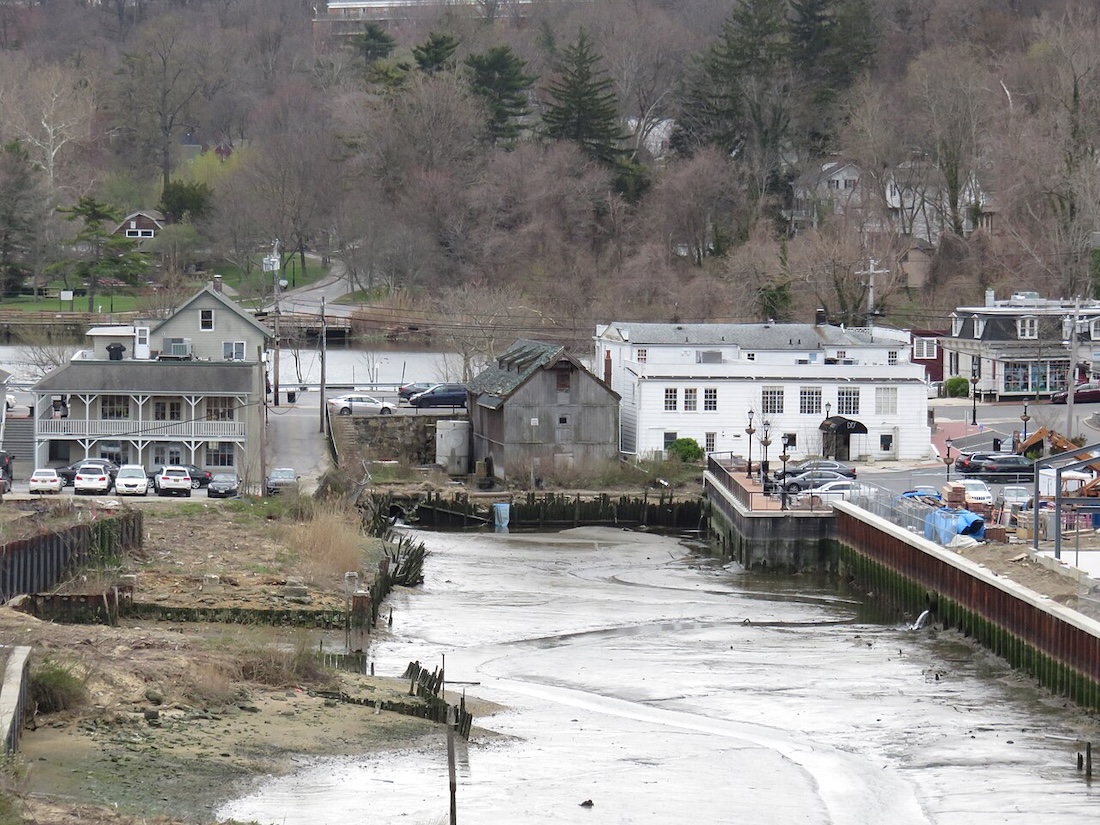
Roslyn Grist Mill viewed from the Roslyn Viaduct in Roslyn, New York in 2016 | Wikipedia (see below for credit)
In 2020, the building was raised using hydraulic jacks to allow for a new foundation. During that work, crews uncovered a time capsule embedded in a 1917 concrete floor. Inside a small milk bottle were four coins, including an 1863 Civil War issue, an 1863 Haitian centime, an 1881 Indian Head penny and a 1905 Indian Head penny, along with two letters. One was written in English by Stephen Speedling, a local carpenter. The other, in Italian, was from Romolo Capparrelli, who identified himself as the designer of the mill’s concrete roof.
In April 2026, Nassau County delivered the second installment of a $2 million capital funding plan to support the ongoing restoration. The project includes siding, windows, doors and structural and accessibility upgrades. The goal is to reopen the mill as a museum, where visitors will be able to see how grain was processed and how the building functioned within the early economy of Roslyn.
From its initial grant in 1698 to its current restoration, the Roslyn Grist Mill has remained a constant presence at the harbor’s edge. Its function has changed over the centuries, but its presence in the life of the village has remained constant.
For more history of Roslyn and the Grist Mill visit the Roslyn Landmark Society website.
Sources
- Spier, Sydney. “The Roslyn Grist Mill and the Underground Railroad in Roslyn.” Long Island Press, August 4, 2025.
- Fuentes, Larissa. “Nassau County delivers final $1M for Roslyn Grist Mill restoration.” Long Island Press, April 27, 2026.
- CBS New York. “Crew Restoring Historic Roslyn Grist Mill Finds 100-Year-Old Time Capsule With Messages From Original Builders.” November 30, 2020.
- CBS New York. “Nassau County Moves Full Speed Ahead With Restoration Of 300-Year-Old Roslyn Grist Mill.” January 23, 2020.
- Hooper, Ben. “103-year-old time capsule found in New York state landmark.” UPI, December 1, 2020.
- Brower, Marion Willets. The Story of Roslyn Grist Mill. Roslyn Landmark Society archival text.
- Overton, Jacqueline. Long Island’s Story, p. 70.
- Roslyn Landmark Society. “Roslyn Grist Mill (Roslyn Mill Tea House).” RoslynLandmarks.org.
Photo credits:
- Antony-22, CC BY-SA 4.0, via Wikimedia Commons (2016 photo)
- CaptJayRuffins, CC BY-SA 4.0, via Wikimedia Commons (sign)