If Long Island had a crown jewel for sports history, Belmont Park would be wearing it proudly. Every June, the racetrack in Elmont becomes the center of the horse racing universe as it hosts the Belmont Stakes, the final and most grueling leg of the Triple Crown. When a three-year-old thoroughbred shows up with wins at the Kentucky Derby and the Preakness, all eyes turn to Long Island to see whether history is about to be made.
But Belmont Park is more than one famous race. Its story weaves together Gilded Age money, early aviation, subway construction, legendary horses, record-breaking crowds, and even a Japanese pine tree planted before the Civil War. You don’t need to head to Saratoga to experience horse racing history. Just follow the border of Nassau County and Queens and step onto a track that has been shaping American sports since the 19th century.
Here are the facts that make Belmont Park one of the most fascinating—and downright unexpected—sports venues on Long Island.

Portrait of August Belmont / Daguerreotype [public domain]
The race before the racetrack
-
The Belmont Stakes was first run in 1867 at Jerome Park Racetrack in the Bronx.
-
It is the oldest of the three Triple Crown races.
-
The first-ever winner was a horse named Ruthless.
-
The race was named for August Belmont I, the businessman who helped finance it.
-
The Belmont Stakes was originally run clockwise.
-
In 1921, the race switched to the counter-clockwise direction still used today.
-
Sir Barton became the first Triple Crown winner in 1919.
-
In 1890, the Belmont Stakes moved to Morris Park Racecourse, also in the Bronx.
Building Belmont Park
-
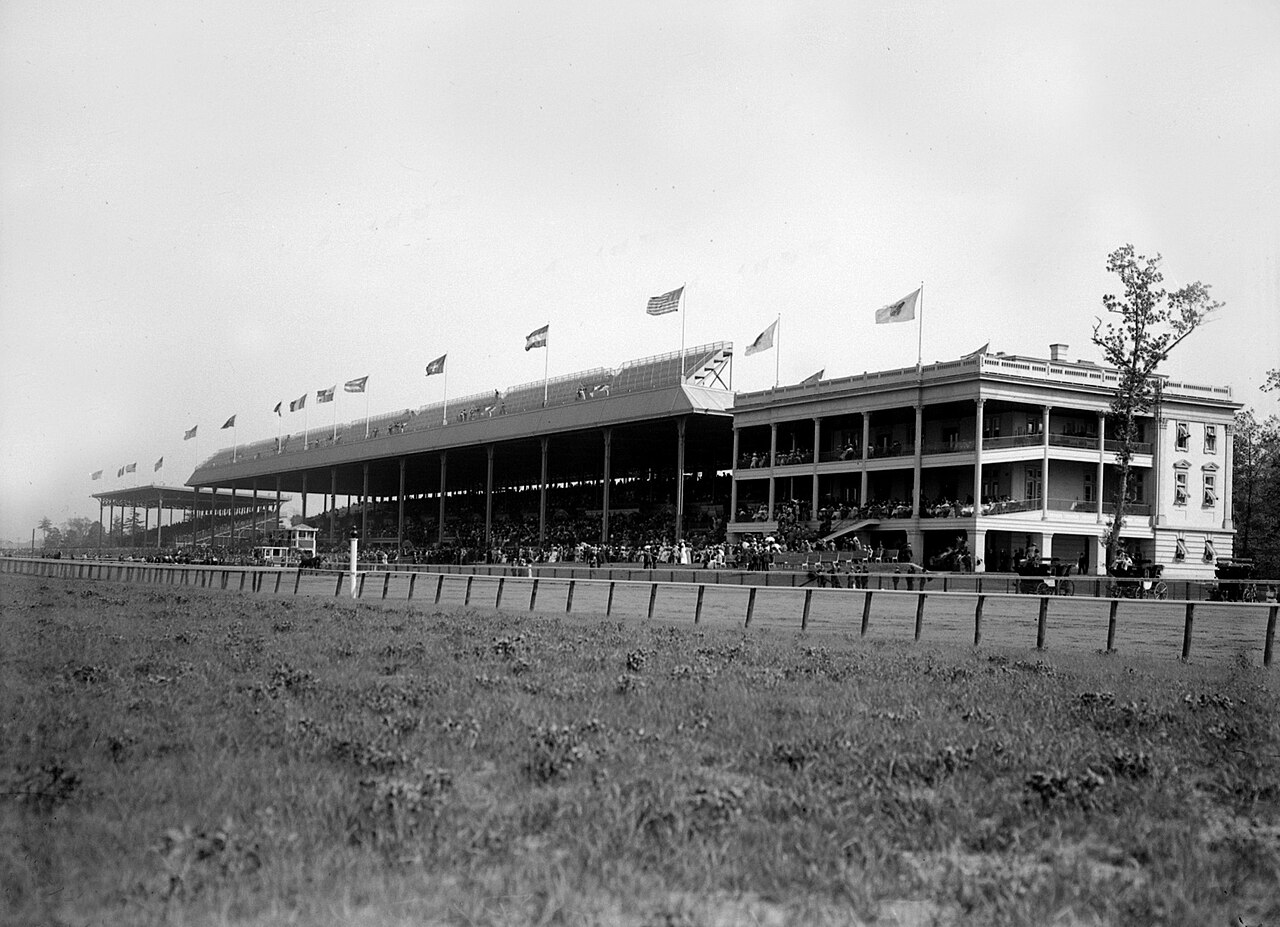
Belmont Park Racetrack officially opened on May 4, 1905.
-
It was built by a group of investors that included August Belmont II.
-
The land was originally known as Foster’s Meadow.
-
The site once housed a Tudor-Gothic mansion owned by William de Forest Manice.
-
Belmont Park was named for August Belmont I and became the permanent home of the Belmont Stakes when it opened.
-
The original park cost $2.1 million to build.

Photo: Crowd watching seven planes in air at Belmont Park air show, New York [public domain]
Not just horses
-
In 1910, Belmont Park hosted the International Aviation Tournament air show.
-
The event was staged by Wilbur and Orville Wright.
-
It included a race from Belmont Park to the Statue of Liberty and back.
-
There was once a nearby racetrack called Belmont Park Terminal.
-
August Belmont II also helped finance the original New York City subway system.
-
From 1911 to 1912, a New York State law banning gambling forced racing at Belmont Park to shut down.
-
Racing resumed at the track in 1913.
-
In 1918, Belmont Park served as the New York City terminal for the first airmail service between New York and Washington, D.C.
Legends of the track
-
In 1973, Secretariat ran the Belmont Stakes in a world-record time of 2:24 on a dirt track.
-
Secretariat won that race by an astonishing 31.5 lengths.
-
A blue-and-white striped pole on the track marks the exact 31.5-length distance from the finish line.
-
Ruffian, a legendary filly who was euthanized after a race at Belmont, is buried beneath the track’s flagpole.
-
Ruffian’s grave is positioned with her nose pointed toward the finish line.
Big Sandy and big crowds
-
Belmont Park’s dirt track is nicknamed “Big Sandy.”
-
It is the longest dirt thoroughbred racetrack in North America.
-
The main track has a circumference of 1.5 miles, or 2.4 kilometers.
-
After a major rebuild in 1968 costing $30.7 million, Belmont Park became home to the largest grandstand in Thoroughbred racing.
-
Julie Krone became the first woman to compete in the Belmont Stakes in 1991.
-
The largest crowd in Belmont Park history was 120,139 people in 2004.
-
That same race saw Birdstone upset Smarty Jones, denying a Triple Crown.
Traditions and hidden details
-
The blanket draped over the Belmont Stakes winner is made from 700 carnations.
-
A Japanese White Pine on the grounds was planted in 1826.
-
That pine tree is featured in the Belmont Park logo.
-
Iron gates from Jerome Park Racetrack depicting the first Belmont Stakes are still displayed inside the Belmont Park clubhouse.
-
Belmont Park actually extends into Queens along its western edge.
Featured image: Photo by Dave Mock. [Public Domain]