If you think Long Island’s newest real estate gold rush is about waterfront condos or warehouse space, think again.
Cannabis.
The latest example landed this week in Riverhead, where a property approved for a cannabis dispensary sold for $6.4 million. According to an exclusive report in Long Island Business News, the building at 840 Old Country Road was purchased by cannabis entrepreneur Dave Patel, who plans to create a new dispensary at the location. The site had previously been occupied by Carzmetics Auto Salon.
And that’s just one piece of a much bigger story.
Across Long Island, legal cannabis shops are slowly opening, tribal dispensaries are already operating, and the industry is quickly becoming one of the most unusual new businesses on the Island.
Here are some crazy facts about the cannabis boom on Long Island.
- The property approved for a cannabis dispensary in Riverhead just sold for $6.4 million, one of the highest cannabis retail real estate prices on Long Island.
- Another cannabis-related property nearby sold for even more overall money. In 2024, an affiliate of the owners of Strain Stars purchased a 14,400-square-foot building on Old Country Road in Riverhead for $9 million.
- Strain Stars operates one of Long Island’s best-known legal recreational dispensaries and has locations serving customers in both Riverhead and Farmingdale.
- Legal recreational cannabis became available in New York after the state passed the Marijuana Regulation and Taxation Act in 2021.
- Even with legalization, Long Island still has relatively few dispensaries compared with the rest of New York State.
- Suffolk County alone has already generated millions of dollars in tax revenue from cannabis sales.
- Beleaf opened its Medford cannabis dispensary at 262 Middle Island Road on Friday, March 6, 2026, more than a year after getting its state license.
- The Medford shop is Beleaf’s second Long Island dispensary after its 2024 opening on Middle Country Road in Calverton, and the company now operates three dispensaries total, including one in Brooklyn.
- There are now four cannabis retail shops in Brookhaven, according to a state list cited by Newsday.
- Roughly 18 cannabis stores are open on Long Island as part of New York’s billion-dollar cannabis market, according to state data cited by Newsday.
- Hugo Rivas of the Long Island Cannabis Coalition said Beleaf’s opening should help Brookhaven tax revenue and further normalize cannabis on Long Island by reducing stigma around the now-legal drug.
- Canna Blooms in Brookhaven received a special permit in June 2025 and opened about six months later, while Long Island Cannabis Club in Babylon went through a yearlong building permit process before opening at the end of 2024.
- New York legalized recreational marijuana in 2021, and four Long Island towns opted into legal retail cannabis sales: Brookhaven, Babylon, Southampton and Riverhead.
- Southampton requires dispensaries to obtain a special permit and limits them to two of its eight commercial business districts.
- Riverhead requires dispensaries to be at least 1,000 feet from schools, which is double the state requirement.
- In Brookhaven Town, dispensaries are limited to industrial areas.
- Riverhead, Brookhaven and Southampton are three of the four Long Island towns that allow dispensaries, Babylon is the fourth, and Babylon is not part of the lawsuit.
- Dispensaries on Native American reservations are not subject to state regulations.
- Abandoned office buildings at Grumman Aerospace’s former Calverton plant have been proposed for redevelopment into an indoor cannabis cultivation facility.
- The proposed Calverton grow site is a 20-acre property on the south side of Grumman Boulevard with three buildings constructed between 1960 and 1988.
- The buildings have been vacant since Grumman closed the site in 1996, when the former facility had been used by the U.S. Navy to assemble and test fighter jets.
- Signature Partners presented preliminary plans for the cannabis grow facility at a Central Pine Barrens Commission meeting on Jan. 21, 2026.
- Cannabis has been classified as a Schedule I drug under the federal Controlled Substances Act of 1970 for more than 50 years, placing it in the same federal category as heroin. Reuters reported in December 2025 that President Donald Trump was considering reducing cannabis to Schedule III.
- James Mallios of Southampton dispensary Charlie Fox said federal reclassification could be game-changing for Long Island’s legal cannabis retailers by lowering tax bills, reducing stigma, and opening more banking options with lower fees.
- Taylor Randi Lee of the New York State Office of Cannabis Management said a federal schedule change would not be expected to alter how New York enforces cannabis possession laws or unlicensed sales.
- Attorney Jason Little said a schedule change would not make cannabis less illegal, but less punishable.
- Kim Stetz of Southampton dispensary Brown Budda said easier access to working capital would make cannabis businesses more sustainable. Cannabis analyst Frederico Gomes said rescheduling would make the industry more profitable and could create more competition among capital providers, improving borrowing terms for operators. Çannabis retailers currently cannot take credit card payments because banks largely avoid the industry.
- Yuvraj Singh, CEO of Strain Stars, said federal reclassification could make cannabis-curious consumers more comfortable trying marijuana.
- Huntington opted out of recreational cannabis sales in 2021.
- Islip Town Supervisor Angie Carpenter said in December 2025 that she had no plan to change her position on opting out.
- Long Island cannabis dispensaries charged an average of $41 for 3.5 grams in 2024, which the New York Post reported was the highest average price per unit in New York.
- The New York Post reported that Long Island accounted for 11 percent of statewide retail cannabis sales while representing just 3 percent of dispensaries.
- The Post also reported that Long Island had only about six legal dispensaries across Nassau and Suffolk at the time of that story.
- According to the Post, pot prices in New York had fallen an average of 17 percent since legal sales began in late 2022.
- The Post reported that Long Island dispensaries generated more retail cannabis revenue than New York City, the Hudson Valley and every upstate region despite having far fewer stores.
- The Post said Suffolk County collected nearly $4 million in tax revenue from dispensaries in 2024, citing figures from the Office of Cannabis Management and the Suffolk Comptroller’s Office.
- The Post reported that each Long Island cannabis storefront averaged about $20 million in sales.
- Under New York law, adults 21 and older may buy, possess and use marijuana or cannabis products, though cannabis remains illegal under federal law. New York law allows an individual to possess up to 3 ounces of cannabis or 24 grams of concentrated cannabis for personal use.
- New York law allows one adult to transfer cannabis to another qualifying adult as long as no compensation is involved.
- New York law allows individuals to possess cannabis paraphernalia.
- A household may grow up to 3 mature and 3 immature cannabis plants if they are kept secure and inaccessible to anyone under 21.
- It remains a crime in New York to drive while impaired by marijuana or cannabis products. New York law enforcement officers can no longer use the smell or presence of marijuana alone as the basis for an arrest or a more intrusive search except in cases involving suspected drug-impaired driving.
But the legal dispensaries are only part of the story. Long before many state-licensed stores opened, cannabis was already being sold on Long Island’s Native American reservations.
- The Shinnecock Indian Nation opened Little Beach Harvest in Southampton in 2023, the first tribally owned and operated cannabis dispensary in Suffolk County.
- The dispensary sits at 56 Montauk Highway on tribal land and sells a range of cannabis products sourced from Indigenous brands.
- Tribal dispensaries operate under sovereign nation rules, which means they can sell cannabis independently from the state’s licensing system.
- The Shinnecock reservation also hosts cannabis smoke shops and related businesses that have sold cannabis-related products for years.
- Another well-known cannabis retail area on Long Island sits on the Poospatuck Reservation in Mastic, where smoke shops and dispensaries have long sold cannabis products and smoking accessories.
- The Poospatuck Tobacco and Herb Center is one of several shops on the reservation offering cannabis products including flower, edibles, concentrates and vapes.
- The result is a strange and uniquely Long Island cannabis map.
- Legal state-licensed dispensaries are slowly appearing in towns like Riverhead and Farmingdale.
- At the same time, tribal dispensaries and smoke shops on the Shinnecock and Poospatuck reservations have been selling cannabis products for years, often attracting customers from across the region.
- Add in high property values, tight zoning rules, and some towns that still resist dispensaries altogether, and the Long Island cannabis market is shaping up to be one of the most unusual in New York State.
One thing is clear. Whether it’s farmland in Riverhead, storefronts along Route 110, or tribal land in the Hamptons, the green rush has officially arrived on Long Island. And judging by the real estate prices, it’s only getting started.
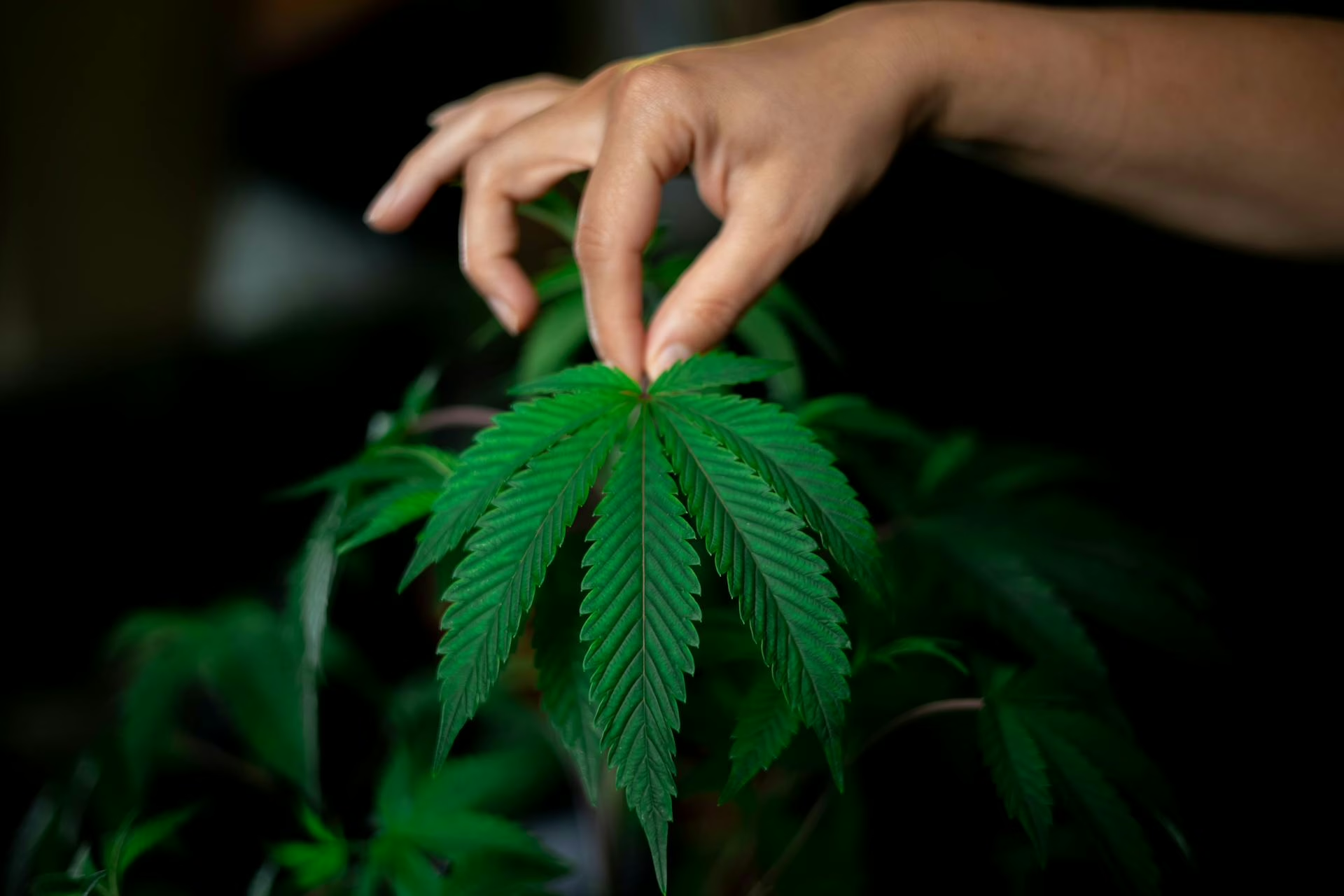
Photo by Kindel Media.