by Lan Chan
Long Island is usually your typical suburb (the first actually – see number 5 below!) But once you actually look into its history, you find some strange things (see number 4 below!). There are abandoned mansions, failed racetracks, giant ducks, and even places tied to kings and conspiracy theories. Here are some of the strangest Long Island stories that most people don’t know about.
1. There’s a random set of mansion ruins in the woods that belonged to a king
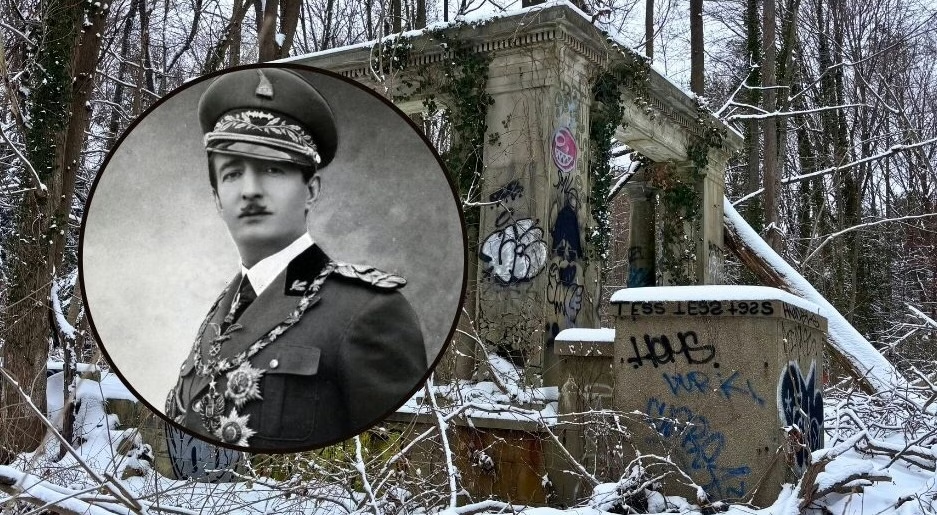
If you go to Muttontown Preserve, you might walk past huge stone staircases and broken structures in the middle of the woods. It looks out of place, and that’s because it is.
These are the remains of the Knollwood Estate, a massive mansion built in the early 1900s for a wealthy Wall Street businessperson. The house had around 60 rooms and sat on over 260 acres, which already sounds extreme.
Click here for more stories about Long Island’s historic landmarks.
Then it gets weirder. In 1951, the estate was bought by King Zog I, who was forced out of his country during World War II. He planned to move to Long Island and basically recreate a royal life here.
He never ended up living there. Because of immigration issues and other problems, the mansion sat empty. People began spreading rumors that there was treasure hidden inside, leading to break-ins and vandalism. Eventually, the whole mansion was demolished.
Now all that’s left are ruins in the woods, and most people walking by have no idea they’re looking at what used to be a royal estate.
2. Long Island built a racetrack that only lasted 113 days
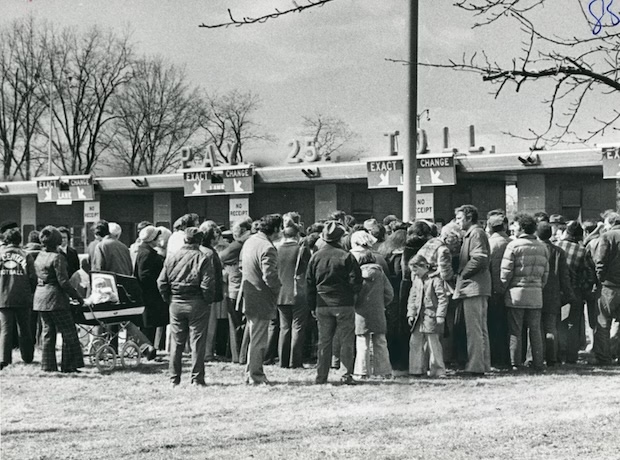
In the 1970s, developers built a horse racing track in Yaphank called Suffolk Meadows (also known as Parr Meadows). The idea was to create a big entertainment destination on Long Island.
It opened in 1977 and failed almost immediately.
The racetrack shut down after just 113 days because of financial problems. That’s barely a season. They tried to bring it back in 1986, but it failed again within months.
The weird part is what happened in between. In 1979, the site hosted a 10th Woodstock anniversary concert. Thousands of people showed up, and for one day, this failed racetrack became a huge music event.
Today, the land is completely redeveloped with stores and buildings. If you drive past it, you will never guess any of this happened there.
Click here to read more about Suffolk Meadows
3. There’s a giant duck on the side of the road, and it actually makes sense
The Big Duck in Flanders looks like a joke at first. It’s literally a building shaped like a duck.
But it’s actually tied to a real industry. Long Island used to be one of the biggest duck-producing areas in the country. At one point, farms in Suffolk County were producing about two-thirds of all the ducks eaten in the U.S.
The Big Duck was built in 1931 by a duck farmer to sell ducks to passing drivers. Although it looks random, it was early roadside marketing.
The weird part is how big the duck industry was. Millions of ducks were raised every year, and it was a huge part of Long Island’s economy. Over time, pollution and environmental issues helped shut down most of it. The Crescent Duck Farm in Aquebogue has been around since 1908 and is still operating, even after surviving the avian flu outbreak a couple of years ago. In fact, it’s the only remaining duck farm in the New York region.
So yeah, the giant duck looks funny, but it represents a huge piece of Long Island history.
Click here to read more about the history of the Big Duck.
4. There’s an old military base that turned into a conspiracy hotspot
Out in Montauk, there’s a place called Camp Hero State Park. Today it’s a park, but it used to be a military base.
During World War II and the Cold War, it was used for coastal defense and radar systems. There were massive guns, hidden bunkers, and structures designed to protect New York.
That alone is interesting, but Camp Hero is also known for conspiracy theories. Some people believe secret experiments were done there, including mind control projects. It’s often linked to the so-called “Montauk Project,” even though there’s no real proof.
The site also inspired parts of Stranger Things, which is why it feels familiar to many people.
Now it’s just a park, but when you see the old structures still standing, it doesn’t feel completely normal.
Want to know more amazing facts about Camp Hero? Click here!
5. Long Island helped create the first suburbs in America
This one sounds less crazy at first, but it actually changed the entire country.
After World War II, Levittown was built on Long Island. It was one of the first mass-produced suburbs in the U.S.
Houses were built super fast, sometimes one every 16 minutes, using assembly-line methods. It made home ownership cheaper and more accessible for many families.
But it also came with problems. Early Levittown had strict racial restrictions and limited who could live there. So, while it helped shape modern suburbs, it also reflects some of the inequalities of that time.
Long Island might look normal on the surface, but its history is anything but. You have an exiled king who almost moved into a mansion in the woods, a racetrack that barely lasted a few months, a giant duck that represents a massive farming industry, and a military base that turned into a conspiracy story.
Once you start looking into it, it becomes clear that Long Island is full of stories that sound fake but are actually real. And most of them are hiding in places people pass every day without thinking twice.
Lan Chan is a reporter with The SBU Media Group, part of Stony Brook University’s School of Communication and Journalism’s Working Newsroom program for students and local media.