In 1969, Suffolk County voters approved an ambitious sewer project intended to protect Long Island’s drinking water and modernize its rapidly growing suburbs. Within a decade, the Southwest Sewer District had become one of the biggest corruption scandals in county history, involving fraudulent contracts, soaring construction costs, criminal investigations and the murder of an official overseeing the project. The controversy helped bring down a county executive and discouraged further sewer expansion for decades, contributing to the reasons hundreds of thousands of Suffolk County homes still rely on cesspools and septic systems today.
Suffolk County’s Growing Sewage Problem
Following World War II, Suffolk County experienced a population boom as farmland and open space gave way to suburban neighborhoods. Much of that development relied on individual cesspools and septic systems rather than municipal sewers, allowing household wastewater to enter the ground above the aquifers that supply Long Island’s drinking water.
County Executive H. Lee Dennison, an engineer by training, supported an extensive sewer-building program during the 1960s. The goal was to protect groundwater while providing the infrastructure needed to accommodate continued residential and commercial development. The proposed system also attracted support from construction companies, engineering firms and developers who stood to benefit from sewer construction and the additional development it could support.
Newsday became an influential advocate for sewer expansion, reflecting the widespread belief that modern wastewater infrastructure was essential to Suffolk County’s future. However, the project faced opposition from residents and officials concerned about its enormous expense, the prospect of increased development and potential environmental consequences.
In 1967, county officials presented voters with a sweeping sewer proposal extending from the South Shore of western Suffolk toward Huntington, Smithtown and Commack. Voters rejected the plan by approximately six to one. Two years later, officials returned with a smaller proposal concentrated in southwestern Suffolk County, and the campaign to win public support took an unusually direct approach.
The Campaign That Used a Toilet Bowl to Sell Sewers
One of the more memorable aspects of the 1969 campaign was a series of full-page newspaper advertisements featuring a toilet bowl. Veteran Long Island journalist Karl Grossman, who covered the sewer controversy as it unfolded, later recalled that the advertisements warned residents that their drinking water could become contaminated by sewage unless the county built a modern sewer system.
The imagery was intended to make the potential consequences of groundwater contamination unmistakable. Suffolk County residents depended on underground aquifers for drinking water, and the campaign emphasized the risks of continuing to rely on thousands of individual wastewater systems.
The advertising also drew criticism from opponents of the project. Shelter Island Supervisor Evans K. Griffing, then chairman of the Suffolk County Board of Supervisors, opposed the proposal and criticized the publicity campaign. Grossman later recalled Griffing objecting to the pressure generated by the advertisements and Newsday’s advocacy.
The debate extended beyond whether Suffolk needed better wastewater treatment. Supporters regarded sewers as essential infrastructure for a growing county, while opponents feared that the project would increase taxes and encourage denser development.
In November 1969, voters narrowly approved the scaled-down proposal, establishing Southwest Sewer District No. 3. The district covered approximately 57 square miles, primarily in Babylon and Islip, and was intended to serve hundreds of thousands of residents. Plans included hundreds of miles of underground sewer lines, pumping stations, a wastewater treatment plant at Bergen Point in West Babylon and an offshore pipeline to discharge treated wastewater into the Atlantic Ocean.
The estimated construction cost was approximately $291 million. That figure would soon become a major source of controversy as the project’s expenses climbed far beyond what voters had originally anticipated.
A $291 Million Project Spirals Out of Control
Construction began in the early 1970s, but the project’s financial problems quickly became apparent. By 1973, its estimated cost had risen to approximately $588 million. Rising construction expenses, financing difficulties, delays and changes in the project’s engineering contributed to the increase.
The situation became so serious that Congress and federal investigators examined the project. In a report issued March 22, 1977, the U.S. Government Accountability Office found that the estimated total cost, including financing, had increased from approximately $521 million in 1969 to $1.5 billion by 1976. Inflation, construction delays and higher borrowing costs accounted for much of that increase, although separate investigations uncovered extensive fraud and corruption.
The magnitude of the increase became a major political issue in Suffolk County. Residents who had approved the original sewer district were confronted with expenses far greater than those presented during the referendum.
The cost overruns were not entirely the result of corruption. Inflation, interest rates and construction difficulties played substantial roles, but investigations also uncovered fraudulent activities that made an already troubled project considerably worse.
Fraud, Kickbacks and Political Corruption
At the center of the expanding investigations was Bowe, Walsh & Associates, a Melville-based engineering firm headed by Charles T. Walsh. The firm served as the project’s principal engineering consultant and received approximately $54 million for its work. A subsequent audit found that about $31 million of those billings involved fraudulent claims.
Investigators uncovered a range of irregularities, including defective concrete sewer pipes, manipulated purchasing arrangements and allegations that money from contractors had been channeled to political figures. Some concrete pipes developed thousands of leaks during construction, raising concerns about the quality of work being performed beneath Suffolk County streets.
Walsh was eventually convicted on federal charges connected with channeling money from sewer contractors to political figures. Numerous investigations examined the conduct of contractors, engineering firms, public officials and others involved in the project.
The scandal also resulted in civil litigation. In January 1981, Suffolk County authorized its district attorney to pursue civil damages connected to the sewer project. The county subsequently brought a federal racketeering lawsuit alleging a pattern of fraud, bribery and political corruption involving the project’s planning, financing and construction.
The litigation was part of a much broader effort to investigate wrongdoing and recover money associated with the sewer district. By the early 1980s, the scandal had become one of the defining controversies in Suffolk County government.
A Murder During the Investigation
One of the most unusual episodes in the scandal occurred in June 1979, when John Flynn, the county official directly responsible for overseeing the sewer project, was indicted on a charge of lying to a Suffolk County grand jury. Following his indictment, Flynn indicated that he was prepared to cooperate with investigators and reveal information about wrongdoing surrounding the project. Before he could provide that account, he was stabbed to death.
The timing of Flynn’s death attracted considerable attention because of his position and the ongoing corruption investigations. However, investigators attributed the killing to a personal dispute involving Sue Thurber Quinn, Flynn’s lover and a former employee. Quinn told authorities that she killed Flynn because he had been unfaithful, rather than as part of an effort to prevent him from revealing information about the sewer scandal.
Although the murder occurred during the investigation, there is no established evidence that Flynn was killed because of his involvement in the sewer project. His death nevertheless became another extraordinary episode in a controversy that had already shaken public confidence in Suffolk County government.
The Scandal Helps Bring Down a County Executive
The political consequences reached the highest levels of Suffolk County government. County Executive John V. N. Klein, who succeeded H. Lee Dennison, became closely associated with the project and its escalating costs. Although Klein was not implicated in the corruption schemes, public frustration with the sewer district damaged his administration.
By 1979, the project had become a central issue in Suffolk County politics. Opponents adopted the slogan “Flush Klein in ’79,” which appeared on large concrete sewer pipes along local roads. The slogan became one of the more memorable political messages in Suffolk County history.
Islip Town Supervisor Peter F. Cohalan challenged Klein in the Republican primary for county executive, making the sewer controversy a major issue in his campaign. Cohalan defeated Klein in the primary and went on to win the general election.
The result demonstrated how thoroughly the sewer scandal had damaged public confidence in county government. A project originally promoted as an investment in Suffolk County’s future had become a political liability, and its impact on local infrastructure policy would extend well beyond the election.
The Sewer System Finally Opens
Despite the corruption investigations and growing political opposition, construction continued. The Bergen Point wastewater treatment plant in West Babylon began operating in October 1981, approximately 12 years after voters approved the sewer district. Work on the broader system and connections continued afterward, gradually bringing wastewater treatment to communities throughout southwestern Suffolk County.
The completed system became an important part of the county’s infrastructure, but its troubled history had consequences far beyond the original district. For years afterward, officials were reluctant to propose major sewer expansions. Political leaders understood that new projects could revive memories of the Southwest Sewer District’s enormous cost overruns and corruption.
The financial landscape also changed during this period. Federal and state governments had provided a substantial share of the financing for the original project, but major federal construction grants became less readily available during the 1980s. Without that support, building extensive sewer networks across Suffolk County became even more expensive for local taxpayers.
The combined effects of the scandal, political resistance, limited funding and the county’s sprawling geography contributed to decades of slow sewer expansion. Suffolk continued to grow, but much of its residential development remained dependent on individual wastewater systems.
Sewers, Development and the Environment
The original sewer debate also revealed a conflict that continues to influence Long Island planning. Sewers can reduce the amount of untreated or poorly treated household wastewater entering the ground, particularly when wastewater is processed through modern treatment facilities. That makes them an important tool for addressing nitrogen pollution and protecting water quality.
However, sewers can also make more intensive development possible by removing wastewater treatment limitations that otherwise restrict the number of homes or businesses a property can accommodate. This tension was present during the original Southwest Sewer District campaign.
Construction and development interests supported the project partly because it would enable continued growth. Opponents questioned whether the environmental benefits justified the expense and whether sewer construction would encourage development in areas that might otherwise remain less densely populated.
Decades later, Richard Murdocco, founder of the Long Island planning publication The Foggiest Idea, revisited many of the same concerns. In a May 2015 analysis of Suffolk County’s Comprehensive Water Resources Management Plan, Murdocco questioned whether sewer expansion designed to improve water quality might also encourage additional development, potentially offsetting some of the environmental benefits. He continued examining that relationship in articles published in 2016 and 2017.
In articles published in 2016 and 2017, Murdocco questioned whether new sewer investments were being promoted primarily to improve water quality or to make additional development possible. He also examined how Suffolk County’s water resources planning recognized the economic development opportunities created by expanded wastewater infrastructure.
His analysis echoed questions raised during the 1960s and 1970s. Sewers could help address pollution from existing development, but they could also encourage additional construction that would place new demands on Long Island’s limited land and water resources.
There was another environmental consideration involving the local water supply. Conventional sewer systems that discharge treated wastewater into the ocean remove water from the local groundwater system. Depending on the system and location, that can affect groundwater recharge and nearby streams, ponds and wetlands.
Those concerns do not eliminate the benefits of sewers, but they demonstrate why wastewater treatment, groundwater protection and land-use planning have remained closely connected issues on Long Island. The debate has persisted through several generations of county officials and changing environmental priorities.
Why So Much of Suffolk County Still Lacks Sewers
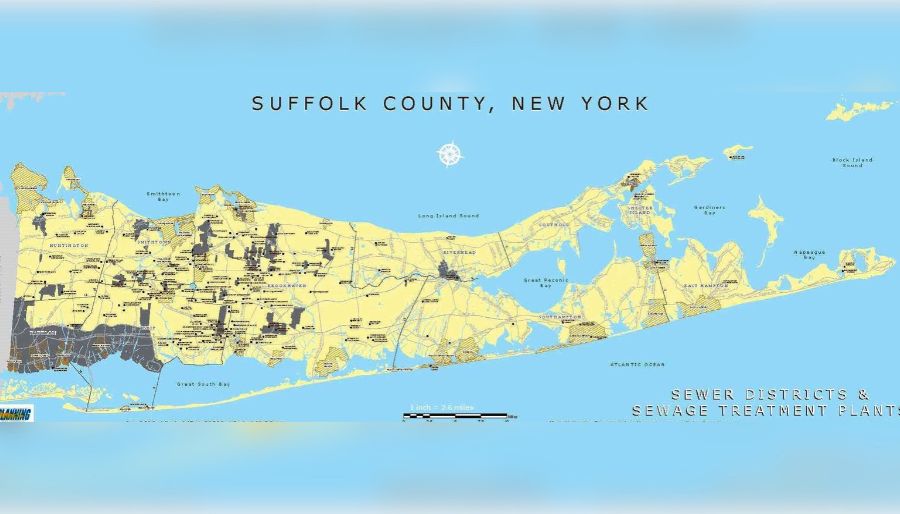
The long-term consequences of the scandal became especially apparent as Suffolk County continued to grow. In 2018, Newsday reported that approximately 360,000 Suffolk County residences, roughly three-quarters of the county’s homes, were not connected to municipal sewers. Most depended on individual cesspools or septic systems.
The Southwest Sewer District scandal was a major reason that large-scale sewer expansion became politically difficult. However, the county’s low-density development patterns, high construction costs and declining federal funding also contributed.
In many communities, household wastewater continued entering the groundwater through conventional septic systems and cesspools. Over time, scientific research and environmental monitoring established that nitrogen from wastewater was contributing to pollution in Long Island’s bays and coastal waters.
Excess nitrogen can encourage harmful algal blooms, reduce oxygen levels and damage marine habitats, contributing to problems affecting shellfish, fish and other aquatic life. These environmental concerns renewed interest in wastewater treatment improvements, particularly in communities where conventional sewers remained impractical or prohibitively expensive.
By the 2010s, Suffolk County officials were promoting new wastewater initiatives, including advanced on-site treatment systems intended to remove more nitrogen than conventional septic systems. The challenge was enormous, since retrofitting hundreds of thousands of existing homes or connecting them to new sewers would require substantial public and private investment.
Suffolk County Tries Again
More than half a century after the original Southwest Sewer District referendum, Suffolk County voters approved a new approach to financing wastewater improvements. In November 2024, more than 71 percent of voters supported the Suffolk County Water Quality Restoration Act, establishing a long-term funding mechanism for sewer expansion and improved septic systems.
The measure created an additional one-eighth-percent sales tax dedicated to wastewater infrastructure while extending an existing quarter-percent sales tax supporting drinking-water protection. The new tax took effect March 1, 2025.
According to the New York State Department of Environmental Conservation, the program is projected to generate approximately $2.6 billion over 35 years to support wastewater improvements and efforts to reduce nitrogen pollution. Unlike the original Southwest Sewer District project, which concentrated on constructing an extensive sewer network in western Suffolk, the newer approach combines sewer expansion with grants and programs to improve individual wastewater treatment systems.
The initiative also reflects the continuing debate over how to protect water quality without encouraging development that creates additional environmental pressures. More than five decades after the original sewer referendum, Suffolk County is still confronting many of the same questions about infrastructure, growth and the protection of its groundwater.
A Scandal With Consequences That Continue Today
The Southwest Sewer District was supposed to mark the beginning of a much larger transformation in Suffolk County’s wastewater infrastructure. Instead, its financial problems and corruption investigations undermined public confidence in large-scale sewer construction for decades.
The scandal ended political careers, led to criminal convictions and left taxpayers confronting costs far beyond the original estimates. Its longer-lasting consequence was the reluctance to undertake similar projects, particularly after the federal funding that once helped make them affordable became harder to obtain.
Suffolk County’s continuing reliance on cesspools and septic systems cannot be attributed entirely to the scandal, but the controversy played an important role in shaping the county’s infrastructure decisions. Today, the county is investing billions of dollars to address wastewater and groundwater problems that officials had already recognized in the 1960s. The same questions surrounding cost, environmental protection and development remain central to the discussion, more than five decades after voters first approved the Southwest Sewer District.
Sources:
- U.S. Government Accountability Office – March 22, 1977, federal investigation documenting approximately $1 billion in estimated project cost increases between 1969 and 1976. https://www.gao.gov/products/ced-77-45
- U.S. Environmental Protection Agency – Historical federal study documenting the 1967 referendum, 1969 approval, project financing, engineering plans and early construction delays. https://nepis.epa.gov/Exe/ZyPURL.cgi?Dockey=9101R029.TXT
- New York State Appellate Division – 1982 judicial decision documenting corruption investigations, civil litigation and the county’s pursuit of damages related to Southwest Sewer District No. 3. https://openjurist.org/86/ad2d/294/in-re-district-attorney-of-suffolk-county
- Newsday – 2018 investigation detailing the original sewer campaign, fraudulent engineering claims, John Flynn’s murder, the defeat of John V. N. Klein and the scandal’s lasting effect on sewer expansion. https://newsday.atexcloud.io/long-island/suffolk-clean-water-t23000
- Molloy University, History of Long Island – Environmental history timeline documenting the sewer scandal, political fallout, convictions and the “Flush Klein” campaign. https://www.molloy.edu/about/community-outreach/history-of-long-island/environment
- Karl Grossman, The Foggiest Idea – June 24, 2015, firsthand historical account of the sewer campaign, toilet bowl advertisements, development interests and subsequent environmental debate. https://www.thefoggiestidea.org/2015/06/24/karl-grossman-a-new-push-for-sewers-in-suffolk-county/
- Richard Murdocco, The Foggiest Idea – May 9, 2016, examination of sewer expansion, economic development, nitrogen pollution and concerns about the county’s wastewater policies. https://www.thefoggiestidea.org/2016/05/09/is-bellones-bid-for-a-drinking-water-tax-a-ploy-to-promote-development/
- Richard Murdocco, The Foggiest Idea – June 12, 2017, analysis of Suffolk County’s limited sewer infrastructure, the historical scandal, development pressures and implications for groundwater protection. https://www.thefoggiestidea.org/2017/06/12/without-a-lid-on-unchecked-development-long-islands-water-quality-will-only-get-worse/
- Suffolk County Government – November 2024 announcement documenting voter approval of the Water Quality Restoration Act and its new wastewater funding mechanism. https://www.suffolkcountyny.gov/Departments/Public-Works/ArtMID/4110/ArticleID/12645/County-Executive-Ed-Romaine-Applauds-Passage-of-Historic-Clean-Water-Bill
- New York State Department of Environmental Conservation – Update documenting the March 2025 implementation of the wastewater sales tax and its projected $2.6 billion in revenue over 35 years. https://content.govdelivery.com/accounts/NYSDEC/bulletins/40ac187
- New York State Department of Taxation and Finance – Official notice confirming the Suffolk County sales tax increase effective March 1, 2025. https://www.tax.ny.gov/forms/locality-notices/st-25-1.htm
- Richard Murdocco, The Foggiest Idea – May 11, 2015, analysis of Suffolk County’s Comprehensive Water Resources Management Plan and the relationship between sewer expansion, development and groundwater protection. https://www.thefoggiestidea.org/2015/05/11/suffolk-plan-wont-save-the-aquifers-by-using-sewers-to-promote-development/
Cover photo: Historical U.S. Geological Survey map showing the distribution of sewer districts, wastewater treatment plants and domestic septic systems across Long Island in 2000. The map illustrates the limited extent of centralized sewer infrastructure in Suffolk County decades after the corruption scandal surrounding Southwest Sewer District No. 3. U.S. Geological Survey (Public Domain)