Long before Jimmy Doolittle became famous for leading the 1942 bombing raid on Japan that bears his name, he helped change aviation history at Mitchel Field on Long Island.
On Sept. 24, 1929, the U.S. Army Air Corps lieutenant took off, flew and landed an airplane while relying on instruments rather than a view of the ground or horizon. The flight is recognized as the first complete blind takeoff, flight and landing.
Doolittle’s flight was the culmination of nearly a year of experiments at the Daniel Guggenheim Fund for the Promotion of Aeronautics’ Full Flight Laboratory at Mitchel Field. Researchers were trying to solve one of early aviation’s major problems: how pilots could safely fly when fog, clouds or darkness eliminated their visual reference to the ground and horizon.
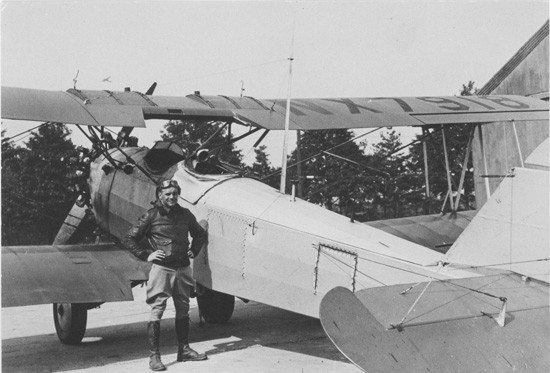
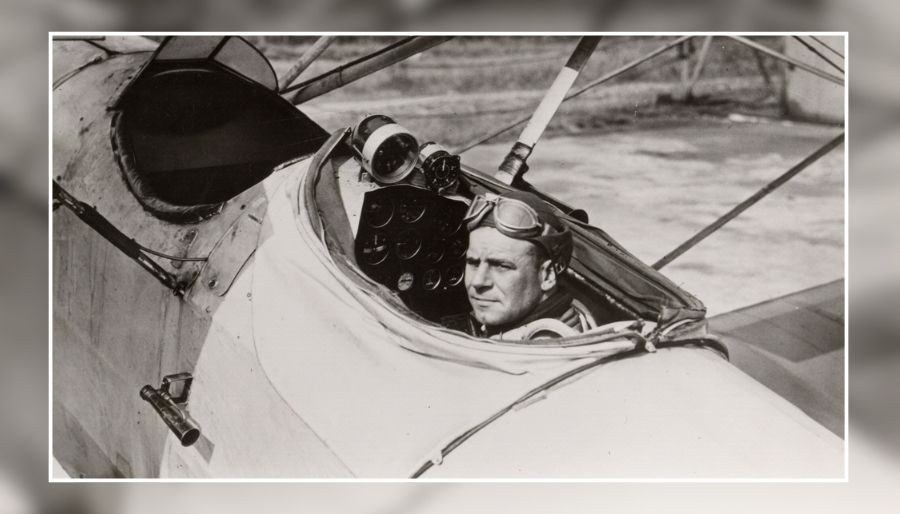
For the official demonstration, Doolittle flew a specially equipped Consolidated NY-2 with his cockpit covered so he could not see outside. Lt. Benjamin Kelsey accompanied him as a safety pilot, but Doolittle flew the aircraft throughout the demonstration.
The airplane brought together several technologies that allowed Doolittle to determine the aircraft’s position and attitude without looking outside. They included an artificial horizon, directional gyroscope, sensitive altimeter and radio navigation equipment.
Click here for more stories about Long Island’s space & aviation history.
Doolittle later described taking off with the cockpit hood closed, climbing to about 1,000 feet and making a 180-degree turn. After flying several miles, he turned again, lined up with the Mitchel Field radio range and began his descent. He leveled off at about 200 feet before using the instrument landing procedure developed during the experiments to guide the airplane to the ground. The entire flight lasted about 15 minutes.
“So far as I know, this was the first time,” Doolittle later recalled, that an airplane had taken off, flown a set course and landed using instruments alone.

The significance of the demonstration was recognized almost immediately. An account published the following year called it “one of the most significant so far in aviation history.” Harry Guggenheim, president of the Daniel Guggenheim Fund, said the experiment demonstrated that “the problem of safe flying in fog has been solved.”
That assessment was not far off. The Smithsonian National Air and Space Museum says technologies Doolittle helped develop became standard equipment on all-weather aircraft and remain fundamental to instrument flying.
Doolittle was particularly well suited to the work. In addition to being an accomplished pilot, he held a doctorate in aeronautical engineering and served as a test pilot for the Guggenheim laboratory.
The importance Doolittle himself placed on the achievement is striking considering what came later. He would describe his participation in the early blind-flying experiments as his “most significant contribution to aviation.”
His career would eventually become much better known for another accomplishment. During World War II, Doolittle planned and led the April 1942 raid in which 16 B-25 bombers launched from the aircraft carrier USS Hornet to strike targets in Japan. He received the Medal of Honor and eventually became a four-star general.
But more than a decade before the Doolittle Raid, his work at Mitchel Field demonstrated an airplane could be controlled from takeoff through landing without the pilot needing to see the world outside the cockpit.
Cover photo: Lt. James H. “Jimmy” Doolittle sits in the Consolidated NY-2 Husky used for his blind-flight experiments, with the fabric hood that could cover his cockpit visible behind him. Photo: National Air and Space Museum, Smithsonian Institution (SI 79-9405).
Photo 2: Lt. James H. “Jimmy” Doolittle stands beside the Consolidated NY-2 Husky used in his pioneering instrument-flight experiments at Mitchel Field. Photo: San Diego Air & Space Museum.
Photo 3: An aerial view of Mitchel Field in 1932, three years after Doolittle completed the first blind takeoff, flight and landing there. Photo: Engineering and Technology History Wiki (ETHW/IEEE).
Sources:
Smithsonian National Air and Space Museum — Flying Blind: Enabling All-Weather Flight
https://pioneersofflight.si.edu/content/flying-blind-enabling-all-weather-flight
Smithsonian National Air and Space Museum — Doolittle and the First “Blind Flight”
https://pioneersofflight.si.edu/content/doolittle-and-first-blind-flight
U.S. Air Corps News, Oct. 17, 1929 — “Lieut. Doolittle Gives Successful Demonstration of Blind Flying”
https://media.defense.gov/2011/Apr/22/2001330129/-1/-1/0/AFD-110422-032.pdf
U.S. Air Force — 1929-1931 Historical Chronology
https://media.defense.gov/2015/Dec/21/2001327906/-1/-1/0/AFD-151221-826-001.PDF
U.S. Air Force, Drew Paper No. 17 — The Shaping of a Commander: The Development of Vice Admiral James H. “Jimmy” Doolittle
https://media.defense.gov/2017/Nov/21/2001847256/-1/-1/0/DP_0017_BISHOP_JIMMY_DOOLITTLE.PDF
IEEE/AIAA — First Blind Takeoff, Flight and Landing, 1929
https://ethw.org/Milestones%3AFirst_Blind_Takeoff%2C_Flight_and_Landing%2C_1929
This Day in Aviation — Sept. 24, 1929
https://www.thisdayinaviation.com/24-september-1929/