On April 6, 1918, Army nurse Ethel Anderson reported for duty and was sent to Camp Upton in Yaphank.
The diary and photograph album she kept during the following year survives in the New York Public Library. It begins on Long Island and goes on to document military hospitals, nurses, soldiers, battle-damaged towns and Anderson’s service in France and Belgium during the final months of World War I.
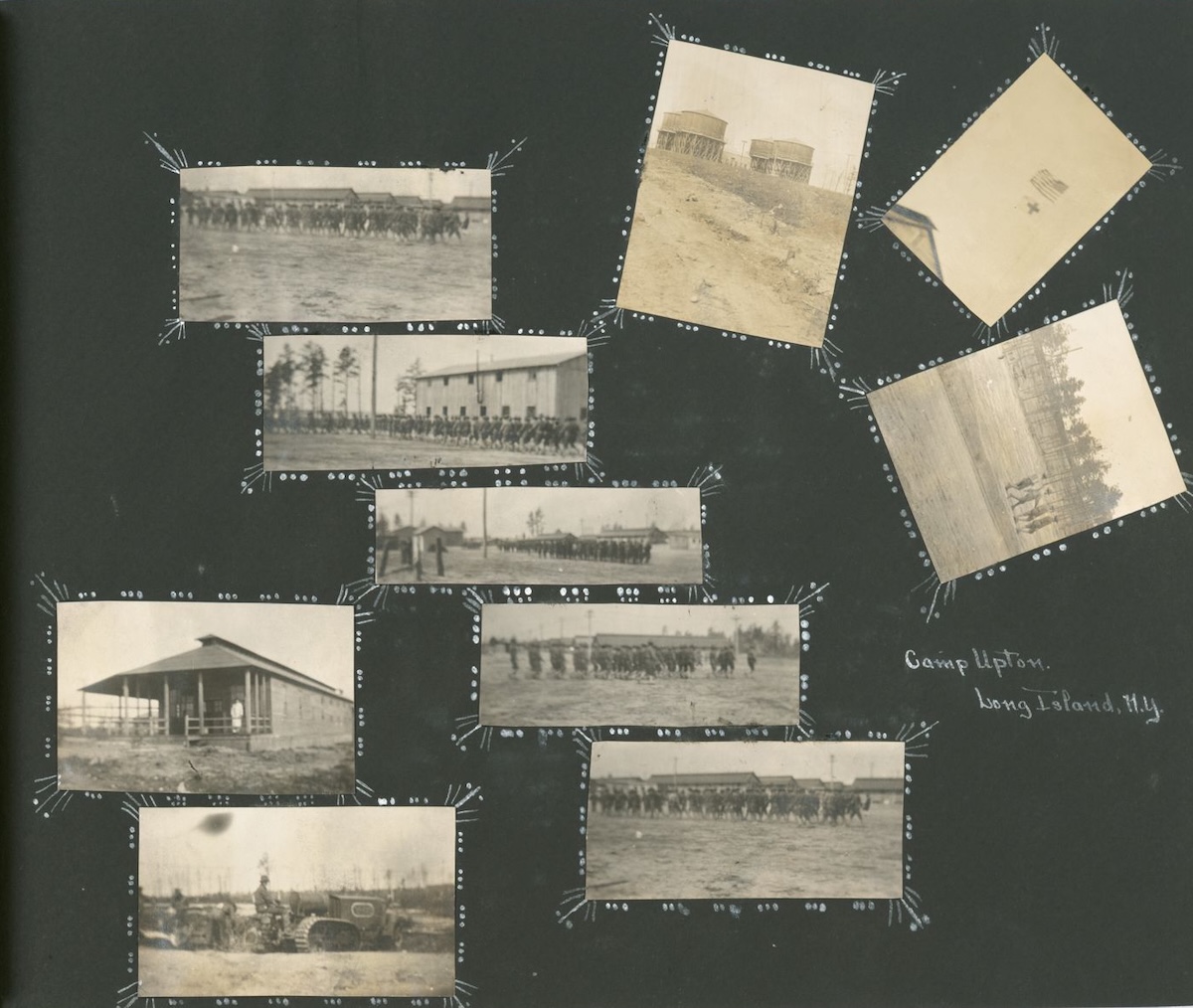
Photo: Troops, barracks, water tanks and American and Red Cross flags at Camp Upton in Yaphank during World War I. Credit: Ethel Anderson Collection, New York Public Library.
Her record began at Camp Upton
Camp Upton was less than a year old when Anderson arrived. The U.S. Army began constructing the camp in the Pine Barrens of central Suffolk County during the summer of 1917. The first 2,000 drafted men arrived on Sept. 10, while about two-thirds of the camp was still unfinished.
Camp Upton was one of the large training cantonments created after the United States entered World War I. Recruits came primarily from New York, New Jersey and Connecticut.
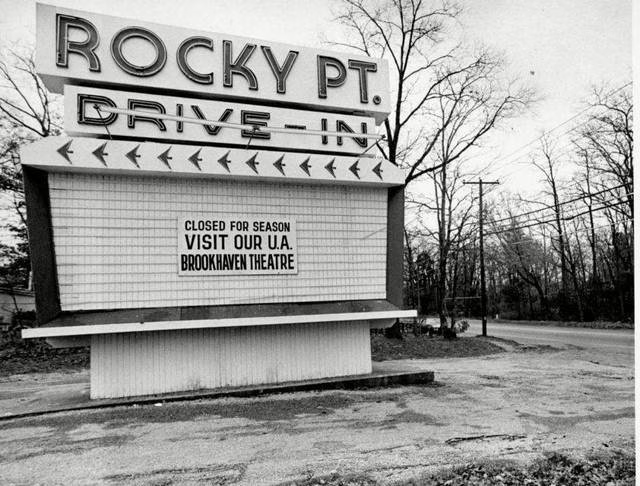
Close to 40,000 men trained there during the war. The land where the camp stood is now part of Brookhaven National Laboratory. Anderson’s album preserves a different side of Camp Upton’s wartime history.
The leather-bound volume, titled Under the Red Cross Flag at Home and Abroad, contains photographs, drawings, poetry, captions and excerpts from her handwritten diary.
Photographs from her time at Camp Upton show nurses, barracks, water tanks and soldiers drilling.
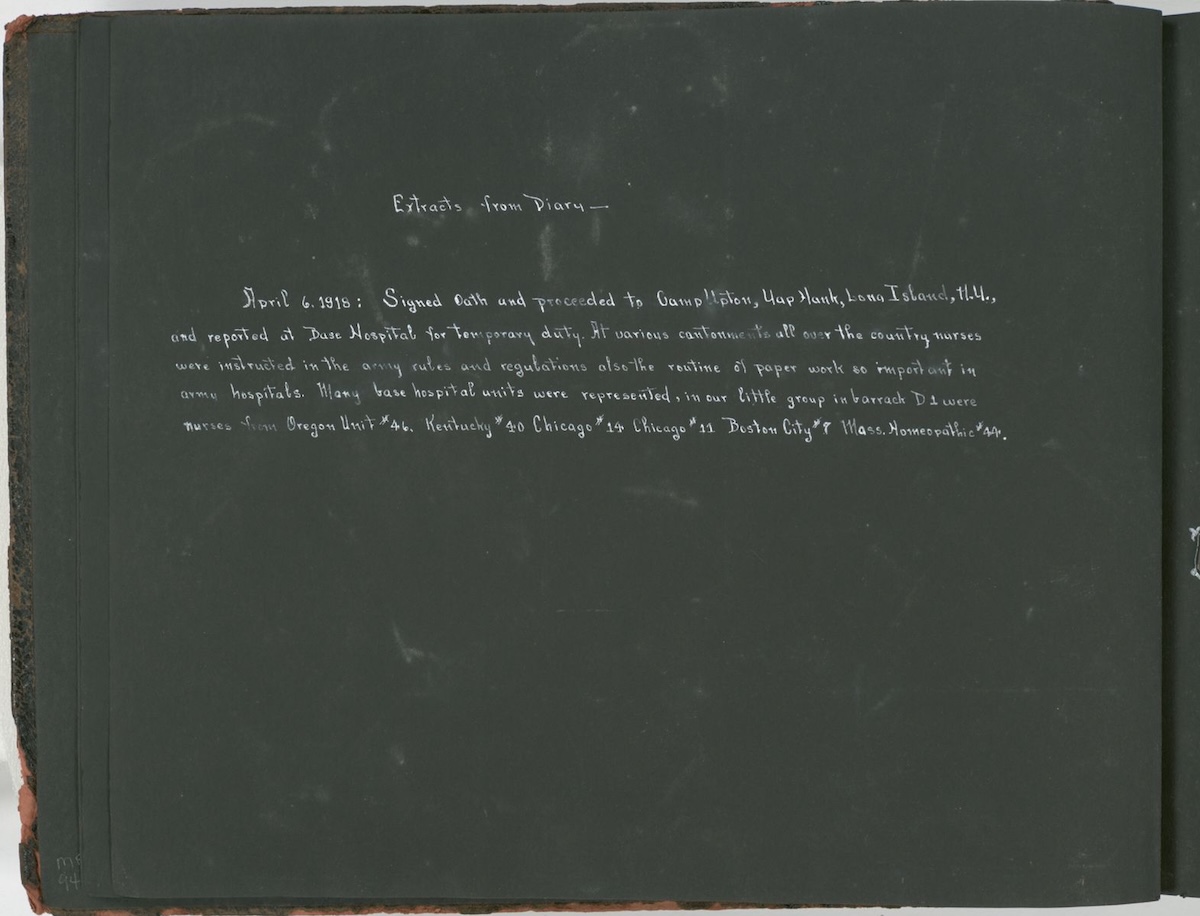
Photo: Ethel Anderson’s April 6, 1918 diary entry recording that she signed her oath and proceeded to Camp Upton in Yaphank. Credit: Ethel Anderson Collection, New York Public Library.
From Long Island to overseas service
Anderson’s album later records her association with Base Hospital Unit No. 44 and Evacuation Hospital No. 5.
The main body of Base Hospital No. 44 did not train at Camp Upton. Army records show that the unit was organized through Massachusetts Homeopathic Hospital in Boston, mobilized there in March 1918 and then trained at Camp Dix in New Jersey. The main unit sailed from Hoboken aboard the Ulysses on July 6.
Anderson’s own diary documents a different route. After Camp Upton, she was later in New York City with nurses preparing for overseas duty. In an Aug. 1 diary entry, Anderson recalled staying at the Judson Hotel, drilling at an armory, taking French classes and assembling equipment.
On July 13, the nurses were ordered not to leave the hotel or communicate outside their unit. They departed the following day and boarded a military transport.
Anderson’s photographs include ships traveling in convoy across the Atlantic. During the voyage, her diary records a stop at Halifax, where she saw damage remaining from the December 1917 Halifax Explosion.
She also described a convoy of 24 ships and an incident in European waters when a possible submarine periscope was reported. Anderson wrote that submarine chasers responded and the convoy changed course, but she did not claim to know whether an enemy submarine had actually been encountered. By Aug. 1, Anderson was in Le Havre, France.
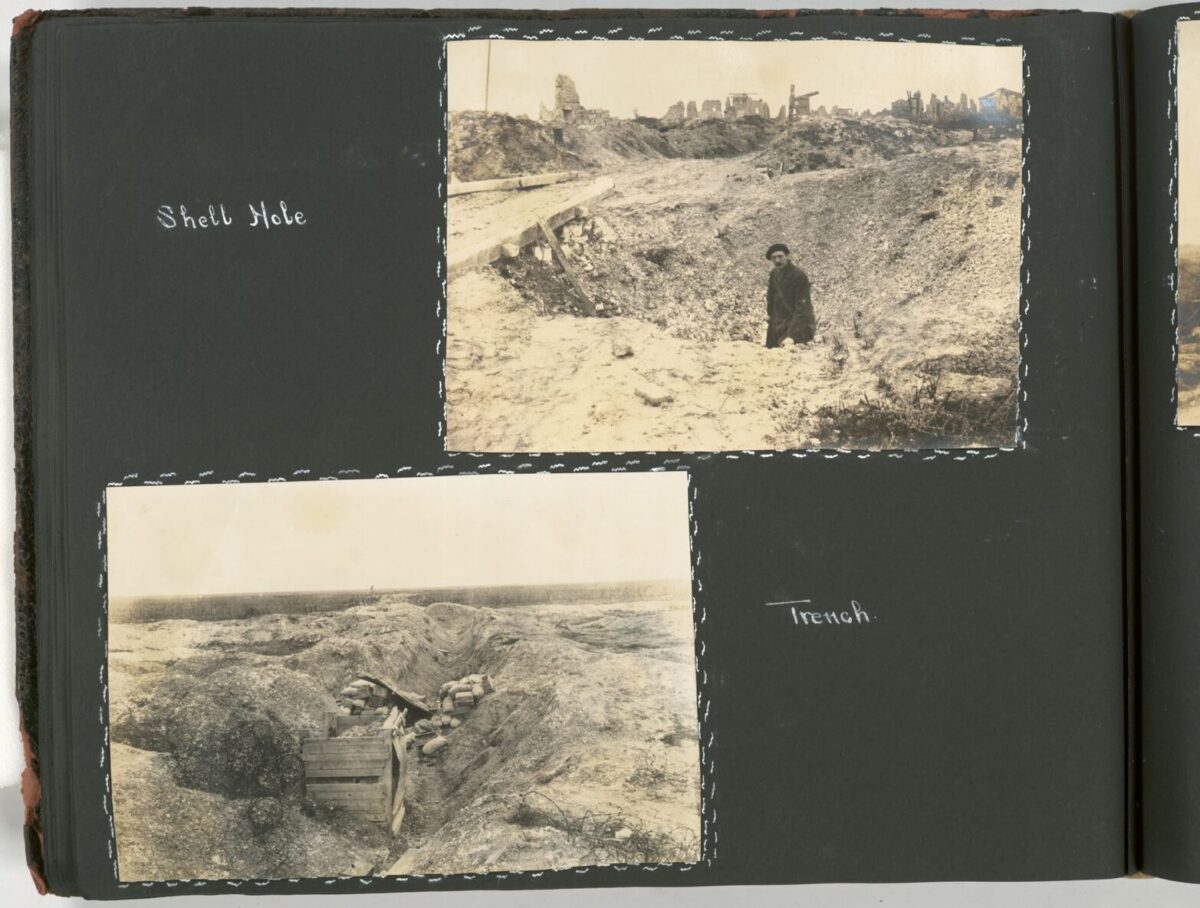
Photo: Trenches, barbed wire and shell holes filled with water in France, photographed during Ethel Anderson’s World War I nursing service in 1918. Credit: Ethel Anderson Collection, New York Public Library.
Nursing closer to the fighting
Anderson eventually joined Evacuation Hospital No. 5. Unlike large base hospitals farther behind the lines, evacuation hospitals received casualties closer to active combat areas and stabilized patients before they were moved farther to the rear.
Official Army records place Evacuation Hospital No. 5 at several locations during the final months of the war. In late August 1918, the hospital operated at Villers-Cotterêts while supporting American forces. Army records show that it admitted 2,167 patients from the 32nd Division there, including surgical, medical and gas cases.
Anderson’s album contains photographs of the hospital camp at Villers-Cotterêts, the ambulance company attached to Evacuation Hospital No. 5 and the nurses who served with the unit.
Her photographs also document the landscape through which the medical units moved. They include damaged areas at Château-Thierry, trenches and shell holes in the Argonne, barbed-wire defenses, Verdun, ruined villages, German and American cemeteries, nurses wearing gas masks and hospital camps.
In an Aug. 28 diary entry, Anderson described a German air attack on a nearby town and finding pieces of shrapnel in the hospital campground the following morning.
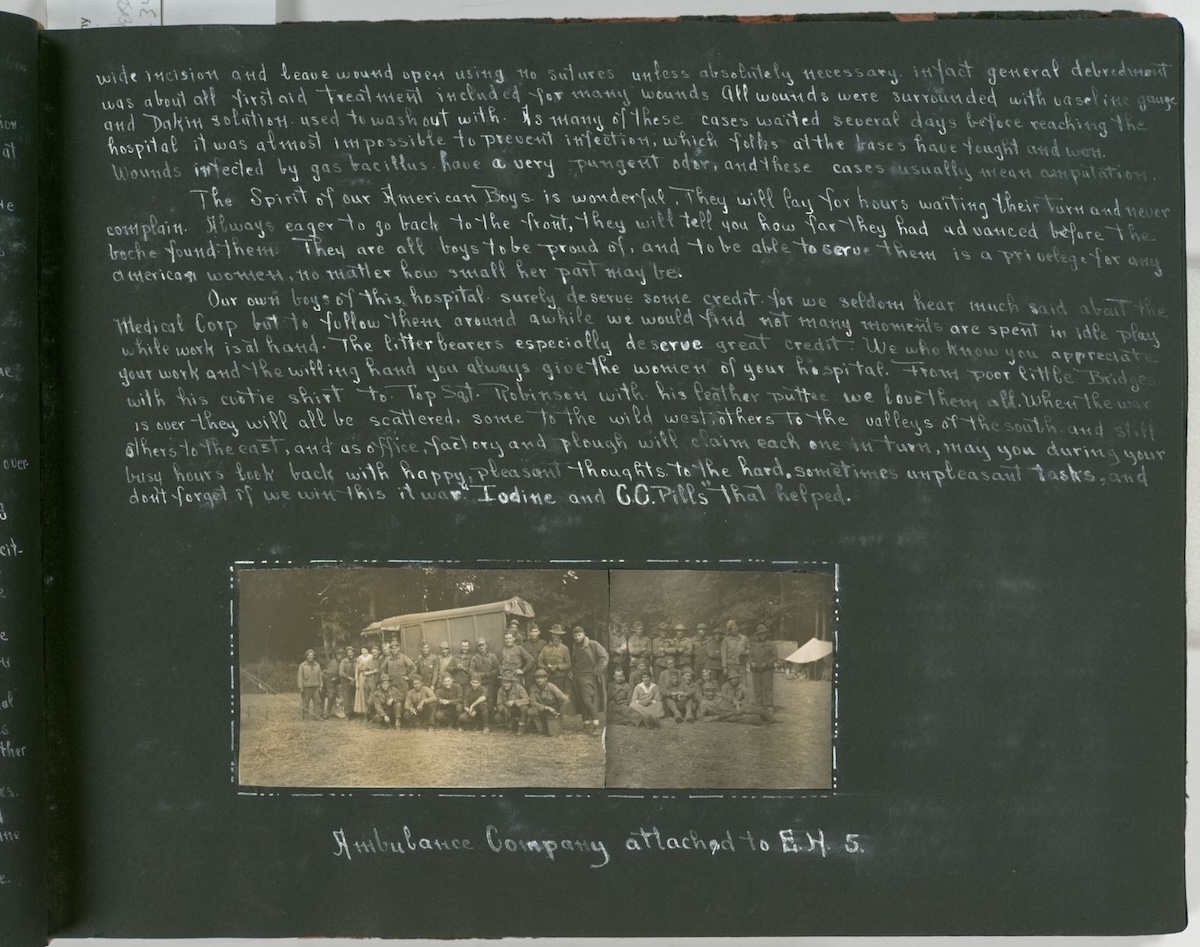
Photo: Personnel of Evacuation Hospital No. 5 at Malo-les-Bains, France, after the Armistice. Credit: Ethel Anderson Collection, New York Public Library.
Ten nurses sent to another hospital
One of the most detailed sections of Anderson’s diary came during the Meuse-Argonne offensive and the 1918 influenza pandemic. By Sept. 18, Evacuation Hospital No. 5 had reached Ville-sur-Cousances and was being held in reserve.
The following day, Anderson and nine other nurses were temporarily separated from their unit and sent to Evacuation Hospital No. 9 at Vaubecourt. Army records independently confirm that Evacuation Hospital No. 9 was operating at Vaubecourt while Evacuation Hospital No. 5 remained in reserve at Ville-sur-Cousances.
The distinction is important because Anderson’s Sept. 25 account of influenza and large numbers of casualties describes conditions while she was assisting Evacuation Hospital No. 9, not her regular assignment with Evacuation Hospital No. 5.
Anderson recorded that the ten nurses had been caring for approximately 1,400 wounded and medical patients during the preceding week. She also wrote about the effects of influenza among the soldiers, including patients arriving with severe respiratory symptoms. After the emergency assignment, Anderson and the other nurses were recalled to Evacuation Hospital No. 5.
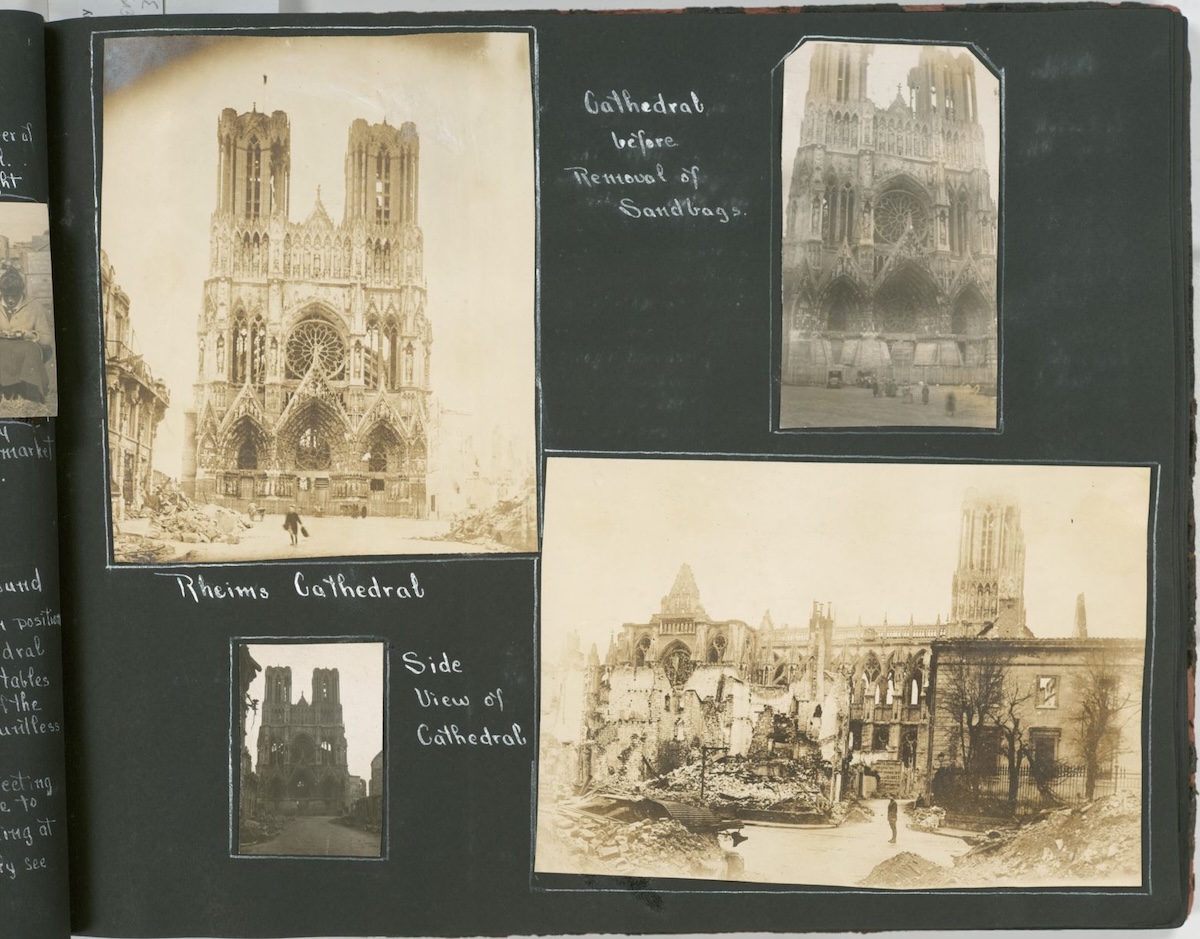
Photo: Reims Cathedral in France, shown in 1918 with wartime protective sandbags still in place. Credit: Ethel Anderson Collection, New York Public Library.
Into Belgium
Evacuation Hospital No. 5 moved again as the American armies advanced. Army records show that the hospital left Ville-sur-Cousances for La Veuve in early October and then moved to Staden, Belgium, later that month. The hospital reached Staden on Oct. 24.
While there, Evacuation Hospital No. 5 admitted 3,918 patients from several American divisions. At one point, an interruption in hospital-train service left the hospital caring for 1,420 patients at the same time.
Anderson’s album follows the nurses into Belgium. Her photographs include ruined Belgian towns, cemeteries, military positions and scenes involving the nurses away from their duties. The hospital remained at Staden until Dec. 9, when it moved to the Dunkirk area.
The NYPL collection includes a group photograph of the staff of Evacuation Hospital No. 5 at Malo-les-Bains near Dunkirk, along with photographs of the nearby beach and other scenes from the area. Anderson’s diary also documents Christmas 1918 and a later 14-day leave during which she traveled through southern France and visited Monte Carlo.
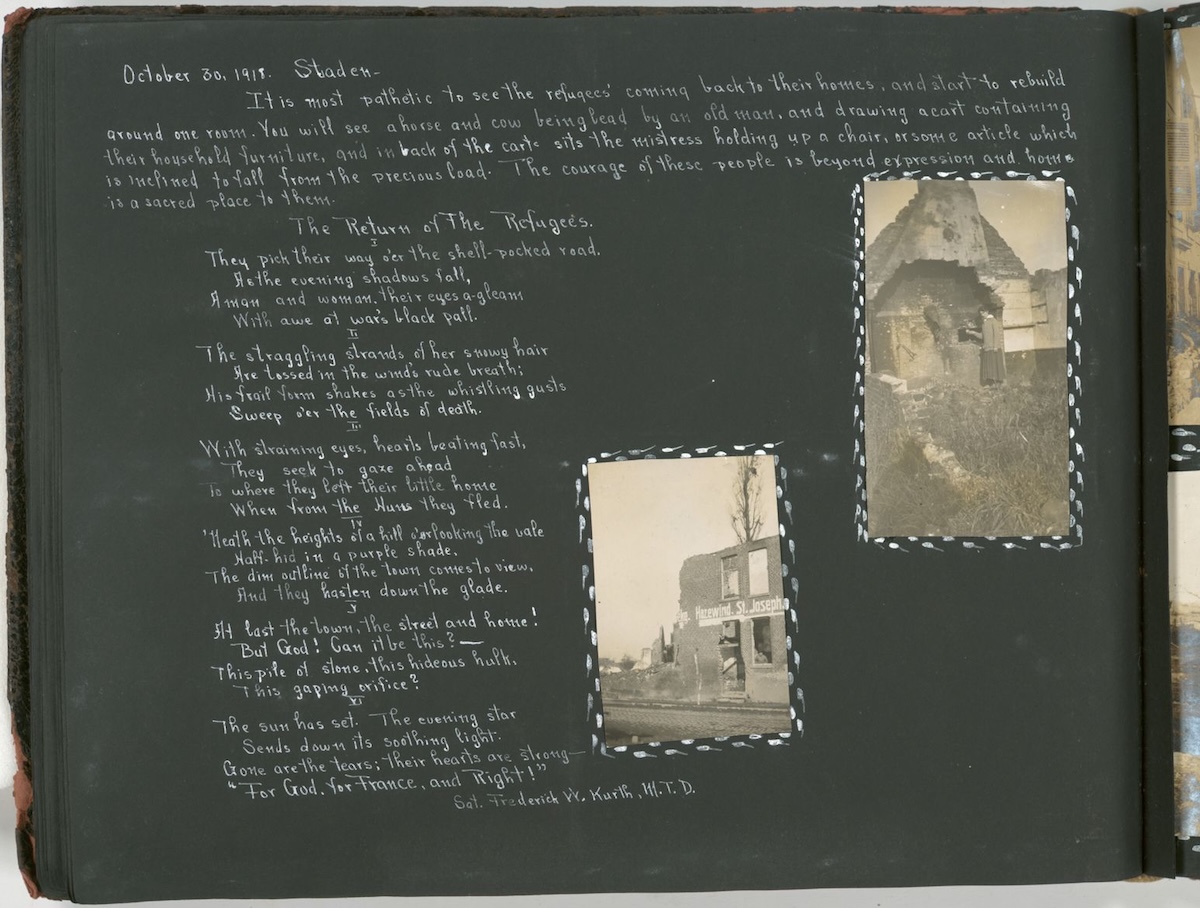
Photo: A nurse stands among war-damaged buildings in Staden, Belgium, on Oct. 30, 1918, during Ethel Anderson’s service with Evacuation Hospital No. 5. Credit: Ethel Anderson Collection, New York Public Library.
Her album ended with the trip home
Anderson eventually returned to the United States aboard the S.S. Mobile. The New York Public Library dates the final diary entry in its collection description to April 20, 1919, when Anderson arrived back in the United States.
Her surviving album therefore covers a little more than a year. It begins with her arrival at Camp Upton in Yaphank on April 6, 1918, and follows her through military nursing service in France and Belgium before her return home the following April.
The collection contains more than a written account. Anderson preserved photographs of the nurses she worked beside, the soldiers and medical units around them, the camps where they lived and the physical destruction left by the war.
For Long Island, the first pages provide a direct record of Camp Upton during its original World War I use, written and photographed by a nurse whose service would soon take her thousands of miles from Yaphank.
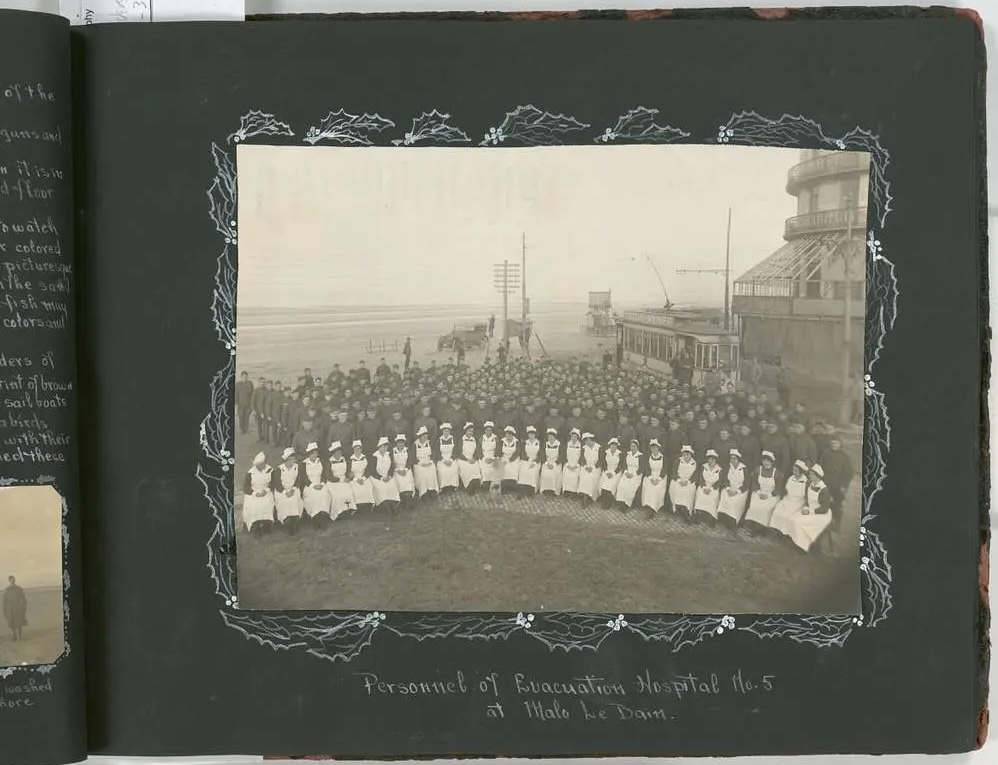
Photo:Personnel of Evacuation Hospital No. 5 at Malo-les-Bains, France, after the Armistice in 1918. Credit: Ethel Anderson Collection, New York Public Library.
See the full collection of photos here!
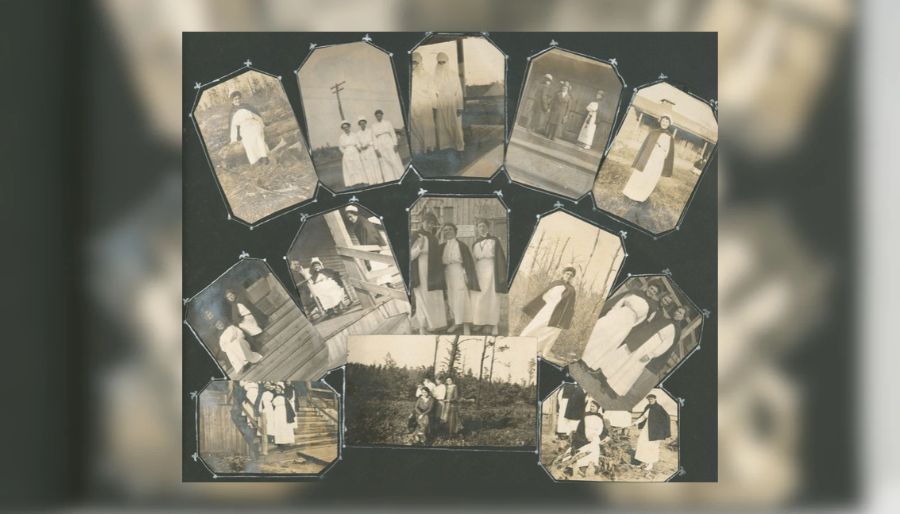
Header image: Nurses at Camp Upton in Yaphank, shown in uniform and civilian dress during World War I. Credit: Ethel Anderson Collection, New York Public Library.
Sources:
- New York Public Library Digital Collections, Under the Red Cross Flag at Home and Abroad: Base Hospital Unit #44, Evacuation Hospital #5
https://digitalcollections.nypl.org/collections/9f86c7b0-c6d0-012f-f3ba-58d385a7bc34 - Library of Congress, Camp Upton
https://www.loc.gov/exhibitions/world-war-i-american-experiences/about-this-exhibition/over-here/raising-an-army/camp-upton/ - Brookhaven National Laboratory, Camp Upton history
https://www.bnl.gov/about/history/campupton.php - U.S. Army Medical Department, Base Hospital No. 44 history
https://achh.army.mil/history/book-wwi-adminamerexp-chapter24/ - U.S. Army Medical Department, Evacuation Hospital No. 5 history
https://achh.army.mil/history/book-wwi-fieldoperations-chapter34/ - U.S. Army Medical Department, Meuse-Argonne hospital dispositions
https://achh.army.mil/history/book-wwi-fieldoperations-chapter20/ - U.S. Army Medical Department, Evacuation Hospital No. 5 in Belgium
https://achh.army.mil/history/book-wwi-fieldoperations-chapter36/ - Blackbird, Virginia Commonwealth University, excerpts from Ethel Anderson’s diary and album
https://blackbird-archive.vcu.edu/v18n1/gallery/anderson-e/red-cross-page.shtml