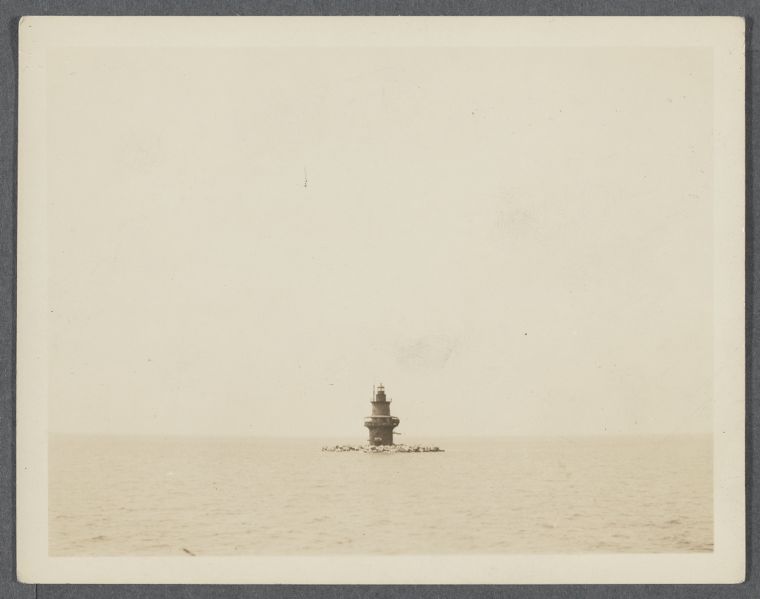
Orient Point Light stands on Oyster Pond Reef in Plum Gut, the narrow passage between Orient Point and Plum Island. The cast-iron lighthouse was first lit in 1899 and remains one of the offshore “spark plug” lighthouse towers built in New York waters.
Orient Point Light has stood offshore since 1899 on Oyster Pond Reef near the northeastern tip of Long Island. The cast-iron structure was built in the narrow and fast-moving channel between Orient Point and Plum Island known as Plum Gut.
The lighthouse is sometimes called a “spark plug” lighthouse because of its shape.
Some basic facts about the structure:
- The lighthouse was first lit on Nov. 10, 1899.
- It stands roughly 52 feet tall.
- The structure was built on a cast-iron caisson foundation.
- The tower is made of cast-iron plates lined with brick.
- It originally used a fifth-order Fresnel lens.
- The light was automated in 1954.
- The station was added to the National Register of Historic Places in 2007.
Before the current lighthouse existed, the site had other navigation markers.
According to the historical record, the United States Lighthouse Service placed a daymarker there in 1855 and announced plans for a beacon. Construction was delayed after workers encountered hard rock, and a trading vessel collided with temporary staging during the work.
In 1874, a stone beacon with an iron cage was placed on the reef. That structure did not last. Ice carried it away in 1896.
Construction of the current tower began in October 1898.
Work stopped for nearly a year because of stormy weather before resuming the following spring. By September 1899, most of the project had been completed. The lamp went into operation that November.
The original lens quickly proved inadequate.
- The fifth-order Fresnel lens was replaced with a fourth-order lens on May 1, 1900.
- A fog signal entered operation on June 1, 1900.
- The fog signal was upgraded in 1905.
The lighthouse sits on a man-made protective base.
Over several years, workers added thousands of tons of riprap around the structure to create a small island around the tower. Historical records note that cracks and rust later required additional cast-iron plates to reinforce one side of the lighthouse. The added weight contributed to the structure tilting about five degrees out of vertical.
The light also narrowly avoided a maritime accident in 1912.
On Aug. 30 of that year, the steamship Halyoke lost steering control and drifted toward the lighthouse. The captain reversed the engines, and the vessel ran onto the rock before backing away. Historical accounts state neither the lighthouse nor the ship was damaged.
The lighthouse was almost demolished decades later.
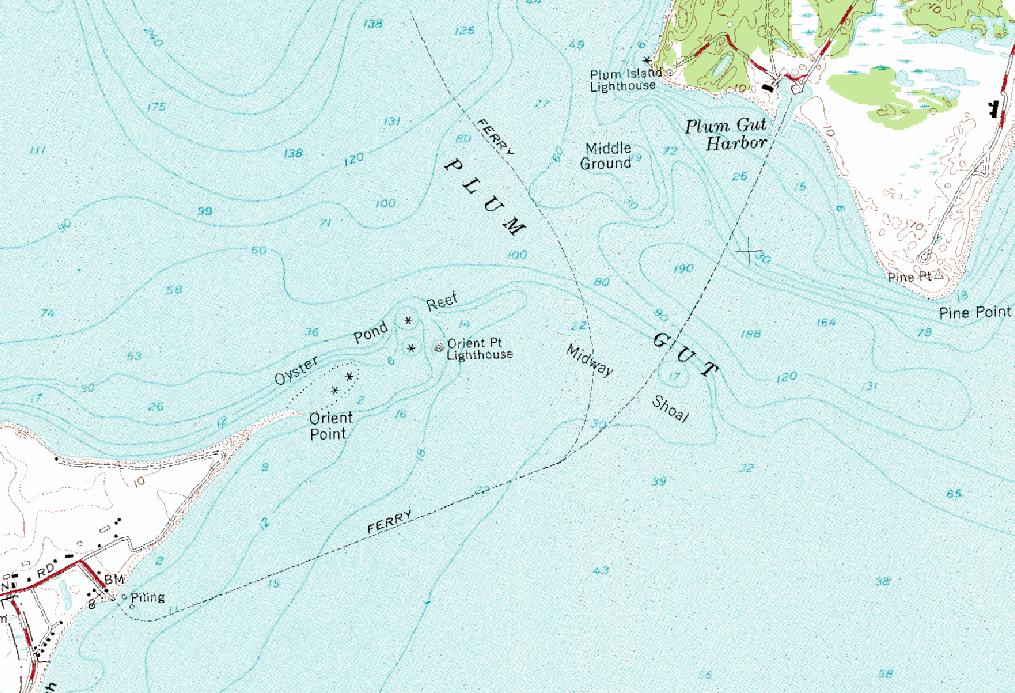
Photo: Detail of USGS Map, Orient Point Light is in the center. USGS, Public domain, via Wikimedia Commons
In 1970, the Coast Guard announced plans to tear the structure down. Public opposition led to the decision being reversed. Instead, repairs were made, including concrete reinforcement at the base along with new paint and epoxy protection.
Additional work followed in later years:
- The lens was replaced in 1988.
- Major repairs were completed in 2000.
- Solar panels and batteries were installed during that work.
The property later entered private ownership.
In 2011, the General Services Administration made the lighthouse available to organizations willing to preserve it. After no caretaker organization was selected, the property eventually went to auction.
Artist and sculptor Randy Polumbo purchased the lighthouse in 2013 for $252,000.
According to a 2019 Northforker report, Polumbo converted part of the interior into an artist residency called “Plum Gut Grotto.” The project included studio space and living quarters while the lighthouse itself remained operational.
The report also noted ongoing structural issues, including sections of the base missing and water seeping into the structure.
A 1923 photograph preserved by the New York Public Library identified the structure simply as: “View of Orient Point Lighthouse. In Plum Gut. Orient Point, Southold.”
More than a century after it was first lit, the lighthouse still stands in the middle of Plum Gut, between Orient Point and Plum Island, continuing to mark one of the narrowest passages in Long Island Sound.