One of the 56 men whose signatures appear on the Declaration of Independence lived in a house that still stands in Mastic Beach. William Floyd, the only signer from Suffolk County, was among four New York delegates who signed the historic document in 1776. His home, known as the Old Mastic House, survives nearly 300 years after its construction and is now preserved by the National Park Service.
The house has an extraordinary Revolutionary War history of its own. Within weeks of the Declaration’s adoption, Floyd’s family was forced to abandon the property as British troops took control of Long Island. Soldiers occupied the house during the war, and Floyd eventually returned to find his estate badly damaged.
A Long Islander Signs the Declaration of Independence
William Floyd was born on December 17, 1734, into one of Long Island’s prominent landowning families. His ancestors had acquired extensive property in the Town of Brookhaven, and in 1755, following his father’s death, Floyd inherited the family home and approximately 4,400 acres in Mastic.
The estate was a substantial agricultural operation producing wheat, rye, oats, corn and flax, along with livestock. Its prosperity depended on the labor of enslaved people, indentured servants and free workers, an important part of the property’s history that the National Park Service now documents.
Floyd became involved in local government and was elected a Brookhaven Town trustee in 1769. He also served as a colonel in the Suffolk County militia before being selected to represent New York at the First Continental Congress in Philadelphia in 1774.
By the summer of 1776, Floyd was participating in one of the most consequential decisions in American history. On July 4, the Continental Congress adopted the Declaration of Independence, formally announcing the colonies’ separation from Great Britain.
Contrary to the familiar image of all the delegates gathering to sign the document on July 4, the formal signing of the engrossed parchment began on August 2, 1776. Eventually, 56 delegates signed, including four from New York: William Floyd, Philip Livingston, Francis Lewis and Lewis Morris.
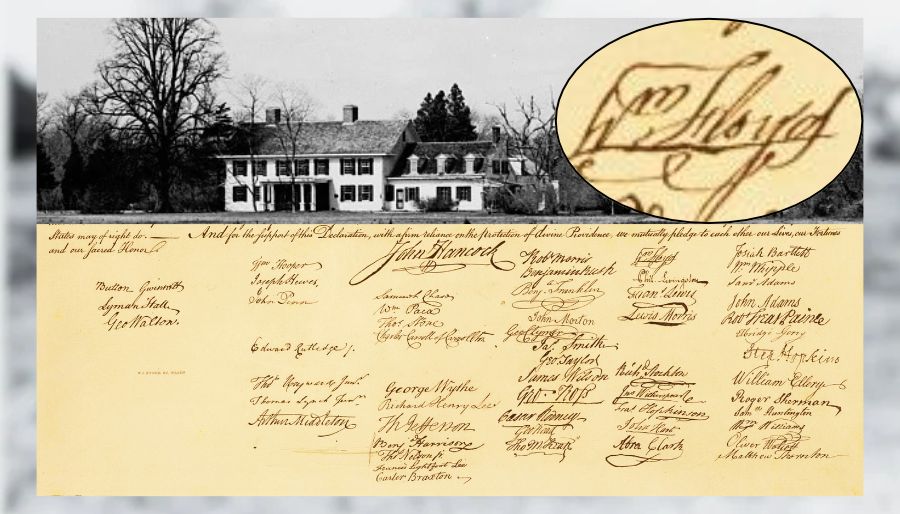
Floyd’s signature appears near the top of the fifth column of names, immediately above Philip Livingston’s. The simple handwritten signature, reading “Wm Floyd,” remains visible on the historic document preserved by the National Archives.
Signing was a dangerous political commitment. The delegates were openly rejecting British rule while the Revolutionary War was underway, exposing themselves and their property to possible retaliation if the rebellion failed.
British Soldiers Occupy the Floyd Family Home
The consequences of the Revolution reached Floyd’s property almost immediately. In August 1776, British forces defeated George Washington’s army in the Battle of Long Island and established control over the island, beginning an occupation that would continue until the end of the war.
Floyd’s wife, Hannah Jones Floyd, and their children fled Long Island and took refuge in Connecticut. William Floyd, meanwhile, was unable to return to his Mastic estate while continuing his political and military-related responsibilities.
British soldiers occupied the Old Mastic House, using the property during their years of control. The family’s farmland and resources were also taken for military purposes, while fences, timber and other improvements suffered extensive damage.
The separation had personal consequences as well. Hannah Floyd died in Connecticut in 1781, before the war ended and before the family could return permanently to Mastic.
When Floyd returned to his estate after the Revolution, he found considerable destruction. The property had suffered years of military occupation, its agricultural operations had been disrupted, and the house required substantial repairs.
The House That Survived the Revolution
The Old Mastic House had already been standing for approximately half a century when Floyd signed the Declaration of Independence. Its earliest section was constructed around 1724 for his father, Nicoll Floyd, as a two-story, six-room wooden house.
The original building was expanded as the family’s wealth and household grew. Following the Revolution, William Floyd undertook further repairs and improvements, adding rooms that reflected both the needs of his family and his increasing prominence in the new nation.
The house also received some notable visitors. In 1791, Thomas Jefferson and James Madison visited Floyd at Mastic, providing a direct connection between the Long Island estate and two of the country’s most influential early political figures.
Today, the house contains 25 furnished rooms representing different periods of the family’s occupancy. Its appearance reflects nearly three centuries of additions and alterations rather than a single moment in colonial history.
The surrounding property also retains important elements of the former estate, including agricultural fields, wooded areas, historic outbuildings and the Floyd family cemetery.
Generations of Floyd Family History
William Floyd continued his public career after the Revolutionary War, serving in the New York State Senate and participating in presidential elections as an elector. In 1803, he relocated to Westernville in Oneida County, leaving the Mastic property to his son Nicoll.
Floyd died on August 4, 1821, at the age of 86 and was buried in Westernville rather than in the family cemetery at Mastic. His descendants, however, continued to maintain the Long Island estate for generations.
The house underwent additional changes during the 19th and 20th centuries. By the 1930s, Cornelia Floyd Nichols had inherited the property and enlarged portions of the residence to accommodate modern household needs.
The property eventually became part of Fire Island National Seashore, which Congress authorized to acquire the estate in 1965. The Floyd family donated the historic house and estate to the National Park Service in the 1970s, preserving a remarkable connection to the nation’s founding.
A Declaration Signer’s House Still Standing in Mastic Beach
Today, the William Floyd Estate encompasses approximately 613 acres along the Great South Bay. Visitors can explore trails, fields and historic grounds surrounding the Old Mastic House, while the residence itself is accessible through seasonal guided tours.
The National Park Service identifies Floyd’s house as the only surviving home of New York’s four Declaration of Independence signers that remains open to the public. Its importance extends beyond its association with one famous signature, offering a record of colonial agriculture, slavery, Revolutionary War occupation and the changing lives of a Long Island family.
The original Declaration of Independence is preserved at the National Archives in Washington, D.C., with William Floyd’s name among the signatures. Nearly 250 miles away, in Mastic Beach, the house in which he grew up and lived for much of his life remains standing.
Photo: The historic William Floyd House in Mastic Beach, pictured above the signatures on the Declaration of Independence, with Floyd’s signature enlarged. House photograph: Historic American Buildings Survey, Library of Congress. Declaration signatures: W. J. Stone engraving, via Wikimedia Commons. Composite illustration: Crazy Facts About Long Island.
Sources:
- National Park Service, William Floyd – Biography, Continental Congress service, family history, estate ownership and significance as Suffolk County’s only Declaration signer. https://www.nps.gov/fiis/learn/historyculture/williamfloyd.htm
- National Park Service, Old Mastic House – Original construction, British military occupation, Floyd family’s exile, postwar restoration and the 1791 visit by Thomas Jefferson and James Madison. https://www.nps.gov/places/old-mastic-house.htm
- National Park Service, William Floyd Estate – Estate history, preservation, grounds, outbuildings, trails and public visitation information. https://www.nps.gov/fiis/planyourvisit/williamfloydestate.htm
- National Park Service, William Floyd Estate Old Mastic House – Architectural development, historic rooms, family occupancy and later additions. https://www.nps.gov/fiis/learn/historyculture/old-mastic-house.htm
- National Archives, Declaration of Independence (1776) – Adoption of the Declaration, preparation of the engrossed document, August 2 signing and names of the 56 signers. https://www.archives.gov/milestone-documents/declaration-of-independence
- Library of Congress, General William Floyd House, HABS NY-5427 – Historic American Buildings Survey photographs, measured drawings and architectural documentation of the Mastic Beach house. https://www.loc.gov/pictures/item/ny0786/
- National Park Service, William Floyd Estate Cultural Landscape Inventory – Detailed history of the Revolutionary War occupation, family exile, property damage and restoration. https://irma.nps.gov/DataStore/FileSource/Get/2186006?filename=FIIS_William+Floyd+Estate_CLI+Update+Park+Report_2025.pdf