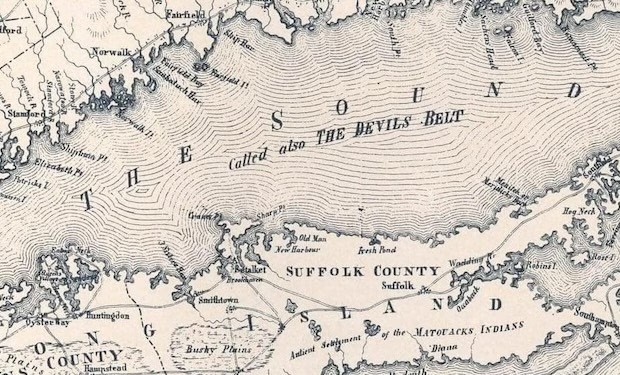
Tucked between Port Jefferson and Miller Place, the hamlet known now as Mount Sinai was known locally by another name entirely many years ago. Long before the modern name appeared on maps, locals called the area something very different and the story of how it changed sounds almost made up. And it has very biblical origins!
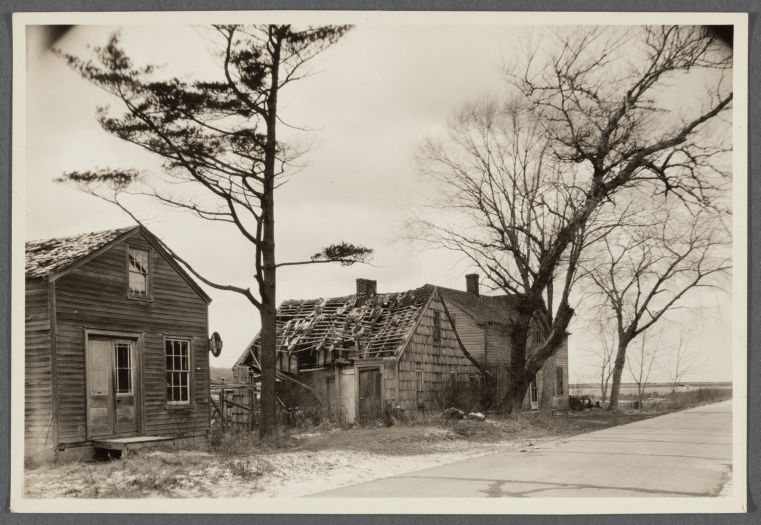
A photograph taken in December 1925 and preserved by the New York Public Library may have accidentally captured a piece of that forgotten history.
The image shows S. Tooker’s store at the northwest end of Mount Sinai. According to the archival description, the building was constructed in 1818 and was still locally known as “The Old Man’s” more than a century later. By the time photographer Eugene L. Armbruster documented it, the structure appeared weathered and partially collapsing, standing beside a quiet rural roadway.
But the real story may be the name itself.
Long before Mount Sinai officially became Mount Sinai, the hamlet was known as “Old Mans.” The name dated back to a 1644 land purchase agreement involving English settlers and Indigenous inhabitants. Historical accounts say the deal included coats, stockings, powder, lead, hatchets, knives, and shirts as payment.
Then things got complicated.
By 1840, residents sought an official post office designation, but federal postal authorities reportedly rejected the name “Old Mans” because it was considered “not proper.”
The community then attempted to use the name “Mount Vernon,” but that was already taken elsewhere in New York.
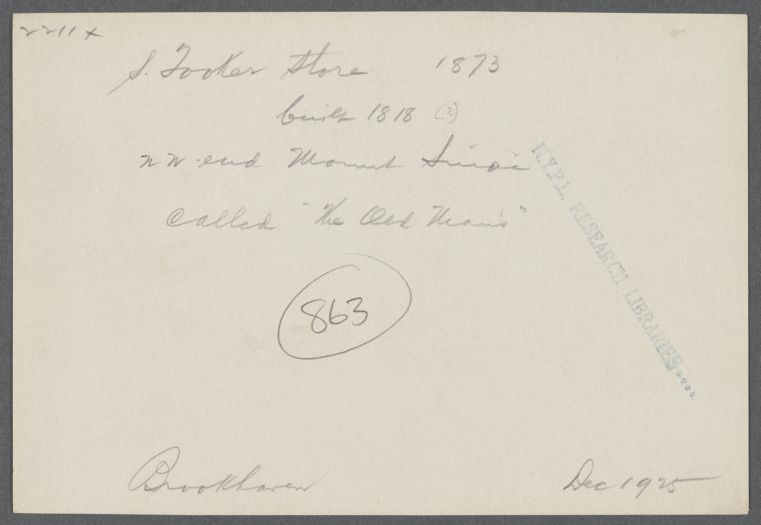
Photo: Handwritten reverse side of Eugene L. Armbruster’s December 1925 photograph documenting S. Tooker’s store in Mount Sinai. The notation identifies the building as “The Old Man’s,” preserving one of the older local references connected to the hamlet before the name Mount Sinai became official. Photo: New York Public Library Digital Collections.
According to longstanding local lore, the first postmaster, Charles Phillips, settled the issue in an unusually direct way:
- He opened a Bible
- Used a knitting needle to point at a random passage
- Landed on “Mount Sinai”
- Submitted the name
And the federal government approved it.
That decision permanently changed the identity of the hamlet, though traces of the older name lingered for decades in local references and landmarks. Even locals probably don’t realize that their town’s official name may have come down to a knitting needle and a random page in a Bible.
The surviving photograph is now part of the Eugene L. Armbruster Collection of Long Island photographic views at the New York Public Library. Armbruster spent decades documenting Long Island communities, preserving scenes that otherwise would have disappeared completely.
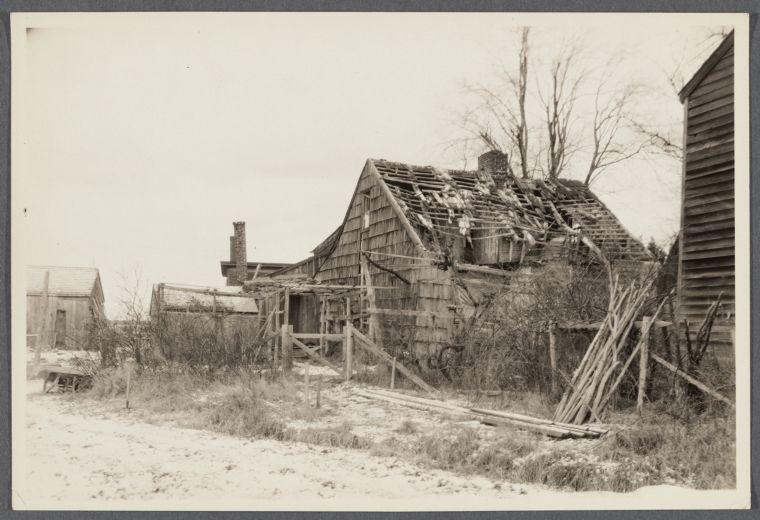
Photo: S. Tooker’s store at the northwest end of Mount Sinai, photographed in December 1925 by Eugene L. Armbruster. The building, reportedly constructed in 1818, was still identified in the archival caption as “The Old Man’s,” preserving a reminder of the hamlet’s earlier name before Mount Sinai became official in the 1840s. Photo: New York Public Library Digital Collections.