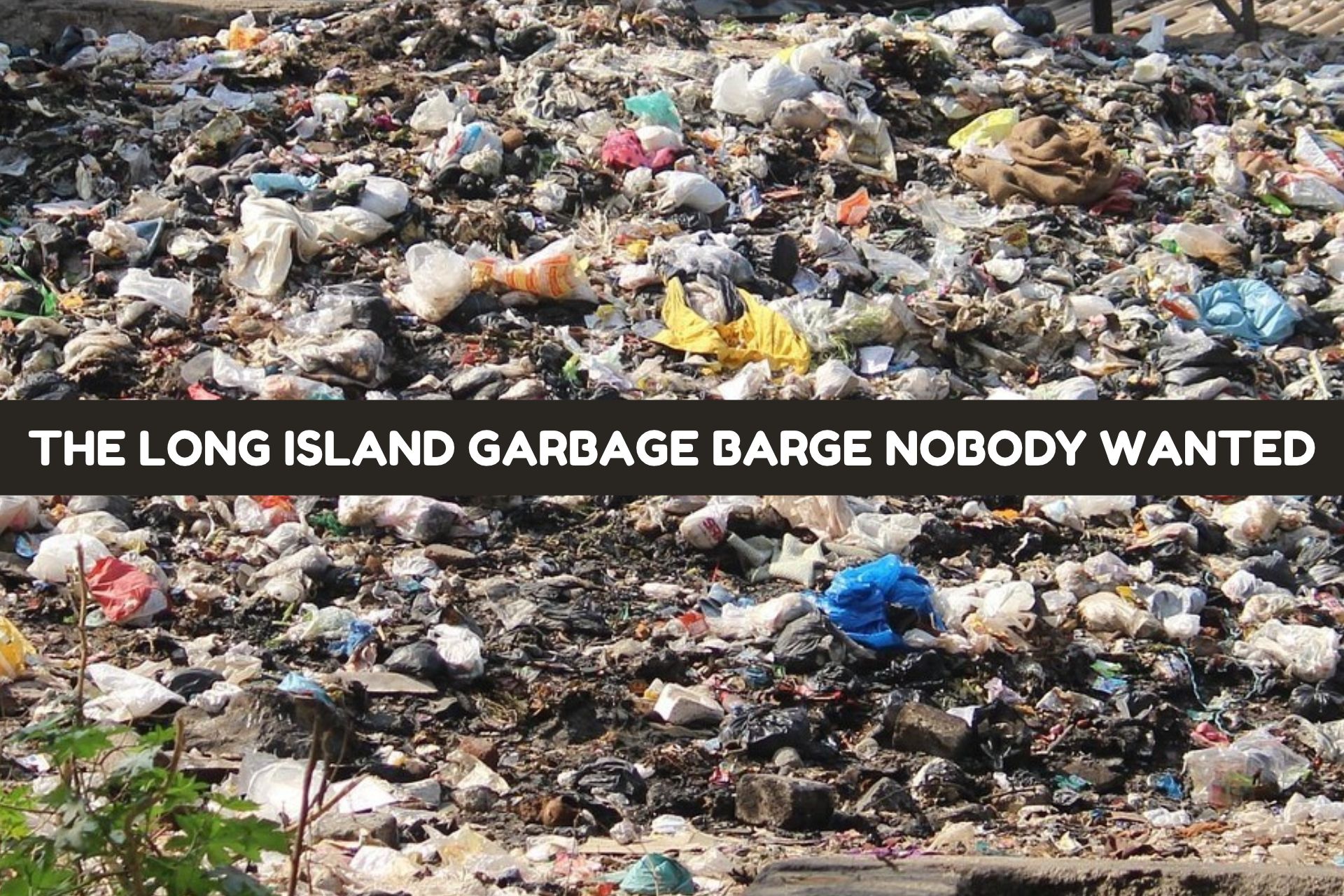
On March 22, 1987, a barge carrying more than 3,100 tons of garbage from Long Island and New York City began what was supposed to be a routine trip to North Carolina. Instead, it traveled roughly 6,000 miles, was rejected by states and foreign countries, and became a national embarrassment. For months, Americans watched as the Mobro 4000, widely known as the Islip garbage barge, searched for somewhere willing to accept its unwanted cargo.
The voyage attracted television reporters, environmental activists, politicians and late-night comedians. By the time the garbage finally reached an incinerator in Brooklyn, the barge had become a symbol of America’s growing waste-disposal problem and helped bring recycling into the national conversation.
Long Island Was Running Out of Places to Put Its Garbage
By the mid-1980s, Long Island faced a serious problem with the disposal of household and commercial waste. Decades of suburban growth had increased the amount of garbage produced by its communities, while concerns about groundwater contamination were making traditional landfills increasingly difficult to operate.
New York State had already passed the Long Island Landfill Law in 1983, requiring the phaseout of landfills in areas where water naturally replenishes the Island’s underground aquifers. Communities needed alternatives, including incineration, recycling and transporting garbage elsewhere.
Islip was among the municipalities looking for a solution. Private waste contractors proposed transporting large quantities of compacted garbage by barge to disposal sites in other states, where land was more readily available and disposal costs could be lower.
One businessman involved in the arrangement was Lowell Harrelson, an Alabama entrepreneur who hoped to demonstrate that shipping garbage by water could be an economical alternative to traditional disposal methods. His plans included using waste at a site in North Carolina where methane gas might be recovered as a source of energy.
The arrangement appeared to offer a practical answer to a growing problem. But transporting the garbage would prove considerably easier than finding anyone willing to receive it.
A 3,100-Ton Shipment Heads South
On March 22, 1987, the Mobro 4000, accompanied by the tugboat Break of Dawn, departed New York carrying approximately 3,168 tons of compacted waste. Although the vessel became known nationally as the Islip garbage barge, the shipment also contained commercial refuse collected in New York City and Nassau County.
The garbage had been compressed into thousands of tightly packed bales and stacked aboard the vessel. Its intended destination was Morehead City, North Carolina, where the cargo would be transported inland for disposal and a proposed methane-recovery project.
There was nothing particularly remarkable about transporting waste from one place to another. Communities throughout the Northeast were increasingly looking beyond their own boundaries for disposal options, and the operators believed the shipment could demonstrate a workable new business model.
That changed when North Carolina residents and officials learned what was approaching their coastline.
North Carolina Refuses the Garbage
On April 1, 1987, WRAL-TV in Raleigh broadcast a report about the garbage shipment, drawing attention to the prospect of thousands of tons of New York waste arriving in North Carolina. Residents objected, and state officials began investigating the cargo.
Concerns about possible medical waste complicated the situation. A state environmental official reported seeing a bedpan among the trash, and suspicions spread that the shipment might contain contaminated materials. North Carolina authorities moved to prevent the garbage from being unloaded.
The operators were left with thousands of tons of refuse aboard a barge and no approved destination. They decided to search for another place willing to accept it.
North Carolina’s rejection was only the beginning.
A 6,000-Mile Search for Somewhere to Dump the Trash
The Mobro 4000 continued south, looking for ports and disposal sites willing to accept the shipment. Officials in Louisiana, Alabama and other states rejected the garbage, while attempts to find a destination outside the United States also failed.
The barge’s travels took it through the Gulf of Mexico and as far as Belize. Mexico and the Bahamas were among the countries that refused to accept the cargo, turning what had begun as a local disposal arrangement into an international controversy.
The vessel’s growing notoriety made finding a destination even more difficult. By then, the garbage had spent weeks aboard the barge, and concerns about contamination had spread well beyond North Carolina.
Television networks followed the journey as the tugboat continued towing the unwanted shipment from place to place. The sight of an enormous pile of New York garbage traveling thousands of miles in search of a home provided an irresistible subject for reporters and comedians.
The Tonight Show Starring Johnny Carson made jokes about the barge, while CBS news anchor Dan Rather described it as an exceptionally well-watched shipment of garbage. The story had become familiar to millions of Americans who had never given much thought to what happened after their trash was collected.
For Long Island, the attention was less amusing. Islip had become nationally associated with a shipment that nobody wanted, and the prospect of bringing the garbage home created another political dispute.
Even New York Didn’t Want It Back
The barge returned to New York waters in May 1987, but that did not resolve the situation. Officials continued debating who was responsible for the cargo and where it could legally be unloaded.
Islip Town Supervisor Frank Jones argued that the town should not be responsible for disposing of garbage that had originated elsewhere. The shipment included waste from New York City and Nassau County, and Jones insisted that responsibility should be divided accordingly.
On June 1, Jones announced that Islip would accept only 1,238 tons of the shipment’s approximately 3,186 tons, according to contemporary Associated Press reporting. He suggested that New York City should dispose of its own portion rather than expect Islip taxpayers to pay for the entire load.
The barge remained in the New York area while officials negotiated and environmental groups raised concerns about accepting the waste. Queens Borough President Claire Shulman also sought to prevent the garbage from being brought ashore in her borough.
Investigations ultimately found no evidence that the shipment presented the infectious-waste hazard that had been feared. Federal, state and local inspectors examined the cargo and determined that it could be handled through conventional disposal methods.
Nevertheless, months of publicity, political arguments and legal disputes had made an already difficult disposal problem far more complicated.
The Garbage Finally Comes Home
By July, New York officials had reached an agreement to dispose of the cargo. The garbage would be taken to Brooklyn, burned at the Southwest Brooklyn Incinerator, and the remaining ash transported to the Islip Town landfill.
The agreement still faced legal challenges, delaying the operation further. On August 24, 1987, the Mobro 4000 finally docked at the Brooklyn incinerator, ending its extended period without an unloading destination.
Workers began removing the compacted bales on September 1. Environmental personnel inspected the garbage before it was placed into the incinerator, where the shipment was gradually reduced to ash.
By October, the disposal process was complete. Approximately 430 tons of ash remained from the original load and were buried at the Islip landfill.
After a voyage of roughly 6,000 miles, rejection by multiple states and countries, months of national publicity and extensive legal proceedings, the garbage ended up back on Long Island.
How the Garbage Barge Helped Change Waste Disposal
The Mobro 4000 became one of the defining environmental stories of the 1980s because it illustrated a problem shared by communities throughout the United States. Americans were producing enormous quantities of garbage, but existing disposal methods were becoming more expensive, controversial and environmentally problematic.
The incident occurred at a particularly important moment in New York’s waste-management history. The state had issued a comprehensive solid waste management plan in March 1987, the same month the barge departed, as officials worked to address shrinking landfill capacity and groundwater concerns.
In 1988, New York enacted the Solid Waste Management Act, establishing a hierarchy that emphasized reducing waste, reusing materials, recycling and recovering resources before relying on disposal. Statewide recycling requirements followed in 1992.
The garbage barge did not single-handedly create those policies, and efforts to improve recycling and waste management had begun before its voyage. Nevertheless, the New York State Department of Environmental Conservation has identified the incident as an important public demonstration of the need for better waste-management practices.
The controversy also helped change how Americans thought about garbage. Instead of treating waste disposal as a routine municipal service, the public was confronted with the enormous quantities of material being discarded and the growing difficulty of finding places to put it.
The Lasting Legacy of Islip’s Most Famous Garbage Shipment
Nearly four decades later, the Mobro 4000 remains one of the most unusual episodes in Long Island’s environmental history. What began as an attempt to save money on garbage disposal became an international news story involving government officials, courts, television networks and communities thousands of miles from Islip.
The barge is remembered for its extraordinary journey, but its importance lies in the waste-disposal problem it exposed. Long Island’s reliance on groundwater, limited available land and dense suburban development made those challenges particularly difficult, and the region continues to confront decisions about how its waste should be collected, processed and disposed of.
There is also a distinctly Long Island conclusion to the entire affair. After months at sea and thousands of miles of travel, the garbage that nobody wanted was reduced to ash and returned to the town whose name had become inseparable from the voyage.
Sources:
- Molloy University, Long Island Environmental History Timeline – Detailed history of the Mobro 4000, including the voyage, rejected ports, political disputes and final disposal. https://www.molloy.edu/about/community-outreach/history-of-long-island/environment
- New York State Department of Environmental Conservation, 2023 Solid Waste Management Plan, Appendix A – Official state history documenting the garbage barge and its role in waste-management policy. https://dec.ny.gov/sites/default/files/2023-12/finalsswmpappendices2023.pdf
- North Carolina Department of Natural and Cultural Resources, Tar Heels Say No to the Mobro Garbage Barge – North Carolina’s response to the shipment, the original television coverage and objections to the cargo. https://www.dncr.nc.gov/blog/2016/04/01/tar-heels-say-no-mobro-garbage-barge
- Los Angeles Times, August 25, 1987, Associated Press – Contemporary account of the garbage barge docking in Brooklyn and plans for incineration. https://www.latimes.com/archives/la-xpm-1987-08-25-mn-4097-story.html
- Los Angeles Times, September 2, 1987, Associated Press – Contemporary account of the unloading, inspection and incineration of the garbage. https://www.latimes.com/archives/la-xpm-1987-09-02-mn-3618-story.html
- Washington Post, June 2, 1987, Associated Press – Contemporary account of Islip’s dispute with New York City over responsibility for the garbage. https://www.washingtonpost.com/archive/politics/1987/06/02/islip-to-accept-less-than-half-of-barges-trash/0c45f1c7-9129-46ef-a7c5-6d7ac48e9940/
- Newsday, Long Island’s Infamous Garbage Barge of 1987 Still Influences Laws – Retrospective reporting on the voyage and its long-term impact. https://projects.newsday.com/long-island/long-island-garbage-barge-left-islip-30-years-ago/