Beneath Bethpage and neighboring Nassau County communities lies one of the largest groundwater contamination plumes in the United States. Stretching approximately four miles south from the former Grumman aerospace manufacturing complex, the underground pollution is roughly two miles wide and reaches depths of up to 900 feet, according to New York State environmental officials. The contamination originated from industrial operations that helped establish Long Island as a center of American military aviation and space exploration.
The chemicals left behind by Grumman and the U.S. Navy have required decades of investigations, drinking-water treatment, legal disputes and extensive cleanup operations. Although much of the contamination is now being actively contained, the environmental consequences of the aircraft manufacturing era remain an ongoing responsibility for the company, the Navy and New York State.
What We Know
- The source: Decades of aircraft manufacturing by Grumman and the U.S. Navy in Bethpage left industrial chemicals in the soil and groundwater, including the cancer-causing solvent trichloroethylene (TCE).
- The discovery: Contamination was detected in a Bethpage Water District public drinking-water well in 1976, although evidence indicates Grumman was aware of pollution problems years earlier.
- The size: According to New York State’s January 2026 update, the groundwater plume extends approximately four miles south, is roughly two miles wide and reaches depths of 900 feet.
- The communities affected: The underground contamination extends beyond Bethpage into surrounding Nassau County communities, requiring extensive groundwater monitoring and treatment.
- The park connection: Portions of Bethpage Community Park were once Grumman industrial waste disposal areas. Six buried steel drums were discovered beneath a former ballfield in 2024.
- The health concerns: TCE is a known human carcinogen. State health officials have investigated cancer patterns in the Bethpage area, although a direct link between the contamination and individual cancer cases has not been established.
- The drinking water: Public water suppliers treat and monitor affected groundwater. State officials report that water delivered to homes meets drinking-water standards.
- The cleanup: As of January 2026, extraction wells were pumping approximately 10 million gallons of contaminated groundwater daily for treatment. In March, the Navy estimated that more than 97% of the plume was under active control, although substantial contamination remains underground.
When Bethpage Helped Build American Aviation
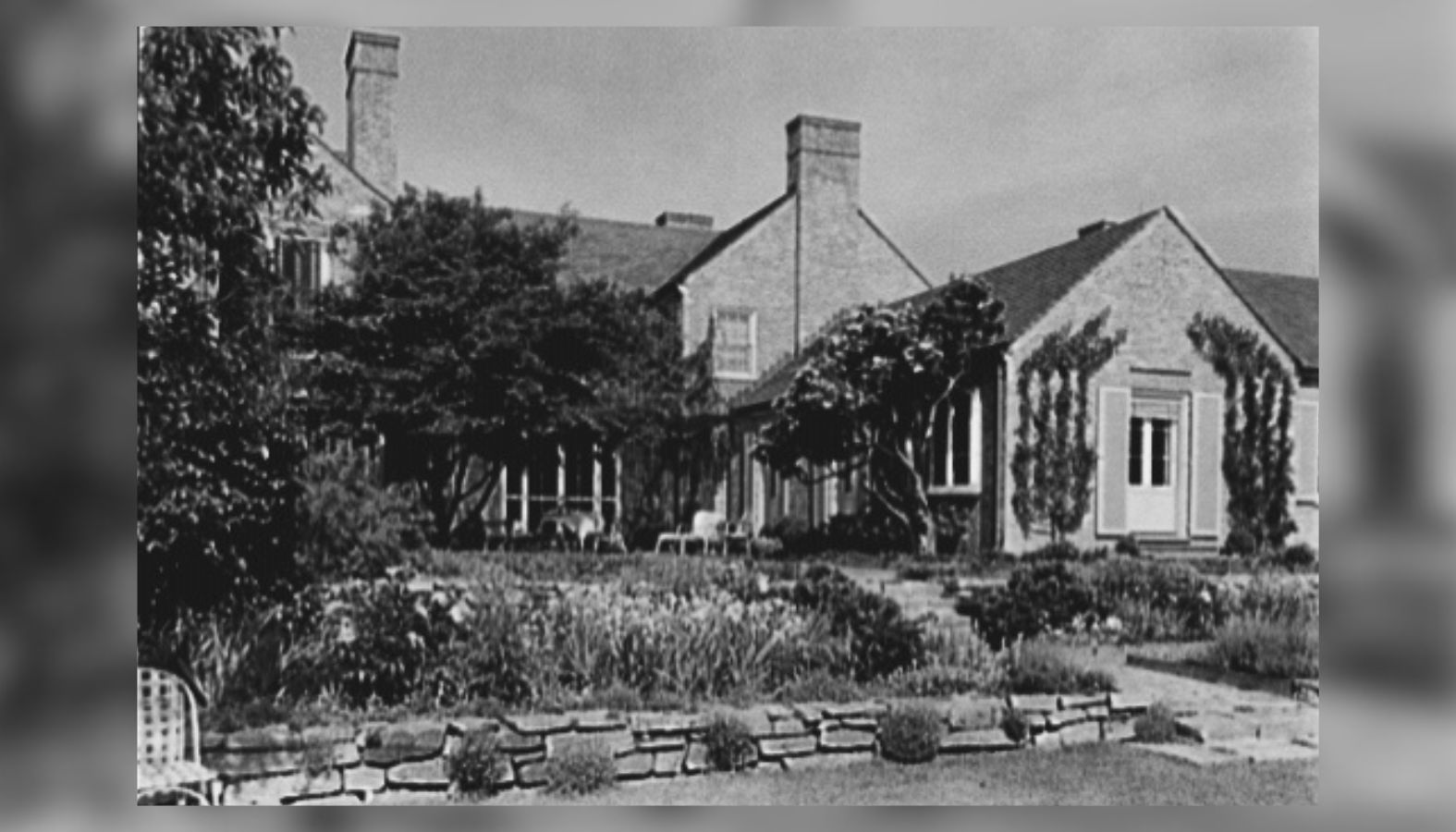
Grumman Aircraft Engineering Corporation was established in Baldwin in 1929 and later expanded into Bethpage, where its operations became an important part of Long Island’s economy. During World War II, the company manufactured thousands of military aircraft for the U.S. Navy, including the F6F Hellcat fighter, which played a major role in the Pacific campaign.
At its peak, the Bethpage manufacturing complex occupied approximately 600 acres and included facilities operated by Grumman and the Navy. The Navy-owned Naval Weapons Industrial Reserve Plant was operated by Grumman under a government contract, supporting the production, testing and development of military aircraft and related equipment.
Grumman continued to play a leading role in aerospace engineering after the war. Its Bethpage operations helped design and build the lunar modules used in NASA’s Apollo program, including the spacecraft that carried Neil Armstrong and Buzz Aldrin to the lunar surface in July 1969.
For generations of Long Islanders, Grumman represented well-paying industrial employment, technical achievement and national prestige. Meanwhile, chemicals used during decades of manufacturing were accumulating in the soil and groundwater beneath the facilities.
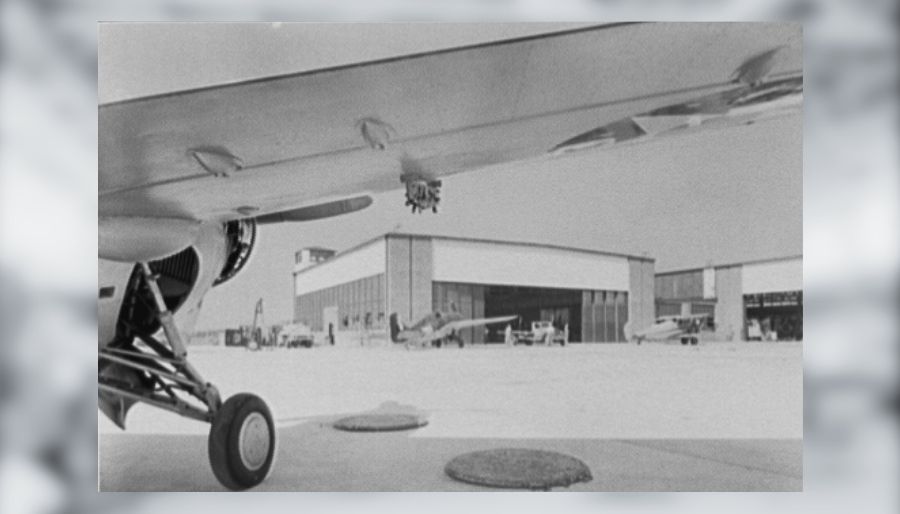
Photo: The Grumman Aircraft Engineering Corporation plant in Bethpage, photographed beneath an aircraft wing on October 12, 1940. (Gottscho-Schleisner Collection, Library of Congress, Prints and Photographs Division)
How Industrial Chemicals Entered the Groundwater
Aircraft manufacturing required industrial solvents to clean metal parts, remove grease and prepare components for assembly. Among the chemicals used at the Bethpage facilities was trichloroethylene, commonly known as TCE, a solvent that can contaminate groundwater and is recognized as a human carcinogen.
Historic storage, handling and waste disposal practices allowed industrial chemicals to enter the surrounding environment. Investigations eventually identified contamination involving TCE and other volatile organic compounds, as well as metals and additional hazardous substances at particular locations.
Long Island’s groundwater system made the contamination especially consequential. Much of Nassau County obtains its drinking water from underground aquifers, and polluted groundwater can migrate away from its original source as water naturally moves through the subsurface.
At Bethpage, contamination originating from industrial activities spread southward and became what environmental officials now call the Navy-Grumman groundwater plume. The chemicals have been detected at different depths within the aquifer, creating a complicated cleanup problem that extends far beyond the boundaries of the original manufacturing property.
Contamination Reaches the Public Water Supply
By the 1970s, Grumman’s own water supply had become contaminated. The company sought to connect its facilities to the Bethpage Water District after testing revealed chemical pollution in wells serving the industrial complex.
In 1976, testing also identified TCE in a Bethpage Water District public supply well. The discovery raised questions about the source of the contamination and the potential consequences for residents who depended on groundwater for drinking water.
The district removed the affected well from service and continued investigating the problem. By the late 1980s, it had installed treatment equipment to remove TCE from the water supply, and Grumman subsequently agreed to pay for treatment-related costs.
However, the contamination was not limited to the first affected well. Additional testing revealed that the chemicals had moved beyond the industrial property, requiring more extensive efforts to protect public water supplies in Bethpage and surrounding communities.
A 2020 Newsday investigation uncovered internal company documents and government records showing that Grumman knew about groundwater contamination decades before publicly acknowledging the extent of the problem. The investigation also revealed that government officials had, at times, downplayed concerns about contaminated water despite evidence of the pollution.
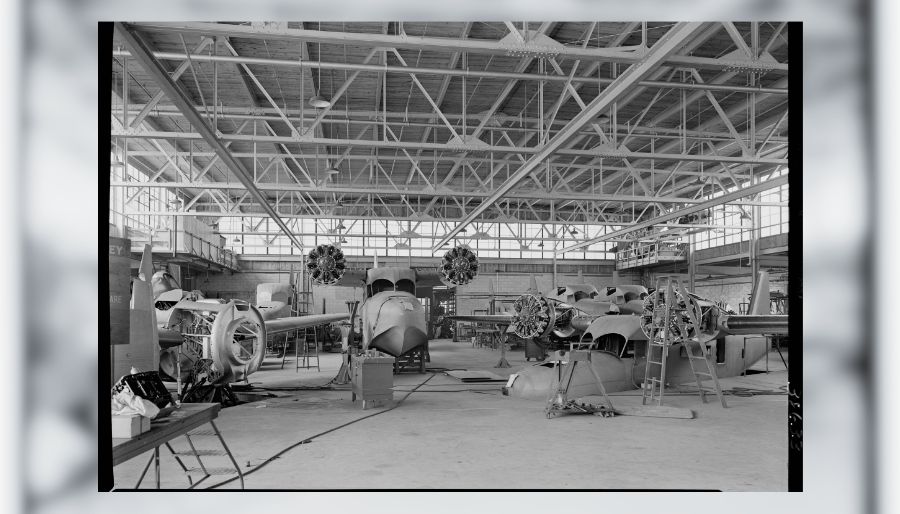
Photo: Inside the Grumman Aircraft Engineering Corporation factory in Bethpage on October 12, 1940. (Gottscho-Schleisner Collection, Library of Congress, Prints and Photographs Division)
The Contaminated Ground Beneath Bethpage Community Park
A striking part of the story involves Bethpage Community Park, a property that had once been used for Grumman’s industrial waste operations. Portions of the land served as settling ponds and sludge drying beds before Grumman donated the property to the Town of Oyster Bay in 1962.
The park later became a community recreation area, but environmental investigations revealed hazardous substances remaining beneath portions of the property. Cleanup operations eventually required restrictions on parts of the park and specialized treatment to address contamination left behind by the earlier industrial activities.
In March 2024, contractors installing equipment for a soil cleanup project discovered six 55-gallon steel drums buried inside a reinforced concrete structure beneath the former ballfield area. The discovery attracted renewed attention to the property’s industrial past and the continuing work necessary to investigate and remove contaminated materials.
State environmental officials reported that the drums were intact and had not leaked. They were subsequently removed, and the Department of Health stated that the discovery had not created a new threat to drinking water or public health.
The park cleanup has continued alongside the much larger groundwater remediation program. In October 2025, the DEC announced completion of the second phase of thermal treatment at the former Grumman settling ponds, using heat to remove contamination from the subsurface.
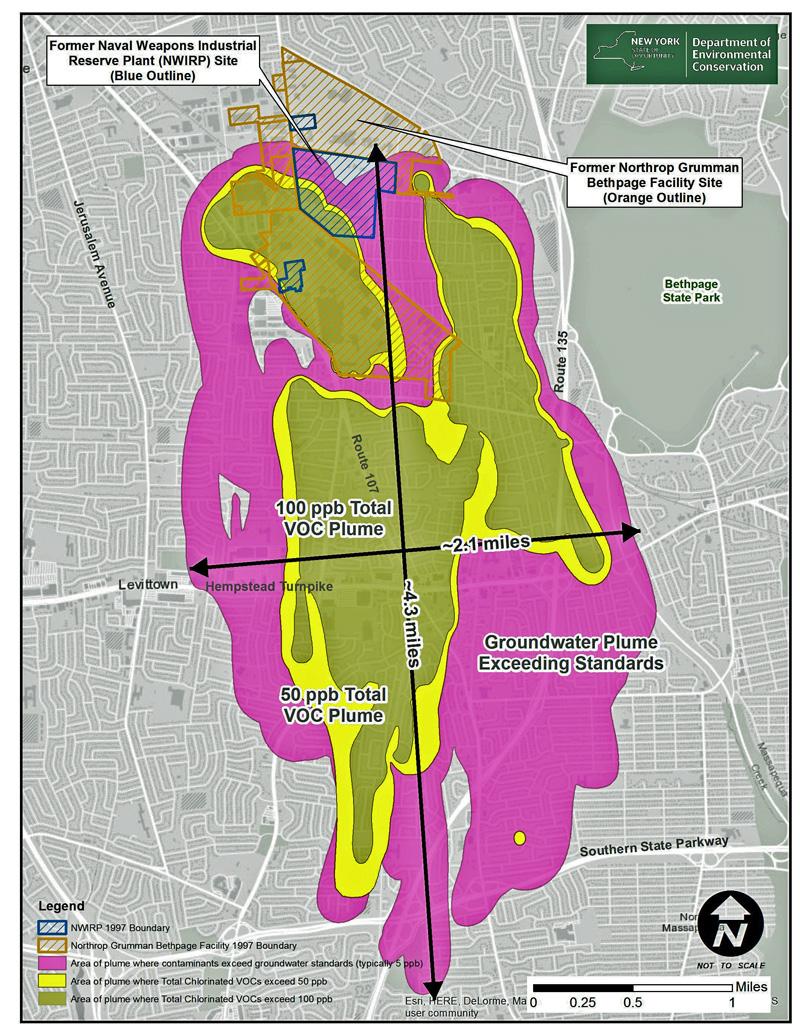
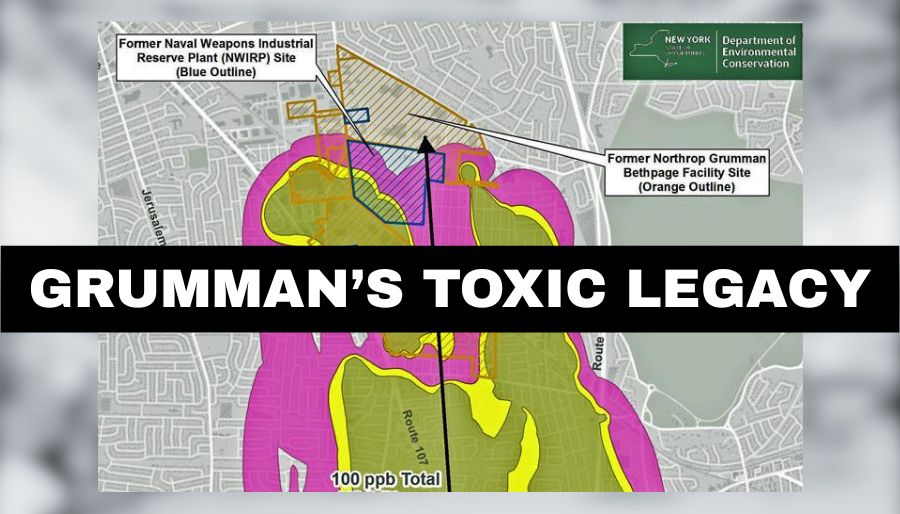
Photo: A New York State Department of Environmental Conservation map shows the extent of groundwater contamination spreading south from the former Grumman and U.S. Navy facilities in Bethpage. (New York State Department of Environmental Conservation)
How Far Has the Pollution Spread?
The main groundwater plume extends south from the former industrial complex through portions of central Nassau County. Its geographic extent includes groundwater beneath communities in the Bethpage, Levittown, Plainview, Farmingdale and Massapequa areas, although contamination levels and depths vary considerably from place to place.
The plume is not an underground lake of chemicals. It consists of groundwater containing dissolved contaminants that have spread through the aquifer, with some locations showing higher concentrations than others.
According to the DEC’s January 2026 update, the plume extends approximately four miles south toward the Southern State Parkway and is about two miles wide. The agency reported that the leading edge of the contamination had not reached the parkway at concentrations exceeding drinking-water standards.
The distinction between contaminated groundwater and water delivered to homes is important. Public water suppliers test and treat groundwater to remove regulated contaminants before distribution, and state officials report that the public water supplied to homes meets drinking-water standards.
Nevertheless, the contamination has forced water districts and government agencies to install and maintain specialized treatment systems. It has also required extensive monitoring to prevent affected groundwater from threatening additional wells.
Health Concerns and the Search for Answers
Concerns about possible long-term health consequences have accompanied the Bethpage contamination for decades. TCE is associated with serious health risks, including certain cancers, and investigators have also documented instances in which contaminated soil vapors entered homes near the former industrial facilities.
Following testing in 2009, the Navy installed protective systems in several homes where contamination associated with the former Naval Weapons Industrial Reserve Plant had been detected in indoor air or beneath the buildings. Additional containment and vapor extraction systems were installed to address the problem.
In 2013, the New York State Department of Health released an evaluation of cancer cases in neighborhoods near the former facilities. The study did not establish an unusual overall pattern of cancer, although residents diagnosed with cancer in one small study area were younger than expected.
The findings did not settle all public concerns. In August 2024, the Department of Health announced an expanded review of cancer incidence in the Bethpage area, explaining that additional information could help clarify local cancer trends.
Determining whether an individual cancer was caused by environmental contamination is especially difficult. Such investigations must consider the nature and duration of possible exposure, the types of cancer involved and other medical and environmental factors.
A Cleanup That Has Taken Decades
Efforts to contain the Navy-Grumman plume have involved pumping contaminated groundwater from the aquifer, treating it to remove hazardous chemicals and preventing further migration. The scale of the operation requires deep extraction wells, underground pipelines, treatment plants and extensive monitoring across Nassau County.
Northrop Grumman, which acquired Grumman in 1994, and the U.S. Navy share responsibility for different portions of the remediation work. In 2022, New York State finalized a consent decree with Northrop Grumman that formalized additional cleanup commitments, including new extraction wells, treatment systems and compensation related to damaged natural resources.
By January 2026, according to the DEC, the Navy and Northrop Grumman were operating 20 extraction wells that collectively withdrew approximately 10 million gallons of contaminated groundwater each day. Further treatment facilities and extraction systems were being developed to intercept contamination in the interior and southern portions of the plume.
On March 31, 2026, the Navy marked the opening of a new Phase II groundwater treatment plant in Bethpage. The Navy estimated that, through the combined cleanup systems, more than 97 percent of the contaminated groundwater plume was under active control and more than 20 percent of the total contamination had been removed.
Those figures represent major progress, but containment and removal are not the same thing. Systems that prevent the plume from spreading must continue operating while remaining contaminants are extracted and treated.

Photo: A Grumman F-14A Tomcat launches from the aircraft carrier USS Theodore Roosevelt in the Atlantic Ocean on September 30, 1987. (U.S. Navy photo by PH1 Gerwien, National Archives)
Grumman’s Complicated Legacy
The environmental history of Bethpage presents a complicated legacy for a company whose achievements remain deeply connected to Long Island. Grumman helped produce the aircraft that fought in World War II and the lunar modules that enabled astronauts to land on the moon, while industrial practices at its manufacturing complex left behind contamination that later generations would inherit.
Click here to read about Grumman’s aviation history on Long Island
The cleanup has also demonstrated how long groundwater pollution can persist after the industrial activity responsible for it has ended. Although Grumman’s large-scale Bethpage manufacturing operations are gone, the movement of groundwater and the need for treatment continue.
For Long Islanders, the most immediate issue is protecting the aquifer that supplies their drinking water. The extensive system of wells and treatment plants now operating beneath Nassau County reflects decades of work to address the consequences of pollution that began when Bethpage was one of America’s most important aerospace manufacturing centers.
Cover photo: A New York State Department of Environmental Conservation map illustrates groundwater contamination extending from the former Grumman and U.S. Navy facilities in Bethpage. (Map: NYS DEC; Graphic: Crazy Facts About Long Island)
Sources:
- New York State Department of Environmental Conservation – Comprehensive history of the former Grumman and Navy facilities, groundwater contamination, Bethpage Community Park and cleanup operations. https://dec.ny.gov/environmental-protection/site-cleanup/regional-remediation-project-information/region-1/environmental-investigation-cleanup-activities-bethpage-facility-sites
- New York State Department of Environmental Conservation, January 2026 – Official groundwater plume update documenting the four-mile extent, contamination depths, extraction wells and cleanup progress. https://dec.ny.gov/sites/default/files/2026-01/grummanupdate0126.pdf
- U.S. Navy, March 31, 2026 – Opening of the Phase II groundwater treatment plant, cleanup investments and estimates of plume containment. https://www.navfac.navy.mil/Home/News-Detail/Article/4452960/navy-marks-major-restoration-milestone-with-launch-of-phase-ii-groundwater-trea/
- Bethpage Water District – Detailed account of the discovery of TCE contamination in 1976, affected drinking-water wells and subsequent treatment operations. https://bethpagewater.com/Blog/article/2435/what-you-should-know-about-the-northrop-grummannavy-plume
- New York State Department of Health – Bethpage environmental health investigations, cancer incidence studies and public health concerns. https://www.health.ny.gov/environmental/investigations/bethpage/
- Newsday, Grumman’s Toxic Legacy – Original investigative reporting by Paul LaRocco and David M. Schwartz documenting Grumman’s historical knowledge of contamination and government responses. Archived by the New York State DEC. https://extapps.dec.ny.gov/data/DecDocs/130003A/Published%20Article.HW.130003A.2020-02-19.Newsday_Grumman_Plume_Decades_Deceit.pdf
- New York State Department of Environmental Conservation, 2016 – Historical overview of Grumman’s Bethpage aircraft manufacturing operations, Apollo lunar module production and early environmental remediation. https://extapps.dec.ny.gov/data/DecDocs/130003A/Fact%20Sheet.HW.130003A.2016-04-01.NGC%20Bethpage%20Remediation%20Update.pdf