Roosevelt Raceway in Westbury is remembered for several innovations in harness racing, but one introduced there in 1946 remains part of the sport today.
On May 24 of that year, the track put Stephen G. Phillips’ improved mobile starting gate into regular use, using a vehicle with folding wings to bring horses toward the starting line together and at speed. When the field reached the start, the wings folded and the vehicle accelerated away. The system reduced the false starts and repeated recalls that had long complicated harness racing, and versions of the same basic arrangement are still used at tracks today.
Roosevelt Raceway began with automobiles, not horses
The Westbury property had originally been developed for automobile racing. Roosevelt Raceway was built for the revival of the Vanderbilt Cup in 1936, with another Vanderbilt Cup held there in 1937. The site was also used for midget automobile racing before George Morton Levy and his associates turned it into a harness-racing operation.
Harness racing began at Roosevelt Raceway on Sept. 2, 1940, with a night program attended by about 5,000 people. Night racing was an important part of Levy’s effort to make the sport more accessible to spectators in the New York metropolitan area, but the track’s first years were difficult, particularly during World War II. Roosevelt nevertheless survived and became an important testing ground for changes intended to modernize harness racing.
The Harness Racing Museum credits Levy with helping revive the sport through several innovations associated with Roosevelt, including night racing, the Phillips starting gate and the elimination of traditional heat racing. These changes were aimed at making race programs easier to follow, more predictable in length and better suited to spectators who were treating an evening at the track as entertainment.
The problem Phillips was trying to solve
Starting a harness race was not always a simple process. Before mobile gates became standard, trotters and pacers had to be brought together for the start without the benefit of a moving barrier that could keep the field aligned. Poorly organized approaches could result in recalls, delays and repeated attempts before a race was allowed to begin.
Phillips was already familiar with that problem before his work at Roosevelt. An experienced harness-racing starter from Xenia, Ohio, he had experimented with mobile starting devices before 1946. Roosevelt Raceway therefore should not be described as the place where Phillips first conceived the idea. Its importance lies in the successful introduction of his improved system into regular racing at a major harness track.
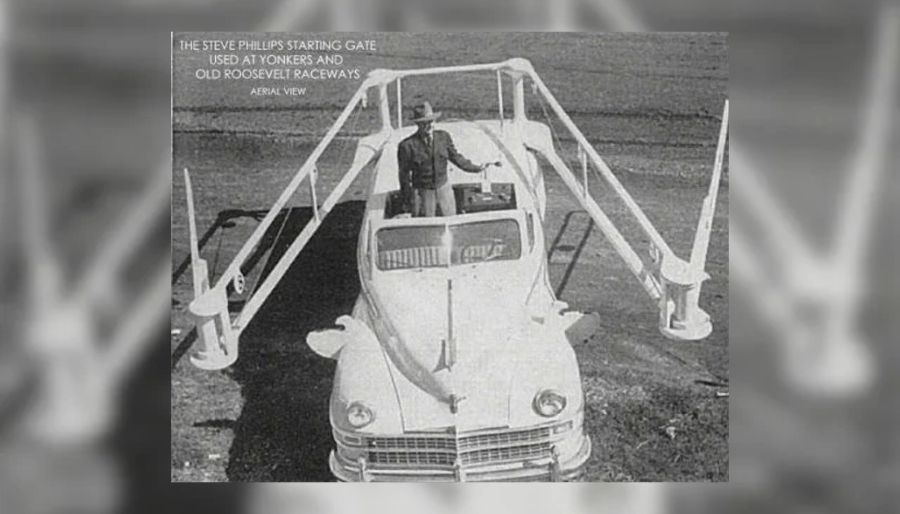
The gate used an automobile with long wings extending from both sides. Horses followed those wings as the vehicle approached the starting point, creating a moving line that helped keep the field in formation. Once the horses reached the start, the wings folded against the vehicle and the car pulled away. Phillips filed a patent application for the system in July 1946, less than two months after its Roosevelt debut, and the patent was later granted in 1950.
The gate debuted at Roosevelt in May 1946
Phillips’ improved mobile starting gate was introduced at Roosevelt Raceway on May 24, 1946. The system provided a more consistent way to bring horses to the starting line, reduced the need for repeated recalls and helped keep race programs moving on schedule.
The idea spread quickly beyond Westbury. Mobile starting gates appeared at other tracks soon afterward and became standard equipment in harness racing. The vehicles and safety systems have changed considerably since the 1940s, but the underlying method remains familiar: horses form behind extended wings, approach the starting line at speed and begin racing as the wings fold and the vehicle accelerates ahead.
Roosevelt Raceway grew after the war
The starting gate arrived just as Roosevelt Raceway was entering the period that would establish its national reputation. The track expanded during the postwar years and became one of the country’s leading harness-racing venues during the 1950s and 1960s.
Several dates help trace that growth:
- 1940: Roosevelt Raceway opened for night harness racing on Sept. 2.
- 1946: Stephen G. Phillips’ improved mobile starting gate went into regular use on May 24.
- 1956: Roosevelt hosted the first Messenger Stakes, which became part of the Triple Crown for pacers.
- 1957: A large new grandstand and clubhouse opened, replacing facilities that dated to the automobile-racing era.
- 1959: Roosevelt inaugurated the International Trot, bringing prominent horses from Europe and North America to Long Island.
- 1960: The International Trot program drew a crowd of 54,861.
- 1988: Roosevelt Raceway closed after nearly 48 years of harness racing.
The rebuilt 1957 complex became known as the “Dream Track” and reflected how far Roosevelt had come from the relatively modest harness operation that opened in 1940. The International Trot further strengthened the track’s reputation, beginning with a 1959 running won by the French trotter Jamin and followed a year later by the 54,861-person crowd.
A Roosevelt innovation that outlasted the track
Roosevelt Raceway remained a major Long Island sporting venue for decades before closing in 1988. The property was eventually redeveloped, but the track’s influence on harness racing did not disappear with it.
The mobile starting gate is one of the clearest examples. Phillips had been developing the concept before his association with Roosevelt, so the track cannot properly be called the birthplace of the idea itself. What Roosevelt Raceway did was put his improved gate into successful regular use on May 24, 1946, helping demonstrate that the system worked at a major harness track.
That basic method became standard throughout the sport. More than 80 years later, the sight of a field lining up behind the wings of a moving starting vehicle remains one of the most recognizable features of harness racing, with an important chapter in its development taking place in Westbury.
Photos:
Photo 1: Steve Phillips with a mobile starting gate of the type he operated at Roosevelt and Yonkers raceways. Credit: Roosevelt Raceway archives, via Standardbred Canada/SC Rewind; photographer not identified. Standardbred Canada
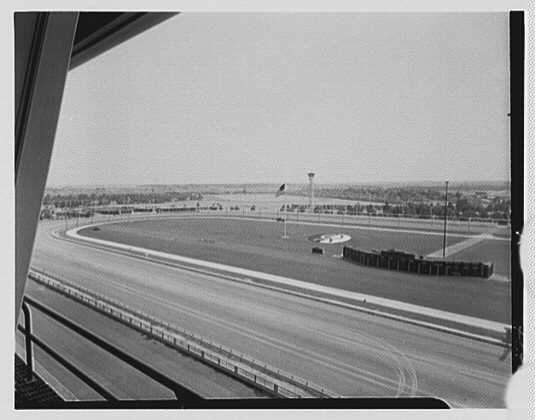
Photo 2: The infield at Roosevelt Raceway in Westbury, photographed July 30, 1958. Credit: Gottscho-Schleisner, Inc., Gottscho-Schleisner Collection, Library of Congress Prints and Photographs Division. Library of Congress
Sources:
- Harness Racing Museum & Hall of Fame, George Morton Levy
https://harnessmuseum.com/content/george-morton-levy - Standardbred Canada, “SC Rewind: The Starting Gate Turns 70”
https://standardbredcanada.ca/news/7-15-17/sc-rewind-starting-gate-turns-70.html - Standardbred Canada, “SC Rewind: The Changing Times”
https://standardbredcanada.ca/news/5-24-25/sc-rewind-changing-times.html - Stephen G. Phillips patent, “Starting Gate for Harness Horses,” filed July 18, 1946
https://patents.google.com/patent/US2497370A/en - Harness Racing Update, “Remembering Roosevelt Raceway and Good Time Park”
https://harnessracingupdate.com/2020/01/24/remembering-roosevelt-raceway-and-good-time-park/ - Yonkers International Trot, history of the International Trot
https://www.yonkersinternationaltrot.com/history - UPI Archives, Roosevelt Raceway and the International Trot
https://www.upi.com/Archives/1988/08/17/In-1959-Roosevelt-Raceway-averaged-22050-fans-a-night/5946587793600/ - Vanderbilt Cup Races, Roosevelt Raceway history
https://www.vanderbiltcupraces.com/blog/article/roosevelt_raceway_1936_1956 - Library of Congress, “Roosevelt Raceway, Westbury, Long Island. Infield I,” 1958
https://www.loc.gov/item/2018729911/ - Library of Congress, “Roosevelt Raceway, Westbury, Long Island. Infield II,” 1958
https://www.loc.gov/item/2018729912/