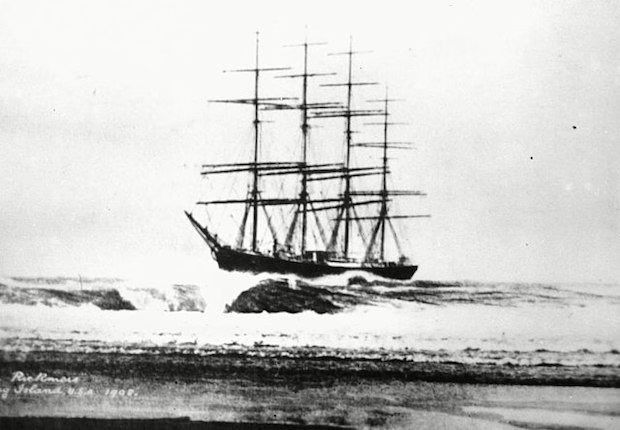
It started as the kind of night sailors feared most: wind howling, rain cutting sideways, and visibility reduced to almost nothing. Somewhere off Long Island’s South Shore in late April 1908, the captain of the Peter Rickmers realized too late that something wasn’t right.
The massive four-masted German bark, built in Scotland in 1889, had been pushing through a brutal gale when it slipped past Zach’s Inlet. In the darkness, with no clear sense of distance from shore, the ship drifted dangerously close. The captain would later admit he had no idea just how close he was until the unmistakable grind of the bow scraping the sandbar jolted the realization home. By then, it was already too late.
Through the night and into the next day, the crew was trapped. Waves slammed relentlessly into the stranded vessel, making it impossible to launch lifeboats. Rescue crews on shore faced their own limitations. The distance was too great for breeches buoys, those lifesaving lines fired from land to ship – to reach the crew. They tried anyway, again and again, but the storm kept winning.
By morning, word had spread along the South Shore. Dozens of lifesavers gathered, watching as the Rickmers slowly shifted closer to land. Equipment was prepared, lines were fired, and more than 30 rescuers stood ready. Still, every attempt fell short. Eventually, a tugboat named the Mohawk was called in, one of several desperate measures taken as the situation dragged on.
What made the wreck even more precarious was what the ship was carrying. The Rickmers was loaded with more than 120,000 cases of kerosene and crude oil, bound for Burma under charter to the Standard Oil Company. In an effort to lighten the ship, some of the cargo was thrown overboard. It didn’t take long for that cargo to reach shore – and for locals to notice. Reports at the time described residents scooping up oil cans and walking off with them, turning part of the disaster into an unexpected windfall.
Meanwhile, salvage efforts grew increasingly chaotic. Additional wrecking steamers were brought in, but the same storm that caused the disaster made any meaningful rescue nearly impossible. The seas were too rough, the conditions too unpredictable. Even with more than 100 men eventually involved in the effort, the ship could not be saved. Its masts snapped under the strain, and water poured into the hold as the hull took on more damage with each passing hour.
Days turned into more than a week, and the situation only worsened. Reports began to shift in tone from hopeful to resigned. By the time more than two weeks had passed, even the The New York Times acknowledged what many already suspected: there was no saving the ship. The hull, once a symbol of industrial strength, would never leave Long Island’s shore.
The crew, fortunately, had been rescued, but the ship itself was left to the elements. The captain remained behind with salvage crews, trying to recover what he could, but the ocean had already decided the outcome.
And then, just when it seemed like the story had run its course, it took another dramatic turn.
As the wreck settled near what we now know as Jones Beach, a new threat emerged. Oil was leaking from the cargo, raising fears about damage to local shellfish beds. In a move that sounds almost unthinkable today, oystermen reportedly set the wreck on fire to stop the spread of contamination. With tens of thousands of oil cases still on board, the result was exactly what you’d expect, a massive blaze along the shoreline.
Even that wasn’t the end. After the flames died down, another storm rolled through. The already weakened hull finally gave way, breaking in two. More oil cans spilled into the surf, and once again, beachcombers were there to collect what washed ashore.
According to logs from the U.S. Life-Saving Service, the Peter Rickmers was declared a total loss. The Long Island Maritime Museum later estimated the ship’s value at $60,000, with cargo worth $200,000, a staggering amount for the time.
And yet, despite the scale of the disaster – the storm, the failed rescues, the fire, and the wreck – every one of the 33 crew members survived.
It’s the kind of story that feels almost impossible today. A massive oil ship drifting onto the South Shore, rescue lines falling short in the surf, locals hauling off cargo, and a wreck deliberately set ablaze on the beach.
And if you’ve ever stood along Jones Beach on a windy day, looking out at the water, you’ve been closer to this story than you probably realized.
Photo: State Library of Queensland, Public domain, via Wikimedia Commons.