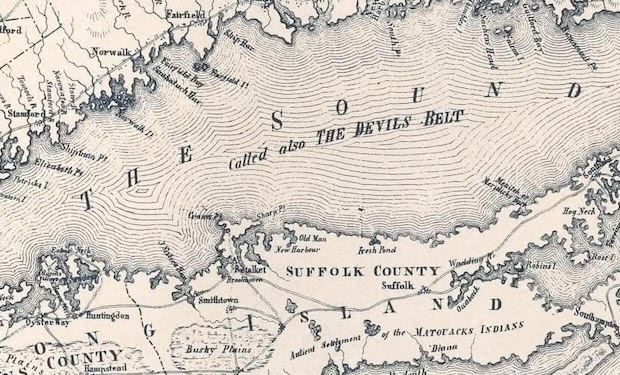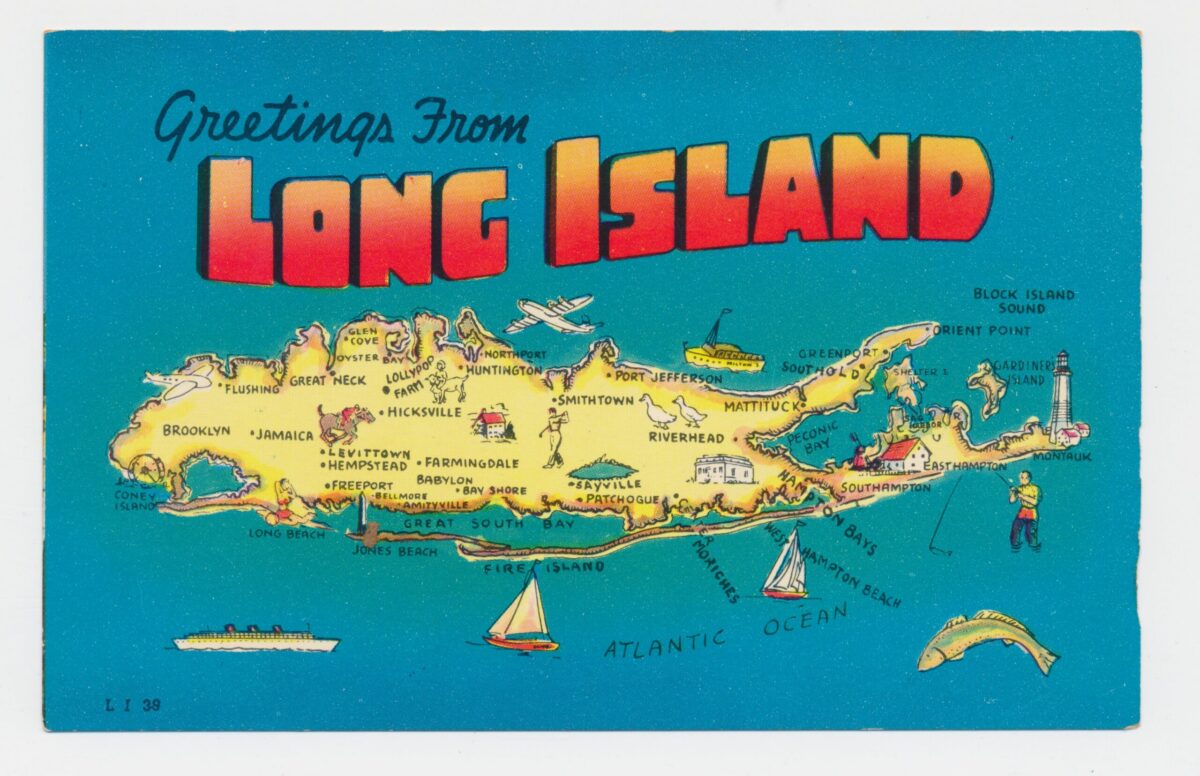
Ever since Adriaen Block sailed around Long Island and had the groundbreaking realization that, yes, this thing is surrounded by water, the place has been struggling to commit to a name. He called it Lang Eylant. Not bad. It only went downhill and sideways from there.
The early European settlers arrived, asked the Native people what everything was called, wrote it down… and then proceeded to tweak, butcher, simplify, or completely replace those names over time. Think of it as the original version of autocorrect, but with permanent consequences.
According to On This Site, a project by Shinnecock artist Jeremy Dennis, Long Island has gone by Sewanhacky, Wamponomon, and Paumanake. Meanwhile, Rev. William Hubbard called it Mattanwake. Other sources tossed in Meitowax and Metoac just to keep things interesting.
So even the island itself couldn’t pick a lane. Naturally, the towns followed suit.
Place names here have changed based on settlers, politics, land deals, and occasionally just vibes. But if there’s one recurring villain in this story, it’s the U.S. Post Office, which spent the 1800s acting like the final boss of Long Island naming rights.
Below are places you know well that used to go by very different names. Some were better. Some were worse. All of them are a little ridiculous.
Hampton Bays
Once called Good Ground. Which means Good Ground Cemetery either sounds like a horror movie setting or a brutally honest real estate description.
Port Jefferson
Before it became Port Jefferson in 1836, named after Thomas Jefferson, it was called Drowned Meadow. Because the harbor flooded twice a day. Imagine trying to sell waterfront property with that name. Before that, it was Sowasset, meaning either “place of small pines” or “where water opens.” Both significantly better branding.
Lindenhurst
Originally Breslau when German settlers arrived. Before that, Native Americans called it Neguntatogue, meaning “forsaken land,” which is not exactly something you put on a welcome sign. In 1891, it became Lindenhurst for reasons lost to history. Also, Pat Benatar is from here, which might be the most logical thing about this town’s story.
Brentwood
Originally called Modern Times, which sounds like either a utopian dream or a very confusing Netflix series. Founded in 1851 by Josiah Warren and Stephen Pearl Andrews as a social experiment. By 1864, they scrapped the experiment and went with Brentwood, named after a town in England. Back to basics.
Lloyd Neck
Originally Horse Neck, because farmers used it to graze horses. Straight to the point. The Matinecock people called it Caumsett, meaning “place by sharp rock,” which sounds much cooler. Then Henry and Rebecca Lloyd showed up in 1711 and, wouldn’t you know it, the place eventually became Lloyd Neck. Funny how that works.
Holtsville
Originally Waverly. The Long Island Rail Road even opened Waverly Station in 1843. Then the post office stepped in and said, “Sorry, already taken.” So they renamed it after Joseph Holt, because when you run out of ideas, you just name your town after the guy in charge of mail. Waverly Avenue is still there as a quiet protest.
Manorville
Used to be called Punk’s Hole. And we just… gave that up. For Manorville.
Wantagh
Originally Jerusalem, thanks to Quaker settlers. Then the railroad came in 1867 and called the station Ridgewood. The post office said no because Queens already had one. So in 1891, they held a naming contest and landed on Wantagh, named after a Montauk Sachem. Today it doubles as a built-in test. If you can pronounce it, you’re local.
Barnum Island
Originally Hog Island, because it was used for pigs. Honest and effective. Also briefly called Jekyll Island. Despite popular belief, it is not named after P. T. Barnum. It was named after Sara Ann Barnum, who owned it and sold it to Nassau County, where they put a poor farm and a smallpox hospital. Not exactly a tourism campaign.
Hicksville
Despite sounding like the setup to a joke, Hicksville actually has one of the most straightforward origin stories on Long Island. The name comes from Valentine Hicks, a wealthy landowner who owned property in the area in the early 1800s. In 1837, the Long Island Rail Road built a station on Hicks’ land and, showing zero interest in overthinking it, named it Hicksville. As the surrounding area grew around the railroad, the name stuck and eventually became the official name of the community.
Island Park
The rebrand of Barnum Island once developers showed up. Basically the sequel nobody asked for but everyone knows.
Mineola
Originally Miniolagamika, meaning “pleasant village.” Someone wisely said, “We are not making people say that every day,” and shortened it to Mineola.
Selden
Originally Westfield. The post office stepped in again and said the name was already taken. So in 1853, they renamed it after Henry Selden, who most of us just met five seconds ago.
Centereach
Started as West Middle Island, then became New Village. When they applied for a post office, they were told New Village was already taken. So they went with Centereach because it’s in the middle of the island. Not flashy, but effective. Possibly the most sensible decision in this entire list.
Sayville
Was supposed to be Seaville. A typo turned it into Sayville, and everyone just shrugged and kept going. That’s commitment.
Malverne
Originally Norwood. Mail kept getting mixed up with other Norwoods, so the name had to go. They considered Lynmouth, but that was too close to Lynbrook, and by now we all know how that ends. They settled on Malvern, inspired by England, then added an extra “e” at the end for no clear reason. Somewhere, a postal worker probably had a say.
Carle Place
Named after a guy named Carle who had a big house there. Originally called Carle’s Place, then simplified once he was no longer around to argue about it. AKA Frog Hollow.
Half Hollow Hills
Originally Half Way Hollow Valley. A name so long it probably used up half the ink in the post office. Eventually shortened, likely out of pure exhaustion.
Dix Hills
Named after Dick Pechegan, a Native American who lived there. Originally called Dick’s Hills before becoming Dix Hills. You can probably figure out why that edit happened.
Bohemia
Originally Lakeland. Renamed Bohemia after Czech immigrants settled there. One of the few times the post office stayed out of it. A rare win.
Ronkonkoma
Already a challenge, but earlier versions included Rockconcomuck and Raconkamucik. So things actually got easier.
Melville
Originally Sweet Hollow. Which sounds like a place where Hobbits live and butter is made fresh daily. And we traded that for Melville.
Lynbrook
Started as Pearsall’s Corners. Then Pearsallville. Then a few more variations. In 1894, Brooklyn transplants showed up and said, “We miss Brooklyn,” and rearranged the letters to create Lynbrook. Problem solved.
Deer Park
Originally Huntington South. Renamed after someone wrote in a diary that there were deer there. Breaking news at the time, apparently.
Shirley
Originally developed as Mastic Acres by Walter T. Shirley. There was an attempt to rename it Floyd Harbor, but it never happened. Probably for the best.
East Rockaway
Originally Clinktown. Possibly named after a boat-building technique or a guy named Clink. Either way, objectively more fun to say.
Glen Cove
Originally Musketa Cove. Changed because it sounded too much like mosquito. Which, fair.
Lawrence
Originally Rockaway Neck. Renamed after the Lawrence brothers, who developed it into a place for wealthy residents. When you build it, you name it.
Cedarhurst
Originally Ocean Point. Renamed after a grove of cedar trees near the post office when it incorporated in 1910.
Mount Sinai
Originally called Old Mans after being purchased in 1644 in a deal that included coats, stockings, powder, lead, hatchets, knives, and shirts. Try pulling that off today. In 1840, the post office rejected the name, not because it was taken, but because it was “not proper.” They tried Mt. Vernon. Already taken. So the first postmaster, Charles Phillips, opened a Bible, pointed with a knitting needle, and landed on Mount Sinai. And that was that. Totally normal.
Jericho
Originally Lusum. Renamed Jericho in 1692 after the biblical city.
If there’s one takeaway here, it’s this. Long Island didn’t just develop over time. It kept rebranding itself, sometimes for practical reasons, sometimes by accident, and sometimes because someone in the 1800s made a decision on a whim that we are all still living with.
And somehow, after all of that, Wantagh made it through unchanged.