The LIRR’s Highest Bridge Has Carried Trains Over Manhasset Since 1898
Anyone riding the Long Island Rail Road between Great Neck and Port Washington crosses a piece of railroad infrastructure that dates to the 19th century.
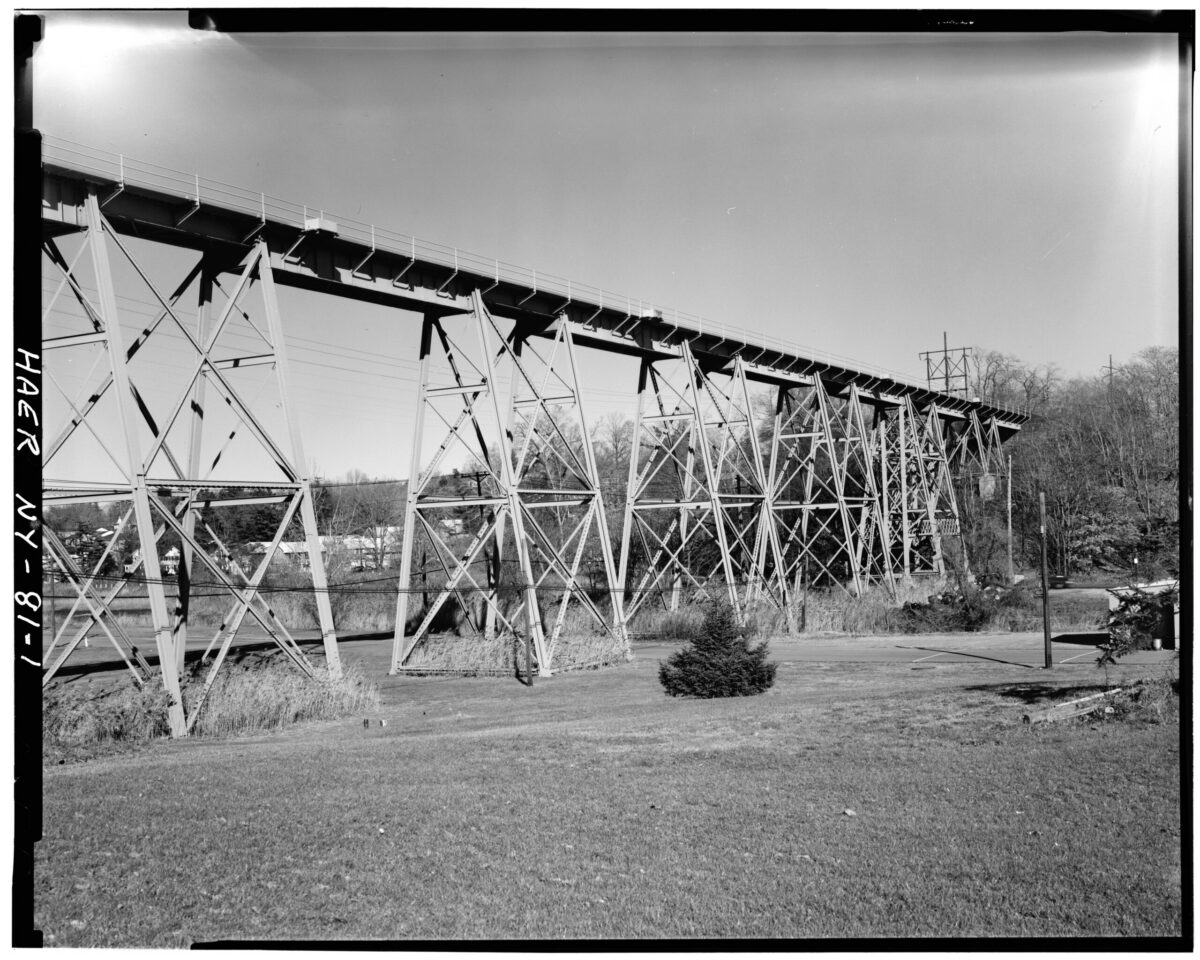
The Manhasset Viaduct was constructed in 1897 and 1898 to carry the railroad across the Manhasset Valley. Approximately 679 feet long and about 81 feet at its highest point, it remains the highest bridge on the Long Island Rail Road system.
More than 125 years after the Port Washington extension opened, trains still use the crossing.
Great Neck was once the end of the line
During the late 19th century, railroad service on this part of Long Island ended at Great Neck. Extending the line farther east presented a substantial engineering problem because the railroad had to cross the Manhasset Valley.
The Great Neck & Port Washington Railroad was chartered on April 15, 1896 to construct the extension to Port Washington.
Carnegie Steel Company was retained for the viaduct project, with Cleveland’s King Bridge Company carrying out the bridge construction.
Work began in 1897.
The resulting structure was a single-track steel viaduct approximately 679 feet long. At its highest point it rises about 81 feet above the stream below.
The original structure used riveted steel deck girders supported by steel bents and stone abutments. Railroad historian Vincent F. Seyfried wrote that nearly 480 tons of steel were required for the bridge.
The extension reaches Port Washington
The completed extension from Great Neck to Port Washington covered approximately 4.2 miles.
A trial train traveled over the new tracks on June 15, 1898.
Regular train service to Port Washington was formally inaugurated eight days later, on June 23, 1898.
That distinction is important because June 23 is sometimes described as the date of the first train over the bridge. Seyfried’s account records the earlier trial run, making June 23 more accurately the opening date for regular service.
Manhasset station was also a separate development. It opened in 1899, a year after through service to Port Washington began.
Rail service changes Port Washington
The arrival of the railroad helped change development on the Cow Neck Peninsula.
Port Washington had long been associated with farming, fishing and maritime activity. Direct railroad access made travel to New York City considerably easier and contributed to the area’s later development as a commuter community.
The significance of June 23, 1898 is still marked in Port Washington. A Cow Neck Historical Society marker at the Port Washington station commemorates the inauguration of train service and describes it as the beginning of the community’s transformation from a farming and fishing village into a commuter suburb.
The railroad itself continued to change.
The Port Washington Branch was electrified to Port Washington in 1913. Electric LIRR trains have therefore been crossing the Manhasset Viaduct for more than a century.
The bridge has undergone inspections, repairs and rehabilitation during its long service life, but the viaduct remains an active part of the Port Washington Branch today.
The Perils of Pauline connection
There is also an unconfirmed piece of Long Island film history associated with the bridge.
The Manhasset Viaduct has sometimes been identified as a possible filming location for the 1914 silent serial “The Perils of Pauline,” starring Pearl White.
A Long Island film-history source lists the viaduct as a possible location but specifically describes the report as unconfirmed.
The better-known story that Pauline was tied to railroad tracks while a train approached should not be treated as evidence that such a scene was filmed at Manhasset.
Silent-film historians have noted that the original 1914 “Perils of Pauline” serial did not actually contain a scene in which Pauline was tied to railroad tracks. That image became associated with silent-film melodrama later and eventually became part of the popular memory surrounding Pauline.
The Manhasset connection therefore remains an interesting piece of local film lore rather than a confirmed part of the bridge’s history.
What is firmly documented is impressive enough: a steel railroad viaduct built across the Manhasset Valley in 1897 and 1898 remains in active LIRR service more than 125 years later.
Photo 1: The Manhasset Viaduct carries the LIRR’s Port Washington Branch across the Manhasset Valley. Photo: David Sharpe, Historic American Engineering Record, Library of Congress.
Photo 2: A Cow Neck Historical Society marker at the Port Washington LIRR station commemorates the inauguration of train service on June 23, 1898. Photo: Ian Lefkowitz, Historical Marker Database, 2025.
Sources:
- Library of Congress, Historic American Engineering Record, Manhasset Viaduct
https://www.loc.gov/item/ny1211/ - Vincent F. Seyfried, The Long Island Rail Road: A Comprehensive History, Volume 6
https://www.trainsarefun.com/lirr/Seyfried/LIRR_Volume-6_Seyfried_Queens-Borough-Library.pdf - Transportation Research Board, Long Island Rail Road engineering paper on the Manhasset Viaduct
https://onlinepubs.trb.org/Onlinepubs/trr/1988/1177/1177-011.pdf - Electric Railroaders’ Association, The Bulletin, March 2018
https://erausa.org/pdf/bulletin/2010s/2018/2018-03-bulletin.pdf - Electric Railroaders’ Association, The Bulletin, April 2018
https://erausa.org/pdf/bulletin/2010s/2018/2018-04-bulletin.pdf - Cow Neck Peninsula Historical Society
https://www.cowneck.org/lirr - Historical Marker Database, June 23, 1898 marker
https://www.hmdb.org/m.asp?m=287578 - HistoricBridges.org, Manhasset Viaduct
https://historicbridges.org/b_h_fipsm.php?bsearch=36059 - Movies Filmed on Long Island, The Perils of Pauline
https://moviesfilmedonlongisland.com/portfolio-item/perils-of-pauline-the/ - The Bioscope, Tied to the Tracks
https://thebioscope.net/2010/11/23/tied-to-the-tracks/