On Friday, August 13, 1926, a Long Island Rail Road express carrying hundreds of summer travelers toward Greenport derailed in Calverton and crashed into a pickle factory beside the tracks. Two steam locomotives overturned, passenger cars tore into the building, and tons of stored salt came crashing down onto the wreckage. Six people, including two young children, their mother, and two railroad employees, were identified among the dead in what became known as the Great Pickle Works Wreck.
The accident destroyed Golden’s Pickle Works, one of Calverton’s major employers, and became national news. Nearly a century later, the Railroad Museum of Long Island began working to commemorate the disaster, culminating in the unveiling of a historical marker at the approximate wreck site on August 13, 2026.
A Friday Express Bound for the East End
The Shelter Island Express was one of the Long Island Rail Road’s premier passenger services during the 1920s. Operating on Fridays, it carried travelers from Jamaica toward Greenport, where many continued to summer homes, hotels, and resorts on the North Fork and Shelter Island.
The train offered more comfortable accommodations than ordinary commuter service. Its Pullman parlor car, named Easter Lily, featured upholstered swivel chairs and attendant service for passengers willing to pay extra for the trip east.
On August 13, the express was pulled by two steam locomotives, No. 214 and No. 2. According to the Interstate Commerce Commission’s subsequent investigation, the train consisted of the parlor car, a combination baggage and passenger car, and four additional coaches, all of steel construction. Contemporary newspaper reporting placed the passenger count at 387.
The train was running approximately 16 minutes behind schedule when it departed Manorville at 5:59 p.m., heading toward Calverton. Thunderstorms had affected Long Island during the preceding day, although federal investigators recorded clear weather and daylight at the time of the accident.
A Defective Switch at Golden’s Pickle Works
Golden’s Pickle Works stood alongside the LIRR main line west of Calverton station, near what is now the Edwards Avenue crossing. The factory had its own railroad siding, allowing freight cars to deliver cucumbers and other ingredients and carry finished products away.
The siding connected to the main line through a switch approximately 1,500 feet west of the station. Under normal conditions, the switch would remain aligned to allow passenger trains to continue east toward Greenport. At approximately 6:05 p.m., the Shelter Island Express approached the switch at an estimated speed of 40 to 55 mph. Something was wrong with the mechanism controlling the rails.
The switch points had become partially disconnected from their operating equipment. Although the switch indicator continued showing that the route was properly aligned for the main track, the rails themselves were no longer securely held in position. As the locomotives passed over the defective switch, the train derailed. Both engines overturned, while the leading passenger cars were thrown from the tracks, with the wreckage crashing into Golden’s Pickle Works. The first locomotive, No. 214, came to rest on its side. The second engine, No. 2, also overturned, and the Easter Lily parlor car was driven into the factory building.
Contemporary newspaper accounts described the passenger car being forced upward before collapsing through the factory roof. Photographs taken after the accident show locomotives on their sides, passenger cars wedged into the damaged structure, and the factory’s enormous pickle-shaped advertising sign still hanging above the wreckage.
Salt From the Factory Buried Passengers
The collision caused extensive damage to the factory’s upper floor, where large quantities of salt used in making pickle brine were stored. As the building collapsed, salt poured down onto the wrecked parlor car and the passengers trapped inside.
Among those killed was Harold Fish, a Manhattan stockbroker traveling to his summer home in East Marion. Fish became pinned beneath wreckage inside the factory, where falling salt eventually buried and suffocated him. Another passenger, James Way of East Marion, faced a similar danger. Former Riverhead Town Supervisor Dennis Homan and George Gassert of Riverhead reportedly crawled beneath the wreckage after hearing his cries and found him buried up to his neck in salt.
The two men used their bare hands to dig the salt away from Way’s head. According to the contemporary Riverhead News, their efforts kept him from being completely buried until the flow of salt finally stopped. The tragedy was particularly severe for the family of Dorothy Angell Shuford, 28, of Biltmore, North Carolina. She was traveling with her two young children, George Jr., 3, and Dorothy, who had turned 1 just two days earlier. The family was visiting Shuford’s parents, who maintained a summer residence on Shelter Island. Both children were killed in the crash. Their mother remained trapped beneath the wreckage for approximately six hours while rescuers worked to cut through the twisted steel surrounding her.
Contemporary newspaper accounts described Shuford remaining conscious during much of the rescue. She was eventually freed and transported to Southampton Hospital, where she died the following morning from injuries sustained in the wreck. The family’s maid, Laura Conley, was also trapped. Rescuers were forced to amputate one of her legs to free her, and she survived despite suffering additional serious injuries.
Two Railroad Employees Killed
The accident also claimed the lives of engineer William Squires and fireman John Montgomery, both of Greenport, who were aboard the leading locomotive. When No. 214 overturned, the men became trapped in the cab amid the wreckage and shifting coal from the locomotive’s tender. Both died in the derailment.
The engineer of the second locomotive, Charles T. Jackson, survived after being thrown from his cab. In testimony collected during the federal investigation, Jackson estimated that the train had been traveling about 50 mph when it approached the switch. Jackson recalled seeing the leading locomotive suddenly rise before he was thrown from his own engine. He believed both locomotives had begun following the turnout rather than continuing along the main line.
Jackson’s account became an important part of the federal investigation. Railroad historian Dave Keller later preserved additional recollections associated with the surviving engineer, along with photographs of the accident and its aftermath.
Calverton Residents Rush to the Rescue
The collision brought people from nearby farms and homes running toward the railroad tracks. Calls for assistance quickly reached Riverhead, where physicians, volunteers, railroad employees, and emergency responders mobilized to help.
Five Riverhead doctors, identified in contemporary accounts as Benjamin, Terrell, Payne, Luce, and Perkins, responded to the scene. Local druggist Fred Barth brought medical supplies, while a Riverhead woman identified as Mrs. Clayton assisted with nursing the injured. As evening approached, motorists positioned their automobiles along the railroad right-of-way and directed their headlights toward the wreckage. The improvised lighting helped rescuers continue their work.
Approximately 100 soldiers from the 62nd Coast Artillery at nearby Camp Upton also arrived with trucks and searchlights. They joined firefighters and volunteers in removing injured passengers, assisting medical personnel, and controlling the crowds gathering around the destroyed factory.
Seriously injured passengers were transported to Southampton Hospital, often in private automobiles. Others received treatment at the scene or found alternate transportation after their train journey came to an abrupt end. The rescue continued well into the night. Railroad wrecking crews subsequently brought heavy equipment to Calverton to remove the damaged cars and locomotives and restore service along the main line.
The Missing Cotter Pin That Caused the Disaster
The investigation into the accident eventually centered on a surprisingly small piece of railroad hardware. The switch serving Golden’s Pickle Works had been in service for approximately 40 years. Its operating mechanism included a connecting rod held in position by a nut and washer, with a cotter pin intended to prevent the nut from loosening.
Following the wreck, investigators discovered that the nut and washer had come off the mechanism, allowing the connecting rod to drop free. With the rod disconnected, the switch points could move independently of the switch stand and its signal indicator. Investigators found no cotter pin securing the assembly. More significantly, the hole intended to hold the pin was packed with old grease and dirt, suggesting that the protective hardware had been absent for some time.
The evidence raised serious questions about the railroad’s inspection and maintenance practices. The section foreman responsible for the switch reported having examined it three days before the accident, but investigators found indications that its condition had not been properly addressed.
The Interstate Commerce Commission issued its report on September 25, 1926. Investigators concluded that the defective switch caused the derailment and placed primary responsibility on the section foreman responsible for its maintenance.
The report also identified broader shortcomings in the railroad’s inspection practices. The disaster became part of a period of increasing scrutiny of Long Island Rail Road safety, with several railroad officials resigning later that year amid criticism following multiple accidents.
The End of Golden’s Pickle Works
The wreck severely damaged the factory building and brought its operations to an end. Golden’s Pickle Works never resumed production at the site, and the damaged structure was eventually demolished. Later historical accounts indicate that many factory employees had been dismissed early on the afternoon of the crash, possibly because of the heat and approaching bad weather. With the train striking the building shortly after 6 p.m., their early departure may have prevented additional casualties.
The destruction was a significant loss for Calverton, where the pickle factory had been an important local employer. Although the railroad tracks were repaired and train service resumed, the factory was not rebuilt. The wreckage also attracted crowds from across Long Island. One later historical estimate suggested that as many as 50,000 people visited Calverton during the days that followed, with automobile traffic reportedly overwhelming nearby roads.
Photographs preserved by railroad historians show spectators standing around overturned locomotives and the shattered pickle works. Some images document the wrecking operations as railroad crews gradually removed the equipment from the factory and returned damaged cars to the tracks.
The locomotives involved in the accident were eventually scrapped, and the surviving sections of the factory disappeared. Over time, the scene of one of the LIRR’s most destructive accidents became an unremarkable stretch of railroad right-of-way.
A Discrepancy in the Historical Record
The accident has generally been remembered as claiming six lives: railroad employees William Squires and John Montgomery, stockbroker Harold Fish, and Dorothy Angell Shuford and her two children.
There is, however, an inconsistency in the surviving official records. The Interstate Commerce Commission’s September 25, 1926 report lists seven fatalities, including five passengers and two railroad employees, along with 28 injuries. The report does not identify the additional passenger. Contemporary newspaper accounts and the historical marker unveiled in 2026 identify six victims. Without further documentation establishing the identity of a seventh person, the discrepancy remains unresolved.
A Historical Marker 100 Years Later
On August 13, 2026, exactly a century after the accident, the Railroad Museum of Long Island held a commemorative ceremony near the former wreck site. Working with the William G. Pomeroy Foundation, the museum arranged for a historical marker at the intersection of Railroad Avenue and River Road in Calverton, near the location of the defective railroad switch that caused the disaster. The marker stands at approximately 14–16 Railroad Avenue, and visitors can find its location on Google Maps using GPS coordinates 40.906244, -72.747623.
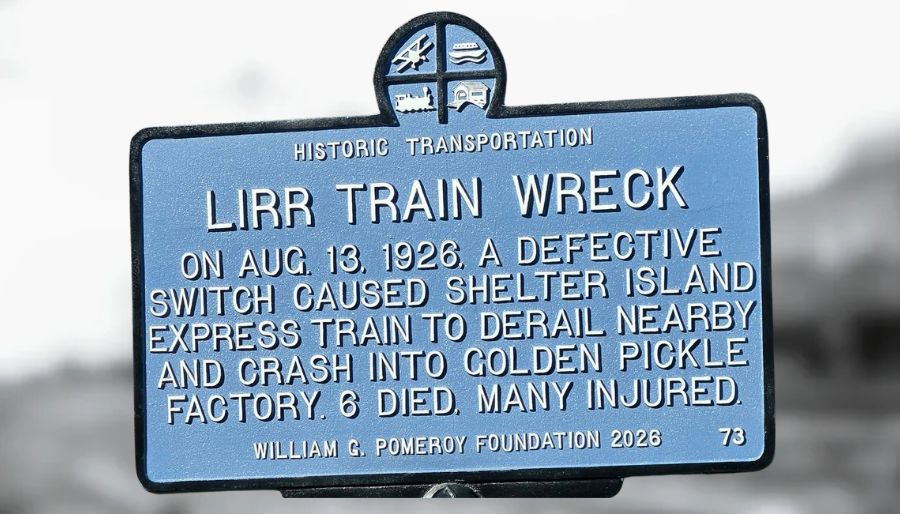
The ceremony was led by museum president Don Fisher and attended by local historians, officials, and descendants of people connected to the disaster. Among those present were Nancy Maulsby, granddaughter of Harold Fish, and Fish’s great-granddaughter, Tyler Duer. Railroad Museum historians rang a bell six times in remembrance of the victims commemorated by the marker. Its inscription describes the defective switch, the crash into Golden’s Pickle Factory, and the lives lost.
Today, the factory, its railroad siding, and the wrecked locomotives are gone. The main line still runs through Calverton, but the new marker provides a permanent reminder of the Friday evening in 1926 when a missing piece of switch hardware sent a passenger express into a local factory and brought an end to one of the community’s important businesses.
Sources:
- Interstate Commerce Commission – September 25, 1926 federal accident investigation documenting the train’s composition, speed, defective switch, mechanical findings, railroad maintenance failures, and reported fatalities. https://rosap.ntl.bts.gov/view/dot/47709/dot_47709_DS1.pdf
- William G. Pomeroy Foundation – Official historical marker record, inscription, supporting historical documentation, contemporary newspaper references, and six-victim commemoration. https://www.wgpfoundation.org/historic-markers/lirr-train-wreck/
- RiverheadLOCAL – August 13, 2026 centennial coverage, drawing on contemporary newspaper accounts, documenting the victims, rescue efforts, factory destruction, historical investigation, and memorial ceremony. https://riverheadlocal.com/2026/08/13/deadly-1926-lirr-pickle-works-train-crash-in-calverton/
- RiverheadLOCAL – December 1, 2025 historical research describing the wreck location, surviving evidence, Railroad Museum of Long Island research, and plans for the centennial marker. https://riverheadlocal.com/2025/12/01/remembering-the-deadly-calverton-pickle-works-train-wreck-as-its-100th-anniversary-nears/
- The Suffolk Times – Historical feature on the Calverton train disaster, including railroad museum photographs and background on the Shelter Island Express. https://suffolktimes.timesreview.com/2025/12/keeping-track-of-history-deadly-crash-at-calverton-station/
- Dave Keller Railroad Archive – Historical photographs, locomotive identification, wreckage images, railroad maps, and recollections relating to engineer Charles T. Jackson and the Golden’s Pickle Works wreck. https://www.trainsarefun.com/lirr/lirrwrecks/lirrwrecks.htm