George Washington did, in fact, stop at Roe Tavern in Setauket on April 22, 1790. That part is not folklore. The part that gets a little fuzzier over time is everything built around it: why he came, whether he specifically gathered former spies there, and whether the famous “Washington slept here” version is as ironclad as people like to say. The real story is better anyway, because it shows how one stop in Setauket opens up a much bigger Long Island trail of spies, taverns, damaged farmland, presidential travel, and a tavern building that has somehow kept reinventing itself for more than 300 years.
By 1790, Washington was president, but New York City was still serving as the national capital. Before Washington, D.C., there were the first two presidential residences in Manhattan: the Samuel Osgood House and then the Alexander Macomb House. A 2024 brochure published by the Manhasset Public Library History Center places Washington’s Long Island tour in that context, noting that he was living in New York City, taking stock of the region, and traveling with a small entourage that included escorts, a coach, and support staff. The brochure also says he had a strong interest in agriculture and recorded the land conditions he saw along the route, which tracks with the diary tradition around the trip.
Click here for more stories about Long Island’s historic landmarks.
That tour was no quick swing through one village. According to the Manhasset Library brochure and a Town of Huntington history handout, Washington’s route ran through what are now parts of Brooklyn, Nassau, and Suffolk, including Hempstead, Copiague, West Bay Shore, West Sayville, Patchogue, Setauket, Smithtown, Huntington, Oyster Bay, Roslyn, Flushing, and back toward Manhattan. In other words, this was not some casual little Sunday drive down 25A. This was a real presidential circuit across Long Island while the nation was still brand new.
Then comes the Setauket stop.
Washington’s own diary entry is the anchor here. A Library of Congress-hosted edition of The Diaries of George Washington records that after passing through Coram and heading to Setauket, he reached “the House of a Captn. Roe which is tolerably dect. with obliging people in it.” That line, preserved in later editions and quoted by historians, is the source of the tavern’s most famous review. Not exactly Michelin, but not bad for 1790.
Where the story gets interesting is that later local accounts and interpretive materials go a step further. The Manhasset Public Library brochure states that Washington arrived in Setauket on Thursday, April 22, and “stayed overnight” at Captain Austin Roe’s home and tavern.
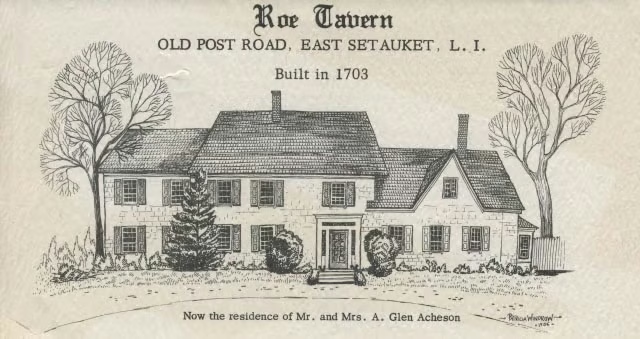
So what’s the safest way to tell it? Like this: Washington definitely stopped at Captain Austin Roe’s place in Setauket, and multiple local historical sources say he stayed overnight. His diary gives us the famous “tolerably decent” line, but it does not spell out a formal thank-you dinner for the Culper Ring in so many words. That distinction matters, because the Long Island version of this story has a habit of marching a little farther than the primary record.
Still, the connection to the Culper Spy Ring is not random decoration. Austin Roe was no bit player. He was one of the key couriers in the Culper network, using merchant business as cover while traveling between Setauket and Manhattan to move intelligence. The Manhasset brochure describes him as the ring’s principal courier and says he rode roughly 55 miles from Setauket to New York, delivering information while avoiding British patrols. The Three Village Historical Society’s current exhibits also identify Roe Tavern as central to the story of Setauket’s Revolutionary War spy operations.
And Roe was hardly the only local name tied to that wider story. The same brochure lays out the broader spy trail through Long Island, naming Benjamin Tallmadge of Setauket, Abraham Woodhull, Robert Townsend of Oyster Bay, Sally Townsend, Caleb Brewster, and Anna Strong. It also explains the Culper code name, the use of ciphers and invisible ink, and how the ring funneled intelligence from British-held territory to Washington’s headquarters. Even if Washington did not write, “Today I am heading to Setauket to thank the spies,” the local logic of the stop is pretty obvious. Setauket was not just another waypoint. It was one of the nerve centers of his wartime intelligence system.
The brochure also adds one of those very Long Island details that sounds too good to be true, but survives as local tradition: Austin Roe was supposedly so excited to see Washington that he fell off his horse and broke his leg while hurrying home. That anecdote appears in the brochure and is echoed in East Hampton Star’s discussion of the tavern story. It is part of the local lore rather than the presidential diary, but it has clearly stuck around.
And Washington did not just breeze into Setauket and vanish. According to the brochure and Huntington material, he left Roe’s house the next morning around 8 a.m., headed to Smithtown and Widow Blidenberg’s house, continued to Huntington where he thanked residents for their support during the Revolution, then passed through Cold Spring Harbor, where local tradition says he helped workers raise a rafter at the Bungtown School and left a dollar for the men. From there he went on to Oyster Bay, spent the night at Captain Daniel Young’s home, then continued west by way of Roslyn, where he visited the Onderdonk mills and reportedly made a sheet of paper before returning toward Manhattan. It is one of those routes that turns half the North Shore into a kind of accidental Washington trail.
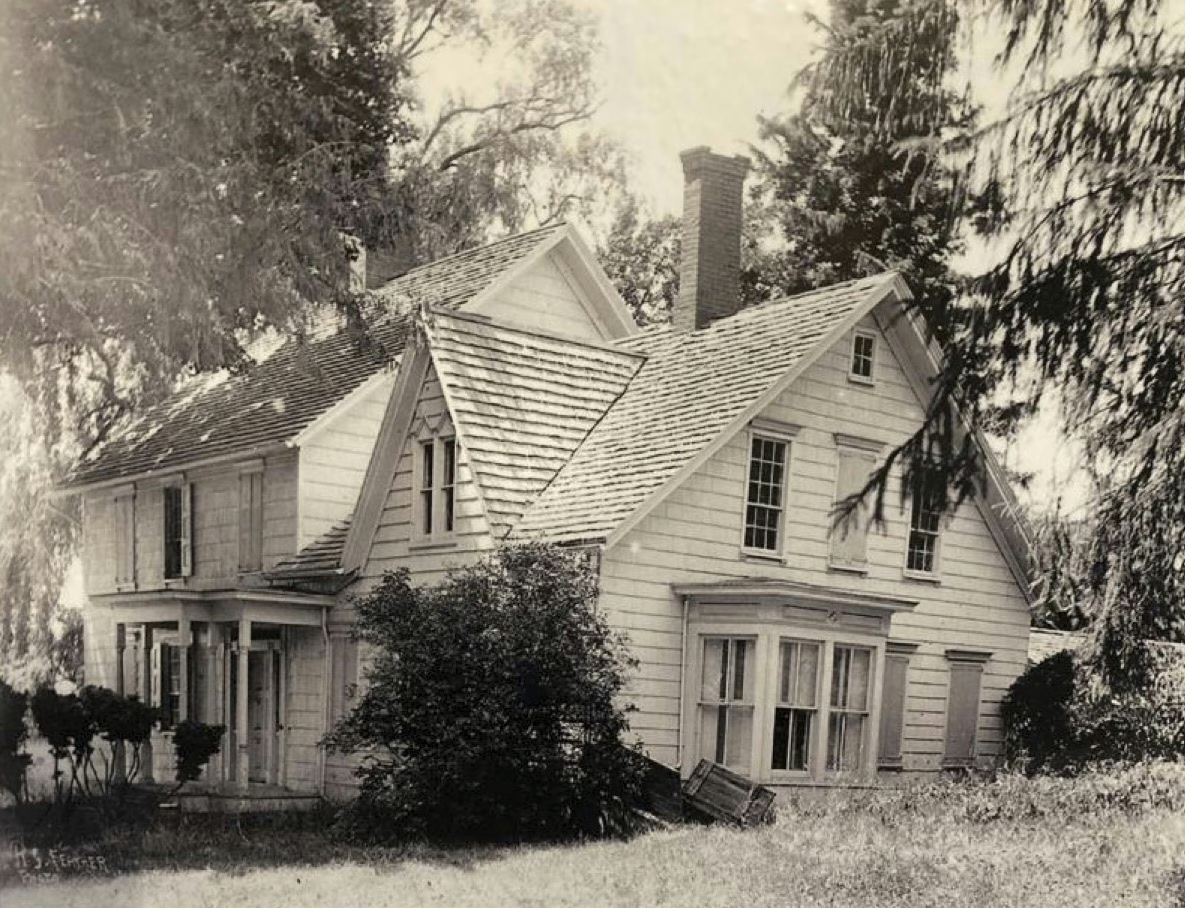
If all of that were the entire story, Roe Tavern would already be a pretty good Long Island footnote. But the building itself has had a second life, and maybe a third. A 2025 Three Village Historical Society exhibit described the structure as having served over time not just as a tavern but also as a political meeting hall, a doctor’s home and practice, a temperance gathering place, a boys’ school, a tea house, and later a literary retreat for Wallace and Laetitia Irwin after it was moved in 1936. That is a lot of mileage for one building.
That relocation matters because Roe Tavern is no longer sitting exactly where Washington would have seen it in 1790. Newsday reported in 2022 that Brookhaven Town approved plans to buy the historic structure, then privately owned as a house, and move it back near its original East Setauket location after it had been relocated in 1936. Greater Long Island’s 2022 article told the same preservation story, noting that the tavern had wound up off Old Post Road and that the town wanted to bring it back close to the original site on Main Street near Shore Road.
That preservation effort is also why the story keeps surfacing now. In 2025, the Three Village Historical Society opened Timbers, Tankards, and Time: The Story of the Roe Tavern and the Power of Place, an exhibit focused on the building’s many lives and Brookhaven’s plan to return it closer to its historic spot along Route 25A. The exhibit description framed Roe Tavern not just as an old house with a famous guest, but as a building that tracked generations of change in Setauket. That is probably the best way to think about it. The Washington stop is the hook, but the tavern’s real value is how much Long Island history it managed to absorb.
So yes, George Washington stopped at Roe Tavern in Setauket. Yes, his diary gives the place one of the most politely restrained reviews in presidential history. Yes, local historical sources say he stayed overnight there during his 1790 Long Island tour. And yes, the stop has long been linked to his desire to reconnect with places and people tied to the Culper Spy Ring, even if the diary itself keeps that part understated.
Photos: Town of Brookhaven archive.