By Amir Browne
When he was young, Darran Handshaw worried his parents by constantly wanting to fix things by taking them apart to see how they worked and then putting them back together. That same curiosity is what drives him today.
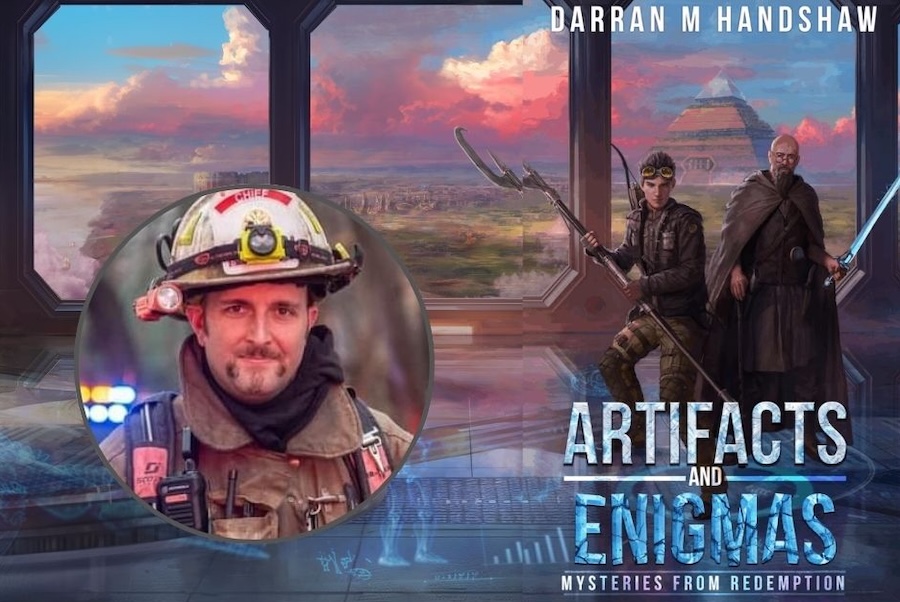
Handshaw, 41 from Miller Place, is a volunteer firefighter, full-time concept engineer, and an author of several books.
Handshaw grew up in and around the firehouse in Miller Place. He describes the Miller Place he grew up in as a farming community, with farms and farm stands along Route 25A, when it was a single-lane road in both directions. Since then, that country route has grown into a major thoroughfare, and the farming community has transformed into “more of a suburban sprawl.” He joined the Miller Place Fire Department as a junior firefighter, working alongside his dad, the ex-chief. When he moved to Sound Beach – a town just next door to Miller Place – he found himself moving up the ranks, serving as chief from 2021 to 2022. Handshaw took over during the pandemic.
“I had to deal with difficulties on the fly, along with the changing environment,” he said.
Despite the hectic experience, he enjoyed taking on the challenges. Now, he’s taken a step back; mostly teaching fire prevention and showing children how to protect themselves and their families, preparing them for the worst-case scenario.
Engineering was, and still is, at the forefront of Handshaw’s interest.
“I was always interested in engineering and design. Even when I was younger, I took things apart and figured out how to fix them,” he said. “It was either throw it away and replace it or give it to me. I took apart VCRs, CD players, and other things like that.”
He even once took apart a grandfather clock a few times, figuring out how to swap gears from different places in the clock to keep it running.
A career as a concept engineer was developed later in life. He started as a mechanical engineer, getting a degree from Binghamton University. Dealing with the mechanisms and designs of plastic housings, die-cast, and sheet-metal parts to test survivability under impacts/drops and temperature was only the beginning.
“I found I was always curious about how the other parts of the product work and how they could be involved, so I started asking a lot of questions about the other engineering disciplines,” he said.
It was his curiosity that led his boss to hire him for a multidisciplinary concept team.
Working at Zebra Technology (formerly known as Symbol Technologies) in the R&D department allows for ideas for new products that haven’t been tested yet.
“We can invent a lot of things, but real inventions solve real-world problems. What’s losing retailers’ money? Or what could cause a mix-up in a hospital?” he said.
Handshaw holds an impressive 150 patents, with more in development. The range of these patents spans different fields, from optical designs for lasers to some of the first patents for incorporating loss-prevention cameras into a scanner.
He received his first patent in college for a vehicle extraction prep tool that “would prepare a car for the jaws of life and cut it apart in the fire service,” he said. “After that, I was hooked. I wanted to keep coming up with new, original ideas that solved problems.”
During this experience, his professor directed him to a patent attorney who guided him in writing his first patent. Although he now has a legal team assisting with patent writing, he still finds the process enjoyable.
Yet, growing up in the firehouse and having a knack for engineering does not fully explain the author in his job description.
Handshaw has always been big into storytelling – pointing to the old-timers at the firehouse who would tell stories about extreme fires, being stuck in a weird situation, or a funny experience.
“I really love story-swapping,” he said. “I started to tell my own stories, and it became a big interest of mine.”
He grew up playing text-based games that required him to type what his character did. After gaining more writing experience, he wanted to try recording some stories. Some of his earlier projects didn’t immediately hook him, but one story in particular motivated him to write.
That story was about meeting his future wife, Stefanie, both literally and figuratively. In his first book, The Engineer, he retold an epic story from Stefanie’s online text-based game called Redemption MUSH (MUSH being the coding language), set in a city called “Redemption,” that follows the story of how his character, Actaeon, meets Eisandre, Stefanie’s character, and their incredible adventures. He fleshed out the universe and, with her permission, started the project.
“She was easily my top supporter,” he said. “She was one of the early readers for the book and copy-edited it for me.”
Publishing The Engineer didn’t come without its challenges. Handshaw decided to take the self-publishing route as he wanted to retain creative freedom, given that this was such a personal story for him. Questions about formatting, creating cover art, marketing, and publishing, among other things, arose.
“It was an uphill battle. I liked writing, but the other stuff was challenging,” he said.
Not to mention, he didn’t have much time to write–balancing a full-time job, being a volunteer firefighter, and the birth of his newborn baby. He started writing in 2014, and it took three years to write, edit, and publish.
Handshaw’s second book was in development while he was a fire chief, taking him five years to write The Dark Heart of Redemption: A Chronicle of Actaeon, a stand-alone sequel to his first book. By this time, he was a better editor, making fewer errors, an improvement that would carry over into his third book, Artifacts and Enigmas: Mysteries From Redemption.
“That drive to finish something really important to me was all the motivation I needed,” he said.
Artifacts and Enigmas: Mysteries From Redemption is a short-story collection set in the same universe as his first two books. It combines mystery elements within his sci-fi world, a decision he was hesitant to make before his boss at Zebra Technologies, the late Ed Barkan, encouraged him to take that route.
“He taught me never to stop asking questions,” he said. “It rubbed off on me in my work as a concept engineer, but with my novels as well. Always questioning things and writing about the curiosity.”
Roger Zelazni’s Chronicle of Amber, Larry Niven’s The Protector, and Arthur C. Clark’s Rendezvous with Rama were just a few of the sci-fi novels that Handshaw credits as influencing him. He grew up watching Star Trek but prefers hard science fiction to the “handwavium” in the show, where most problems were solved by shooting a tachyon pulse.
“I want to understand the theory of operation behind the technology,” he said. “If I’m going to shoot a beam at something, I want to know the scientific theory behind the beam, along with its limitations.”
He loves The Captive Wars series, which uses a writing approach that features a cliffhanger at the end of every chapter, which is more of the new-generation science fiction he indulges in.
His character takes on the mold of MacGyver, a role in which he often carried several tools that allowed him to invent his way out of a situation – with failure resulting in death. The characters in the post-apocalyptic city of Redemption don’t understand how the high-tech equipment works but try to figure out how to use it despite it being broken. This same line of thinking is present during his real-life firefighter work; showing up to different scenes with limited tools and on-the-fly thinking that could make the difference in saving someone’s life.
Handshaw is a case study in how pursuing your passion can bear fruit.
“My biggest piece of advice to aspiring authors is to find time to do it,” he said. “Even if it takes years, you’ll eventually have a novel.”
Although this advice is geared toward aspiring authors, it’s a philosophy applicable to anyone pursuing their passion.
“I’m a father, a full-time engineer, a volunteer firefighter, and I find the time to write because I want to,” he said.
Handshaw will be signing his books on May 16, 2026 from 11am to 3pm during Rocky Point Day at the Rocky Point High School track. You can also pick up a signed copy of his books at Kids’ Day in downtown Sound Beach on July 26, 2026.
Amir Browne is a reporter with The SBU Media Group, part of Stony Brook University’s School of Communication and Journalism’s Working Newsroom program for students and local media.
Photos: Courtesy of the Author