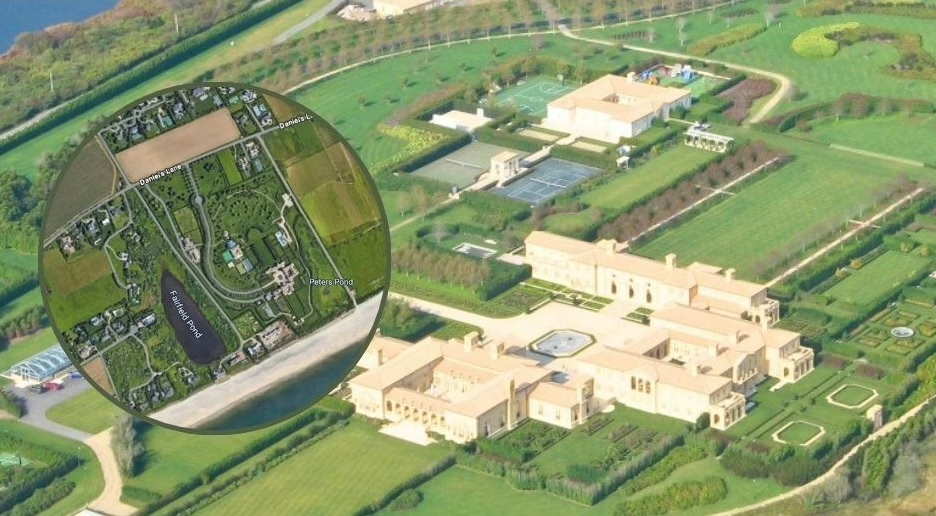
On Long Island, we have plenty of big houses. Then there is Fair Field in Sagaponack, which is less summer home and more what if a private residence tried to outmuscle a resort. Built for billionaire Ira Rennert on 63 acres along the Atlantic, the estate became famous not just because of its size, but because it was so enormous it helped push Southampton to tighten the rules on how big a house could be.
The basic numbers are absurd enough
- Fair Field is in Sagaponack at 281 Daniels Lane
- The property sits on 63 acres fronting the Atlantic Ocean
- The house was built in 2003, though the battle over the project dates back to the late 1990s
- The main house is generally listed at about 64,000 square feet, while the total floor area for the full compound is about 110,000 square feet
- That makes it one of the largest private homes in the United States
- Depending on the source, the estate has either 29 bedrooms and 39 bathrooms or 21 bedrooms and 18 bathrooms. The difference appears to come down to whether people are counting the whole compound or just the main house
- Fair Field has been valued in a wide range over the years, including about $248 million in 2015, a tax value range of roughly $267 million to $500 million, and a reported $425 million figure in a 2024 report
Then you get to the this is a house part
- Reports have described the estate as having three swimming pools
- It also has a 164 seat theater, which is a very Long Island way of saying your movie room is larger than some actual theaters
- The estate includes a 100 car garage
- A 10,000 square foot playhouse has been reported to include a basketball court and a two lane bowling alley
- Other reported features include billiards, two tennis courts, and two squash courts
- The house has been described as having 12 chimneys
- One report said the dining room is 91 feet long. Another account described a main dining room measuring 1,575 square feet and large enough to seat 105 people
- Reports have also described the home as having a limestone exterior and an Italian Renaissance style
Why Long Islanders got so worked up about it
- When the plans surfaced in the 1990s, neighbors and local groups pushed back hard over the scale of the project
- A local homeowners group formed specifically to fight the project
- One major fear was that the compound did not look like a typical single family home and might one day function more like a resort, conference center, retreat, or other institutional use
- Even years later, the structure was still widely viewed in Sagaponack as an unwelcome intrusion, even after tempers cooled
- For all the outrage, local officials also said there had been no real complaints about activity there once the Rennerts moved in. One village official summed it up simply: it is just big
It was so big it helped change the rules
- In response to the uproar over houses of this scale, Southampton later moved to limit single family homes to 20,000 square feet unless an exception is granted by the zoning board
- Additional rules were also put in place requiring more review for very large residential projects on large agricultural parcels
- In other words, Fair Field was not just a mega mansion. It became part of the reason the town got a lot less interested in seeing another one
The controversy did not stop with the size
- Ira Rennert is the owner of Fair Field and the founder of the Renco Group
- In 2015, Rennert was ordered to pay at least $118 million in damages in a case tied to claims that money from a now defunct mining business was used to help fund the estate
- More recently, Rennert and Renco have been back in headlines because of a long running lawsuit tied to alleged contamination in La Oroya, Peru
- That same 2015 case also involved allegations that he pushed Magnesium Corp. of America into bankruptcy while building the Sagaponack estate
Fair Field also fits into a bigger Gold Coast and East End tradition
- The estate has often been compared to the giant Long Island compounds built by earlier tycoons such as the Pratts, Goulds, Whitneys, and Otto H. Kahn
- That comparison is part of what makes Fair Field so weirdly perfect for Long Island history. It is both a modern Hamptons excess story and a sequel to the old era when rich industrialists kept trying to build the biggest thing anyone had ever seen
- Fair Field may be massive, but by some historic Long Island standards it is still playing in a very competitive league. Oheka Castle, for example, has long been cited as even larger at about 109,000 square feet, with its own over the top history
The most Long Island takeaway of all
- Fair Field is one of those places you have probably heard about for years without ever really seeing much of it. That is part of the legend. It is a giant, famously controversial Hamptons estate that somehow still manages to feel like a rumor with landscaping
- Love it, hate it, or just stare at the numbers in disbelief, Fair Field remains one of the strangest status symbols ever planted on Long Island soil
Sources
- https://en.wikipedia.org/wiki/Fair_Field
- https://www.businessinsider.com/ira-rennerts-hamptons-mansion-2015-3
- https://www.realtor.com/news/unique-homes/hamptons-sagaponack-mansion-ira-rennert-billionaire/
- https://www.27east.com/residence/real-estate-news/article_c40bdf7d-5b05-5ff8-9c95-2153d03ddc1f.html
- https://virtualglobetrotting.com/map/fair-field-estate/view/google/
- https://luxtionary.com/places/fair-field-the-249-million-house/
Images: Cfijames at English Wikipedia, Public domain, via Wikimedia Commons/Google Maps