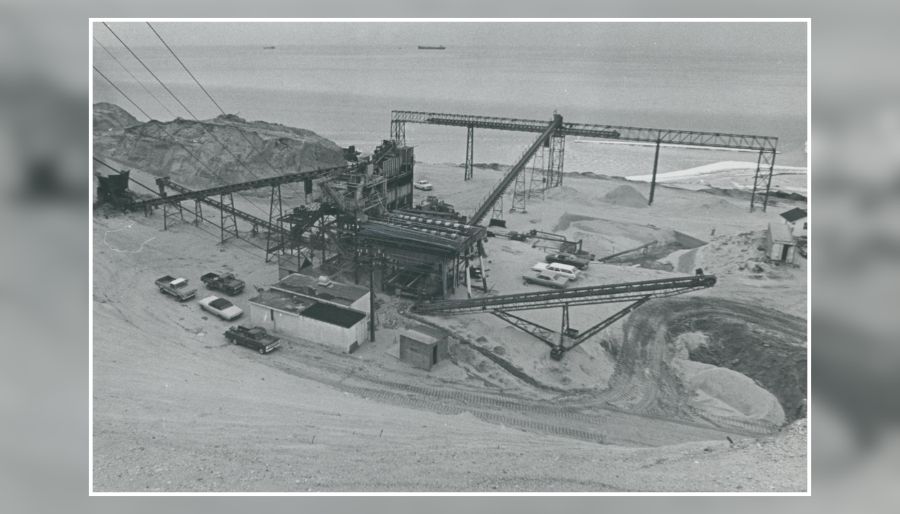
A Long Island Daily Press photograph taken on February 10, 1970, shows a sand-mining plant operated by Levon Properties Corporation along the Long Island Sound.
Today, much of the larger property connected to that operation is preserved as Hallock State Park Preserve and protected farmland. In between, however, this stretch of the North Fork was proposed for an enormous industrial harbor, nuclear power plants and a coal-fired generating station.
The 1970 photograph captures the property near the middle of that transformation.
A property with a much older name
The land lies in the northeast corner of Riverhead Town, with part extending into neighboring Southold Town.
Historian Richard Wines of Hallockville Museum Farm writes that the area later known as the KeySpan property covered approximately 520 acres and included about 300 acres of farmland, 200 acres of woodland and more than 5,000 feet of Long Island Sound shoreline backed by high bluffs of sand and clay.
Click here for more stories about Long Island’s historic landmarks.
Long before KeySpan, the area was known as Hallockville because of the large number of Hallock families who lived there during the 19th century. Wines notes that historic Hallockville roughly corresponded to the property that would later pass through Levon Properties, LILCO and KeySpan.
That history explains the Hallock name that survives today at Hallockville Museum Farm, Hallock Pond and Hallock State Park Preserve.
The plan was much bigger than a sand mine
In 1963, Levon Corporation, controlled by George Semerjian of Port Jefferson, proposed something called the Riverhead Harbor Industrial Park.
The proposal was enormous.
Plans called for a $250 million industrial complex built around an artificial deep-water harbor roughly half a mile square. Industrial buildings would surround the harbor, while waterfront garden apartments and a marina were also envisioned.
The Riverhead Town Board unanimously approved the necessary rezoning in December 1963. The development was projected to be completed by 1973.
Creating the harbor required excavation on a scale rarely associated with the North Fork.
Levon calculated that approximately 40 million cubic yards of material would need to be removed. The property included bluffs rising more than 100 feet.
The Peconic Land Trust says Levon had assembled 10 parcels totaling more than 540 acres and confirms that significant quantities of material were eventually removed from the central portion of the property.
Historical sources use slightly different acreage totals for the tract at different stages, but all describe a property of more than 500 acres.
Long Island sand was going across the Sound
Curtiss-Wright Corporation acquired a controlling interest in Levon Properties in March 1967, although Semerjian remained involved.
Excavation and dredging began in earnest that year after Levon received state and federal approvals.
Equipment was installed to mine, wash, grade and move material. Jetties were constructed into Long Island Sound as part of the planned harbor entrance.
The operation also included a dock and barge-loading equipment.
A later federal court decision documented how the material left Long Island. Levon loaded fill onto steel barges at its dock, which the court described as being at Jamesport, and the barges were towed across Long Island Sound to Connecticut.
Levon had an agreement involving 15 steel barges.
One of them, the SEL-1, completed six trips between Long Island and Connecticut before its deck fractured while being loaded on September 3, 1968. The damage was severe enough for the barge to be declared a constructive total loss.
Was the sand mining illegal?
Some later accounts describe the property as the site of “illegal sand mining,” but the historical record is more complicated.
According to Wines, Riverhead did not initially have an ordinance regulating or prohibiting sand mining.
When the town adopted its first sand-and-gravel ordinance in 1969, former Riverhead Supervisor Robert Vojvoda later wrote that Levon was the first operator to comply with its requirements.
Levon eventually encountered other regulatory problems, but describing the entire sand-mining operation simply as illegal does not accurately reflect the available record.
The fight intensified in 1970
By the time the Long Island Daily Press photograph was taken on February 10, 1970, opposition to the project had become substantial.
Three days later, on February 13, approximately 800 people attended a six-hour public hearing concerning Levon’s application to renew its Army Corps of Engineers dredging permit and extend its jetties.
Congressman Otis Pike was among the project’s most prominent critics.
Pike accused Levon of misleading Riverhead officials and argued that the proposed industrial park had effectively become a massive sand-and-gravel operation.
Those were Pike’s allegations at the time, not a later court finding.
Riverhead Supervisor Bruno Zaloga defended the project and continued to maintain that the promised deep-water industrial port would eventually be built.
The disagreement had become a major East End environmental and political controversy.
The Long Island Press was investigating too
Long Island Press reporter Karl Grossman was examining the operation during this same period.
Grossman later recalled reporting on the discrepancy between the proposed industrial development and the large-scale movement of sand from the property.
His reporting on the Jamesport sand operation earned him a George Polk Award in 1970.
That timing is particularly interesting because the Long Island Daily Press photograph is dated February 10 of the same year, although the surviving photo record does not establish that this particular image was taken specifically for Grossman’s reporting.
Regulators and lawsuits added to Levon’s problems
The opposition was not Levon’s only obstacle.
Hallockville’s history records that federal authorities determined Levon had failed to comply with an order concerning wastewater-discharge basins associated with the washing of sand and gravel.
Work stopped for a period.
Although the Army Corps later approved another permit, construction of the industrial harbor did not resume. The development was also experiencing financial problems.
Meanwhile, neighboring Long Island Sound property owners sued Levon and Curtiss-Wright over the jetties.
The homeowners alleged that the structures interfered with the natural movement of sand along the shoreline and contributed to severe erosion of their beachfront property.
Federal coastal research later documented changes in sediment movement associated with the structures.
The mining operation was abandoned in the early 1970s, and the jetties were at least partially dismantled by 1972.
Litigation continued much longer. Property owners eventually won compensatory and punitive damages. In 1982, an appellate court eliminated the punitive damages but otherwise allowed the judgment to stand.
Then LILCO arrived
Curtiss-Wright sold the property to the Long Island Lighting Company in 1973 for approximately $2 million.
The industrial harbor was dead, but the property was hardly free from large development proposals.
LILCO considered building nuclear generating facilities on the site.
A proposal that eventually went through the state siting process involved two 1,150-megawatt nuclear units. The project was rejected in January 1980.
LILCO subsequently proposed an approximately 850-megawatt coal-fired generating station before abandoning that project in 1983.
This was not even the first nuclear-related idea associated with the area.
During the mid-1960s, New York State’s Atomic and Space Development Authority had promoted a project known as SURFSIDE at Riverhead on Long Island Sound. Contemporary material described a nuclear-powered facility designed to produce fresh water, electricity and radioactive isotopes.
That project was never built either.
Hallockville survived the development era
The fight over LILCO’s plans also helped preserve another part of the property’s history.
Local residents organized during the 1970s to save the surviving Hallock family buildings along Sound Avenue.
That effort became Hallockville Museum Farm.
LILCO cooperated with the preservation effort, first leasing historical structures and eventually donating the Hallock homestead, additional buildings and land to the museum.
The museum today preserves the agricultural history that predates the industrial plans by generations.
From LILCO to KeySpan
When parts of LILCO and Brooklyn Union Gas were combined in 1998, the property passed to KeySpan.
Much of the tract remained undeveloped.
Farming continued on approximately 300 acres, while vegetation gradually reclaimed portions of the former Levon operation.
By this point, environmental groups, agricultural advocates and government officials were working to permanently protect the property.
A major preservation agreement was announced in 2002.
The Trust for Public Land ultimately helped protect approximately 525 acres of the KeySpan property.
The land was divided between public parkland and agricultural preservation.
Jamesport State Park becomes Hallock State Park Preserve
In 2005, Gov. George Pataki opened a 225-acre portion of the property as Jamesport State Park and Preserve.
Approximately 300 adjoining acres were preserved for agricultural use.
There was one problem with the park’s name: it was not actually in the hamlet of Jamesport.
Jamesport lies to the south, while the park property spans portions of Riverhead and Southold towns.
During the state’s 2010 master-planning process, the property was renamed Hallock State Park Preserve, drawing its name from Hallock Pond and the Hallock family history of the area.
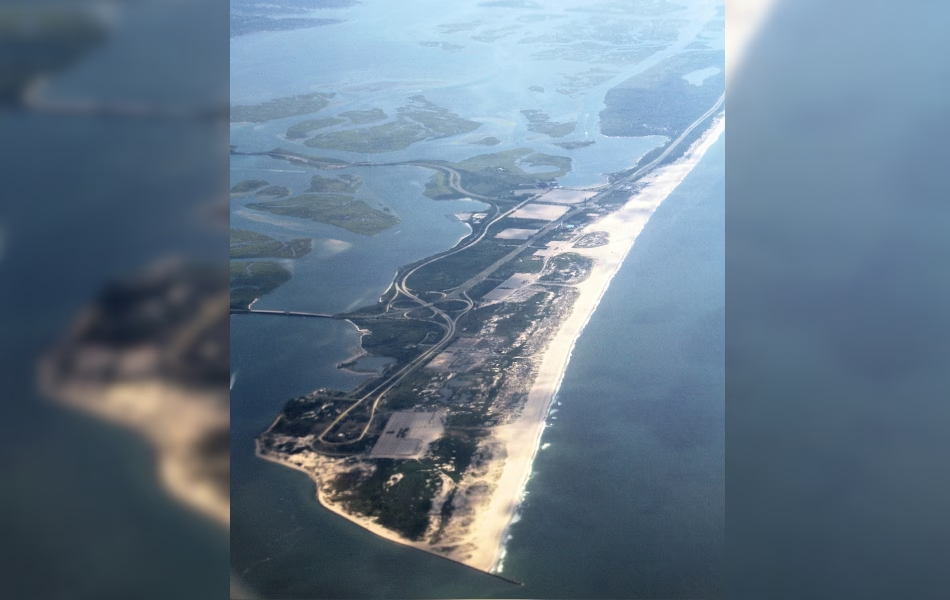
Today, Hallock State Park Preserve covers 225 acres and includes nearly a mile of undeveloped Long Island Sound shoreline.
New York State’s own park history identifies sand mining and Levon’s proposed industrial harbor among the previous uses and plans for the property.
What the 1970 photograph actually shows us
There is an important distinction when looking at the Long Island Daily Press photograph.
The Levon sand-mining operation can be firmly connected to the larger property from which Hallock State Park Preserve was eventually created. Court records also document Levon’s dock and barge operation on this section of the Sound.
What cannot yet be established from the photograph alone is the exact camera location or whether the particular machinery visible on February 10, 1970, stood inside the precise boundaries of today’s 225-acre park.
The broader transformation is well documented.
A property once envisioned as a massive industrial harbor, excavated for millions of cubic yards of material, proposed for nuclear and coal power plants and fought over for decades now consists largely of state parkland and permanently protected farmland.
Photo credit: Long Island Daily Press, “Sand Mine on Long Island Sound,” February 10, 1970. Long Island Daily Press Photograph Morgue Collection. Gelatin silver print, 7 x 9 inches. Identifier: aql:31840 / ldp-002167. Copyright holder unknown.
Sources
- Queens Public Library Digital Archives, Long Island Daily Press Photograph Morgue Collection
https://digitalarchives.queenslibrary.org/ - Hallockville Museum Farm, Richard Wines, History of Hallockville
https://hallockville.org/what-is-hallockville/history/ - Peconic Land Trust, Hallockville Museum Farm and Hallock State Park, former KeySpan property
https://www.peconiclandtrust.org/our-work/projects/hallockville-museum-farm-and-hallock-state-park-former-keyspan-property - New York State Parks, Hallock State Park Preserve Master Plan, Chapter 3
https://www.parks.ny.gov/documents/inside-our-agency/Masterplans/HallockStateParkPreserve/HallockStateParkChapter3.pdf - New York State Parks, Hallock State Park Preserve Master Plan, Chapter 5
https://www.parks.ny.gov/documents/inside-our-agency/Masterplans/HallockStateParkPreserve/HallockStateParkChapter5.pdf - New York State Parks, Hallock State Park Preserve
https://parks.ny.gov/parks/181/ - Neubros Corporation v. Northwestern National Insurance Co., 359 F. Supp. 310
https://law.justia.com/cases/federal/district-courts/FSupp/359/310/1470930/ - Suffolk Life, February 1970 archive
https://www.mattitucklaurellibrary.org/sites/default/files/content/minutes/February%201970.pdf - Maitrejean v. Levon Properties Corp., 1974
https://case-law.vlex.com/vid/maitrejean-v-levon-properties-886343154 - Maitrejean v. Levon Properties Corp., 1982
https://law.justia.com/cases/new-york/appellate-division/1982/87-ad2d-605-1.html - Trust for Public Land, New Long Island State Park Celebrated
https://www.tpl.org/media-room/new-long-island-state-park-celebrated-ny - Shelter Island Reporter, Karl Grossman retrospective
https://shelterislandreporter.archive.timesreview.com/2017/04/suffolk-closeup-50-years-covering-uncovering-long-island/ - U.S. Army Corps of Engineers coastal study
https://erdc-library.erdc.dren.mil/bitstream/11681/7605/1/CHL-TR-06-1.pdf