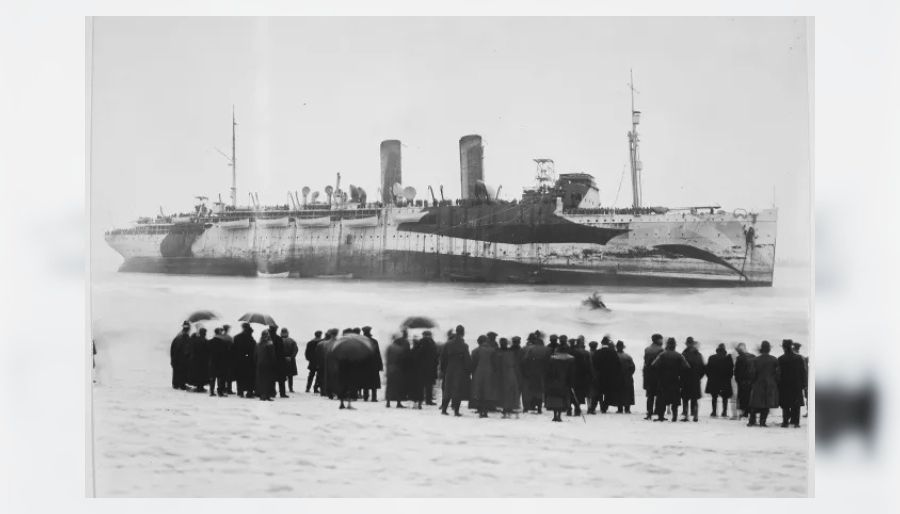
On New Year’s Day 1919, a U.S. Navy troopship carrying thousands of American servicemen returning from World War I ran aground off Lonelyville, a small community on Fire Island approximately 2½ miles east of the Fire Island Lighthouse. Among the passengers aboard the USS Northern Pacific were more than 1,500 wounded soldiers, including approximately 300 confined to their beds. The accident set off a massive rescue operation that brought everyone to safety.
The ship eventually settled about 200 yards off Fire Island’s ocean beach, where it remained stranded for more than two weeks. Remarkably, the rescue was completed without a single loss of life, and photographs preserved by the National Archives document the extraordinary effort to bring the returning soldiers ashore.
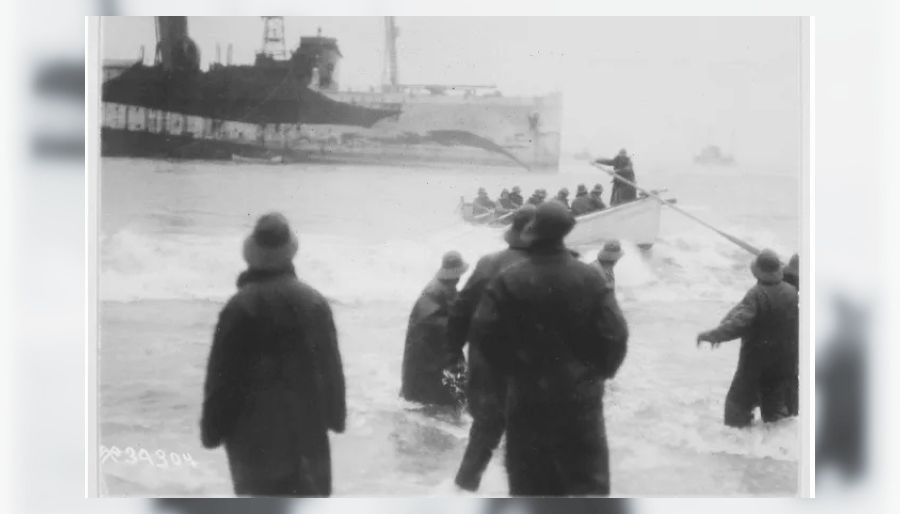
Photo: Rescuers wade into the surf as a lifeboat approaches the Fire Island shoreline during the January 1919 evacuation of the stranded USS Northern Pacific. National Archives, 111-SC-34304.
A Voyage Home from World War I
The Northern Pacific had originally been built as a passenger steamship in 1914, operating between Astoria, Oregon, and San Francisco. After the United States entered World War I, the vessel was acquired for military service and converted into a troop transport.
During the war, the ship made repeated Atlantic crossings between Hoboken, New Jersey, and Brest, France, carrying American troops overseas and bringing soldiers home. According to the Naval History and Heritage Command, the Northern Pacific transported more than 22,000 troops and passengers to France during its wartime service.
On December 25, 1918, the ship departed Brest on another homeward voyage. The armistice ending the fighting had been signed just six weeks earlier, on November 11, and thousands of American servicemen were beginning the long process of returning to the United States.
According to the U.S. Naval Institute, the Northern Pacific carried 2,518 passengers and a crew of 451, bringing the total number of people aboard to 2,969. More than 1,500 of the returning servicemen were wounded, including approximately 300 who were bedridden. The ship also carried Navy nurses responsible for caring for the injured soldiers during the voyage.
The Ship Runs Aground Off Fire Island
At approximately 2:20 a.m. on January 1, 1919, the Northern Pacific struck a sandbar near Fire Island while approaching New York Harbor. The weather was miserable, with rain, strong winds and rough seas making navigation difficult.
The vessel initially attempted to free itself, but those efforts failed. According to the U.S. Naval Institute, the ship originally grounded approximately 300 yards off Lonelyville. Winds and currents subsequently pushed it farther onto the sandbar, leaving the large transport stranded roughly 200 yards from shore in shallow water.
Coast Guardsman Roger Smith reported sighting the stranded vessel that morning, and emergency preparations began along the Fire Island shoreline. Captain Louis J. Connelly, commanding the Northern Pacific, sent a distress message requesting assistance.
The Navy dispatched several vessels to the scene, including the cruisers Columbia and Des Moines, the transport Henry R. Mallory, submarine chasers and the hospital ship Solace. Tugs and other rescue craft also arrived, but the rough conditions initially prevented crews from reaching the stranded soldiers.
Although the ship was close enough to shore to be plainly visible, the distance was dangerous. Heavy surf repeatedly battered small boats attempting to approach the transport, and the wounded men aboard could not simply be brought ashore in ordinary lifeboats.
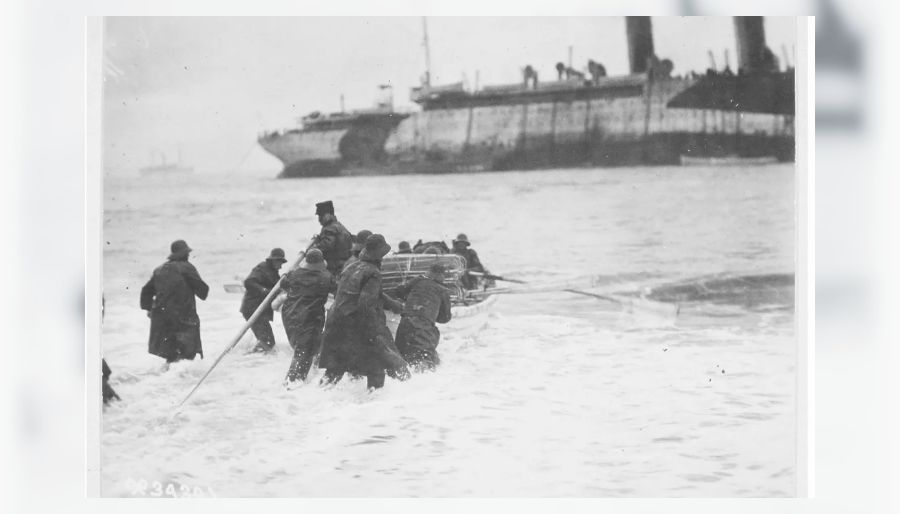
Photo: Rescuers maneuver a boat through the surf off Fire Island during the January 1919 evacuation of the stranded USS Northern Pacific, visible in the background. National Archives, 111-SC-34301.
Rescuing Soldiers with Ropes and Surfboats
One of the most remarkable aspects of the rescue was the use of a breeches buoy, a lifesaving apparatus developed for evacuating people from ships stranded near shore.
The device consisted of a circular life ring fitted with a canvas seat, suspended from a rope and pulley system. Rescuers established a line between the stranded vessel and the beach, allowing passengers to be carried over the water one at a time.
For the able-bodied soldiers aboard the Northern Pacific, the apparatus provided a means of escape without requiring a boat to navigate the dangerous surf. The National Archives preserves several photographs showing passengers arriving by breeches buoy, confirming that the equipment was actually used during the operation.
Coast Guard crews also employed specialized surfboats, carrying approximately ten people per trip between the transport and shore or other vessels. The operations were hazardous, with three rescue boats reportedly overturning in the rough seas. Despite these accidents, rescuers continued ferrying passengers away from the stranded ship.
According to the National Archives, three soldiers nearly drowned when a rescue craft capsized, but Coast Guardsmen were able to revive them. Despite the weather and the number of wounded passengers, the operation continued without a fatality.
A Massive Rescue Effort
By January 2, rescue operations were underway in earnest. Coast Guard crews worked from the beach while Navy vessels stationed offshore waited to receive passengers transferred from the stranded ship.
As Coast Guard crews brought soldiers ashore, rescuers waded into the surf to help them from the boats and carry those unable to walk onto the beach. Bonfires provided warmth while Red Cross volunteers distributed hot coffee and sandwiches. Many of the rescued men were then transported by boat across Great South Bay to Bay Shore, where arrangements had been made for medical care and accommodations.
The rescue also drew assistance from elsewhere on Long Island. More than 3,000 blankets were sent from Camp Mills in Garden City to help care for the returning soldiers, while local boat owners and commercial operators assisted with transportation. The effort required coordination between the Coast Guard, Navy, Red Cross and residents of nearby communities.
Weather conditions continued to complicate the operation. Strong winds, heavy seas and poor visibility interrupted the movement of passengers, while the most seriously wounded soldiers required special handling.
The Navy’s shallow-draft submarine chasers proved especially useful because they could maneuver close to the stranded transport. These smaller vessels helped transfer wounded men to the hospital ship Solace, while other passengers were taken aboard additional Navy ships.
Contemporary newspaper accounts described the difficult task of moving bedridden soldiers between vessels in rough water. Even after leaving the Northern Pacific, the wounded still had to be transferred safely to ships capable of bringing them to hospitals.
By January 4, the last wounded soldiers had been evacuated from the Northern Pacific, completing the passenger rescue operation without a single loss of life. Some passengers had been brought ashore on Fire Island, while others were transferred directly to Navy vessels, including the hospital ship Solace. Although the passengers were safe, the stranded troopship and its salvage crew remained offshore for another two weeks.
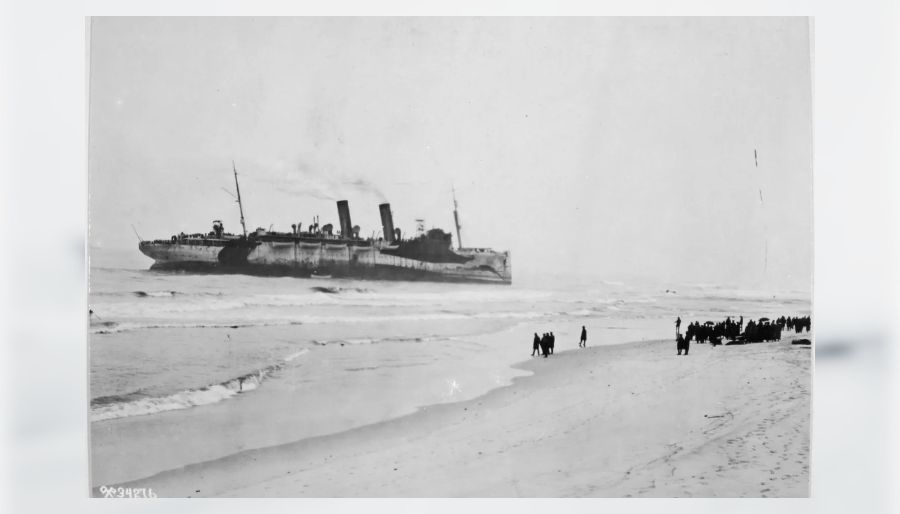
Photo: Spectators gather along Fire Island’s shoreline as the USS Northern Pacific sits stranded on a sandbar off Lonelyville in January 1919. National Archives, 111-SC-34276.
The Ship Remained Stranded for 18 Days
Although the passengers had been rescued, the Northern Pacific remained firmly grounded off Fire Island. Salvage crews now faced the separate challenge of freeing the large transport from the sandbar.
Workers removed heavy equipment to reduce the ship’s weight, while powerful tugs attempted to pull it back into deeper water. The operation required repeated efforts over several days as the vessel resisted attempts to dislodge it.
Coast Guard personnel maintained a watch over the stranded ship throughout the salvage effort. Finally, on January 18, 1919, the Northern Pacific was refloated and taken to Staten Island.
The grounding damaged the ship’s hull and rudder, requiring extensive repairs before it could return to service. A Navy court of inquiry convened on January 21, 1919, to investigate how the transport had ended up on the sandbar. Investigators identified several navigational errors, including an incorrect estimate of the ship’s position, failure to follow the prescribed approach course and failure to take soundings to determine the water’s depth.
Captain Louis J. Connelly subsequently faced a general court-martial on three charges related to the grounding. According to the National Archives, he was convicted on two of the charges. The findings established that the accident involved failures in navigation rather than weather conditions alone.
The Northern Pacific eventually returned to transatlantic service, making two additional voyages during 1919. Its career ended in February 1922, when the ship was destroyed by fire while being towed toward a shipyard in Pennsylvania.
The Photographs That Preserve the Rescue
The Fire Island rescue is particularly well documented because photographers recorded the stranded transport and the efforts to evacuate its passengers.
Photographs preserved by the National Archives show the Northern Pacific sitting on the sandbar, Coast Guard surfboats approaching the vessel and soldiers arriving ashore using the breeches buoy. One image captures a soldier suspended above the water as he travels along the rescue line toward the beach.
The Library of Congress also holds photographs from the George Grantham Bain Collection related to the incident. Among them are images of soldiers being rescued and a demonstration of the ship-rescue apparatus used during the operation.
These photographs provide a detailed visual record of the techniques employed by lifesaving crews more than a century ago. They also document the important role played by Fire Island’s Coast Guard personnel during an emergency involving thousands of returning American servicemen.
The Northern Pacific was eventually freed from the sandbar, repaired and returned to service, leaving little physical evidence of its ordeal off Fire Island. The photographs, official rescue reports and contemporary newspaper accounts preserve the details of an operation that brought thousands of World War I soldiers safely home to American shores.
Photo: Spectators gather on Fire Island’s shoreline as the USS Northern Pacific sits stranded offshore in January 1919. National Archives, 111-SC-34272.
Sources:
- National Archives – “Rescue from Fire Island,” documenting the 1919 grounding of the USS Northern Pacific, rescue operations, Coast Guard records and archival photographs. https://unwritten-record.blogs.archives.gov/2019/02/12/rescue-from-fire-island/
- Naval History and Heritage Command – Official history of the USS Northern Pacific, including its World War I service, January 1919 grounding, salvage and later history. https://www.history.navy.mil/research/histories/ship-histories/danfs/n/northern-pacific.html
- Library of Congress – “Rescues from GREAT NORTHERN,” an original Bain News Service photograph documenting the rescue of passengers from the Northern Pacific. https://www.loc.gov/item/2014708387/
- Library of Congress – “Man demonstrating ship-rescue apparatus,” an original Bain News Service photograph showing a breeches buoy demonstration associated with the rescue. https://www.loc.gov/item/2014710128/
- Fire Island News – “The Miraculous Rescue of the U.S.S. Northern Pacific,” historical reporting on the grounding, evacuation timeline, local rescue efforts and recovery of the ship. https://www.fireislandnews.com/history/the-miraculous-rescue-of-the-u-s-s-northern-pacific/
- U.S. Naval Institute – “Detour at Longelyville,” published in Naval History magazine in April 2004, documenting the ship’s grounding location, passenger and crew totals, Coast Guard rescue operations, assistance from Long Island communities and the Navy’s investigation. https://www.usni.org/magazines/naval-history-magazine/2004/april/detour-longelyville