Cold Spring Harbor Lighthouse spent 75 years guiding ships around a dangerous shoal on Long Island’s North Shore before being retired in 1965. The wooden lighthouse was scheduled for demolition, but a Centre Island resident purchased the structure for just $1 and arranged to have it moved to her waterfront property. More than a century after it was built, the original lighthouse remains standing on private property, roughly a mile from its original location.
The unusual preservation effort saved a piece of Long Island’s maritime history that otherwise would have disappeared. According to the U.S. Coast Guard, the lighthouse had been in operation since January 31, 1890, and was replaced by a modern navigational structure after its retirement.
A Lighthouse Built to Protect Cold Spring Harbor
During the 19th century, Cold Spring Harbor was an important maritime community, particularly during its years as a whaling port. Ships entering the harbor faced a navigational hazard: a shallow shoal extending approximately 1,500 feet from the eastern side of Centre Island.
The shoal forced vessels to navigate close to Lloyd’s Neck to avoid running aground. Despite the harbor’s commercial activity, a permanent lighthouse was not established at the entrance until 1890.
Congress appropriated $20,000 for navigational improvements on March 3, 1875, originally considering a system of two range lights on shore. Difficulties acquiring suitable property delayed the project, and officials eventually approved construction of a single offshore lighthouse.
Work began in 1889, and the finished structure was first illuminated on January 31, 1890. The lighthouse stood on a cast-iron and concrete caisson anchored in the shoal, with a square, pyramidal wooden tower rising approximately 35 feet above its foundation.
Originally painted white with a black lantern, the lighthouse was equipped with a fourth-order Fresnel lens that displayed a fixed red light. In 1892, its light characteristic was changed to white with a red sector to warn mariners away from hazardous waters.
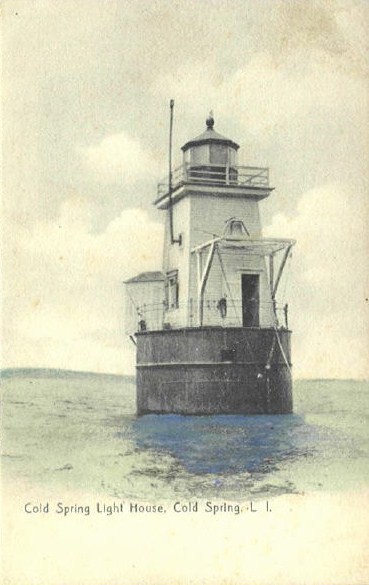
Photo: Unknown. Published for Gildersleeve Studio, Huntington, New York, Public domain, via Wikimedia Commons
Life at the Lighthouse
Keeping the lighthouse operating was only part of the job. During one year, Keeper Louis P. Brown helped rescue four people aboard a disabled motor launch, two young men whose canoe had filled with water during a storm, and five men stranded in a dory. In one particularly difficult rescue, Brown towed a disabled launch carrying two couples approximately 1¾ miles to safety during a northwest gale. Rough conditions prevented him from returning to the lighthouse until the following morning, but his wife remained at the station and kept the light operating in his absence.
Operating the offshore station required keepers to maintain the lamp, monitor the equipment and travel by boat between the lighthouse and the mainland. The lighthouse was equipped with a small boat suspended from davits, allowing its keepers to reach shore when conditions permitted.
The first keeper, William S. Keene, was selected from approximately 75 applicants but resigned after only a month. His successor, Arthur Jensen, had previously served at Execution Rocks Lighthouse. Historical lighthouse accounts also describe visits from President Theodore Roosevelt, who reportedly rowed into the harbor with his children from nearby Sagamore Hill.
Click here for more stories about Long Island’s maritime history.
The station also experienced tragedy. On August 3, 1908, Keeper Chester Rowland slipped from the lighthouse’s steep ladder and fell into the water while returning from an outing in Huntington Harbor. Rowland could not swim, and although two men on shore attempted to help, his body was not recovered until three days later near Whitehead Point.
His successor, Arthur Jensen, had previously served at Execution Rocks Lighthouse. Historical accounts also describe visits to Cold Spring Harbor Lighthouse by President Theodore Roosevelt, who occasionally rowed into the harbor with his children from his nearby Sagamore Hill residence.
Winter weather presented another serious challenge. In February 1918, a large sheet of ice struck the lighthouse during a gale, shaking the structure and forcing Keeper Louis P. Brown to temporarily extinguish the main lamp. A 1919 inspection determined that ice had caused approximately $12,800 in damage.
The lighthouse continued operating through subsequent improvements, including the installation of an oil vapor lamp in 1929. It was automated in 1948, with Coast Guard personnel stationed at Eaton’s Neck assuming responsibility for maintenance.
Sold for $1 and Moved to Centre Island
By 1965, the original lighthouse was no longer needed for navigation. The Coast Guard replaced the wooden structure with a steel skeletal tower on the existing offshore foundation, allowing an automated light to continue marking the shoal.
The old lighthouse was scheduled to be demolished, but a Centre Island resident known in historical accounts as “Lady Glen” intervened. She purchased the structure for $1 and arranged for it to be transported to her waterfront property.
Lady Glen had known the lighthouse long before she acquired it. According to historical accounts, she remembered a keeper who had a piano inside the station and would play music that could be heard across the harbor. Her recollections were later documented in a November 1995 Lighthouse Digest interview about the lighthouse’s preservation.
The relocation proved more complicated than expected. In a 1995 interview with Lighthouse Digest, the woman known locally as Lady Glen recalled that the barge transporting the lighthouse became stranded on a sandbar. Efforts to free it failed, and the structure reportedly remained stranded for nearly a year before rising water finally allowed the barge to move.
Attempts to free the stranded barge included attaching a heavy steel cable, which snapped under the strain. The lighthouse remained stranded until the water rose high enough to float the barge free, allowing the relocation to Centre Island to be completed.
The wooden lighthouse was eventually installed on the owner’s property overlooking the harbor where it had once stood. Its relocation preserved the original 19th-century structure, although it no longer functioned as a navigational aid.
The United States Lighthouse Society records that the lighthouse underwent restoration in 1994, nearly three decades after its removal from the water.
Where Is the Cold Spring Harbor Lighthouse Today?
The original Cold Spring Harbor Lighthouse remains on private waterfront property in the Plum Point area of Centre Island, near Bayville. It is not open to the public, and its grounds and tower are privately owned.
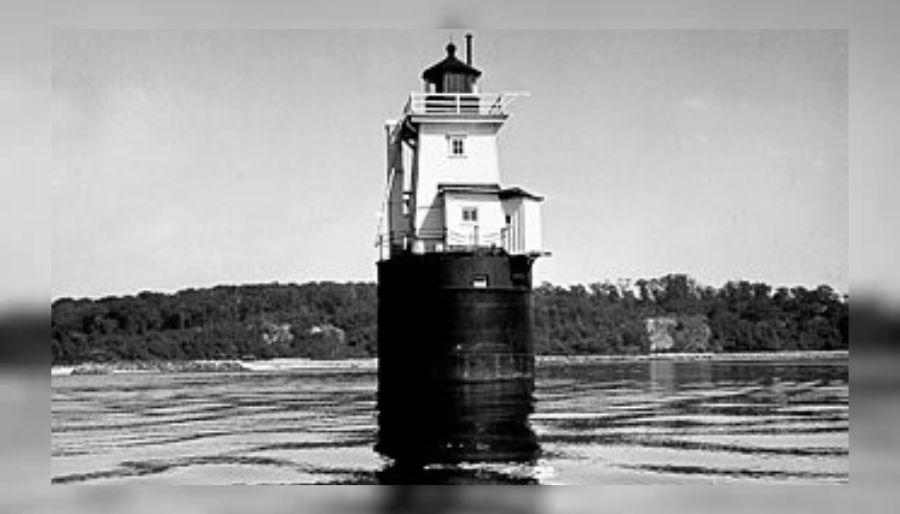
A modern skeletal tower and daymark occupy the original offshore foundation, marking the location where the wooden lighthouse stood until 1965. The replacement structure occupies the same shoal that prompted construction of the original lighthouse in the 19th century.
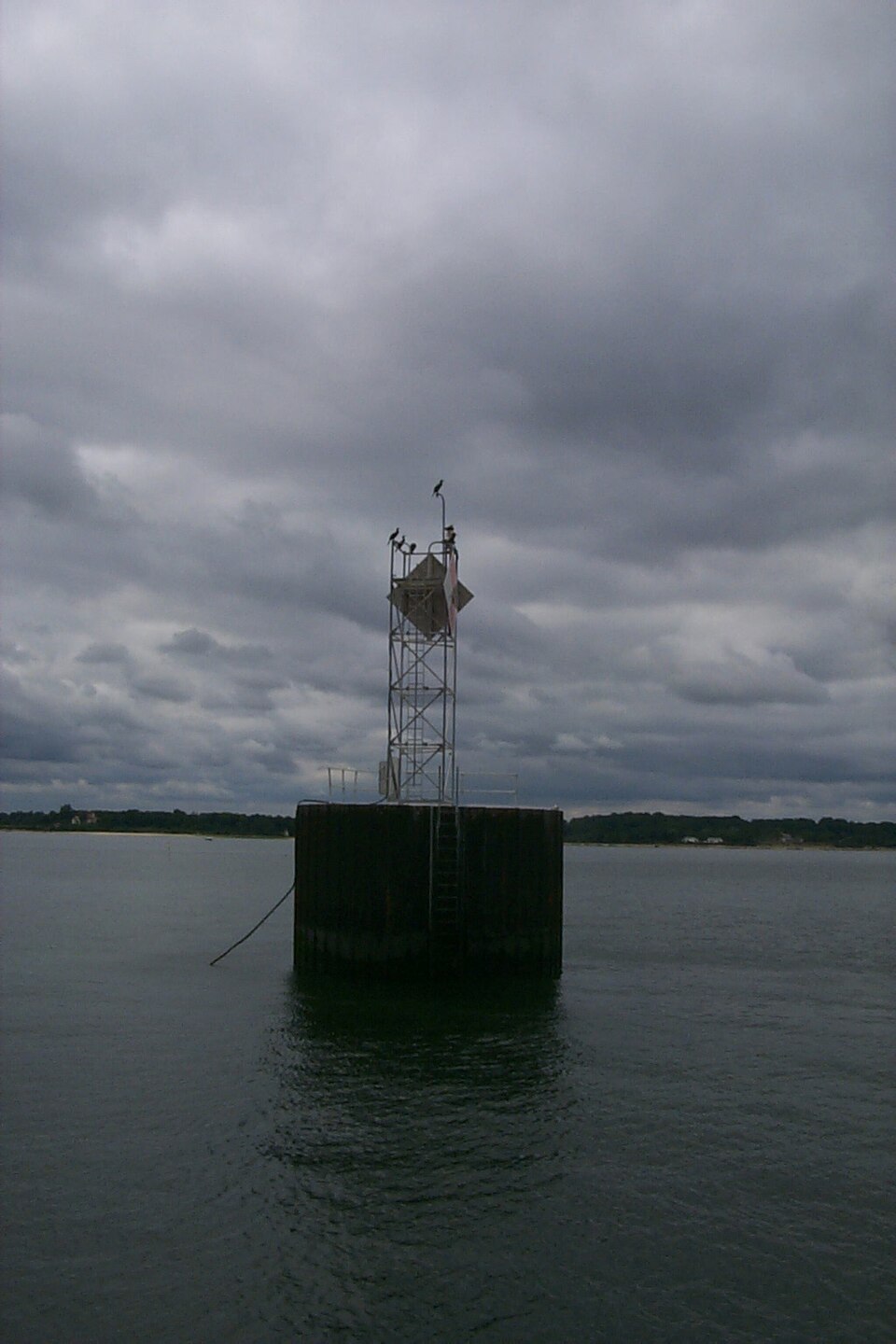
Photo: J Clear at English Wikipedia, CC BY-SA 3.0, via Wikimedia Commons
Both the original lighthouse foundation and the relocated wooden structure can be viewed from Lloyd Beach on Lloyd’s Neck. The original caisson remains offshore, while the historic wooden lighthouse stands across the harbor on private property on Centre Island.
The two structures illustrate different periods in Long Island’s maritime history. One reflects the transition to automated navigation, while the other survives because a local resident purchased an obsolete government lighthouse for the price of a single dollar.
Cover photo: Cold Spring Harbor Lighthouse on its original offshore foundation before the wooden structure was relocated to Centre Island in 1965. Photo: U.S. Coast Guard, public domain.
Sources
- U.S. Coast Guard, Cold Spring Harbor Light: Official construction chronology, lighthouse specifications, deactivation and $1 purchase. https://www.history.uscg.mil/Browse-by-Topic/Assets/Land/All/Article/1912757/cold-spring-harbor-light/
- United States Lighthouse Society, Cold Spring Harbor: Historic lighthouse documentation, relocation and 1994 restoration. https://archives.uslhs.org/places/cold-spring-harbor
- United States Lighthouse Society, Cold Spring Harbor Lighthouse 1890–1965: Historical research by Robert G. Bachand. https://uslhs.org/resources/keepers-log/select-articles/cold-spring-harbor-lighthouse-1890-1965-only-yesterday
- Lighthousefriends.com, Cold Spring Harbor Lighthouse: Detailed history of the keepers, lighthouse operations, Lady Glen and the barge relocation. https://www.lighthousefriends.com/light.asp?ID=748