World Space Week is underway, and the Cradle of Aviation Museum in Garden City is marking the occasion by highlighting a part of history in which Long Island played a substantial role.
Held annually from Oct. 4 through Oct. 10, World Space Week celebrates achievements in space science and technology. The 2026 theme is “Rocket Revolution,” focusing attention on rocket technology and the systems that have made space exploration possible.
At the Cradle of Aviation, visitors can follow much of that development through the museum’s Space Gallery, moving from early rocketry into the Mercury, Gemini and Apollo programs and eventually the Space Shuttle era.
“The Museum has a lot of space history to explore,” the Cradle of Aviation said in an Instagram post marking World Space Week. The museum is also using the week to highlight Long Island’s connections to the people and technology behind the American space program.
Those connections are considerable. Long before the current generation of commercial rockets and reusable launch systems, Long Island was one of the centers of the American aerospace industry. Grumman Aircraft Engineering Corporation was founded in 1929 and eventually operated major facilities in places including Bethpage and Calverton. The company developed aircraft for the U.S. military before becoming an important part of the American space program.
We previously looked at the company’s history in Grumman’s Long Island Legacy in Aviation, Space and Industry. Grumman received the NASA contract to develop the Apollo Lunar Module in November 1962, and every Lunar Module was built on Long Island.
The Lunar Module was the spacecraft that carried astronauts from lunar orbit to the surface of the Moon and then returned them to the Command and Service Module for the trip home. Grumman ultimately built 13 Lunar Modules, 10 of which went to space, while six carried astronauts to the lunar surface.
Lern more about the history of rocketry in this video below:
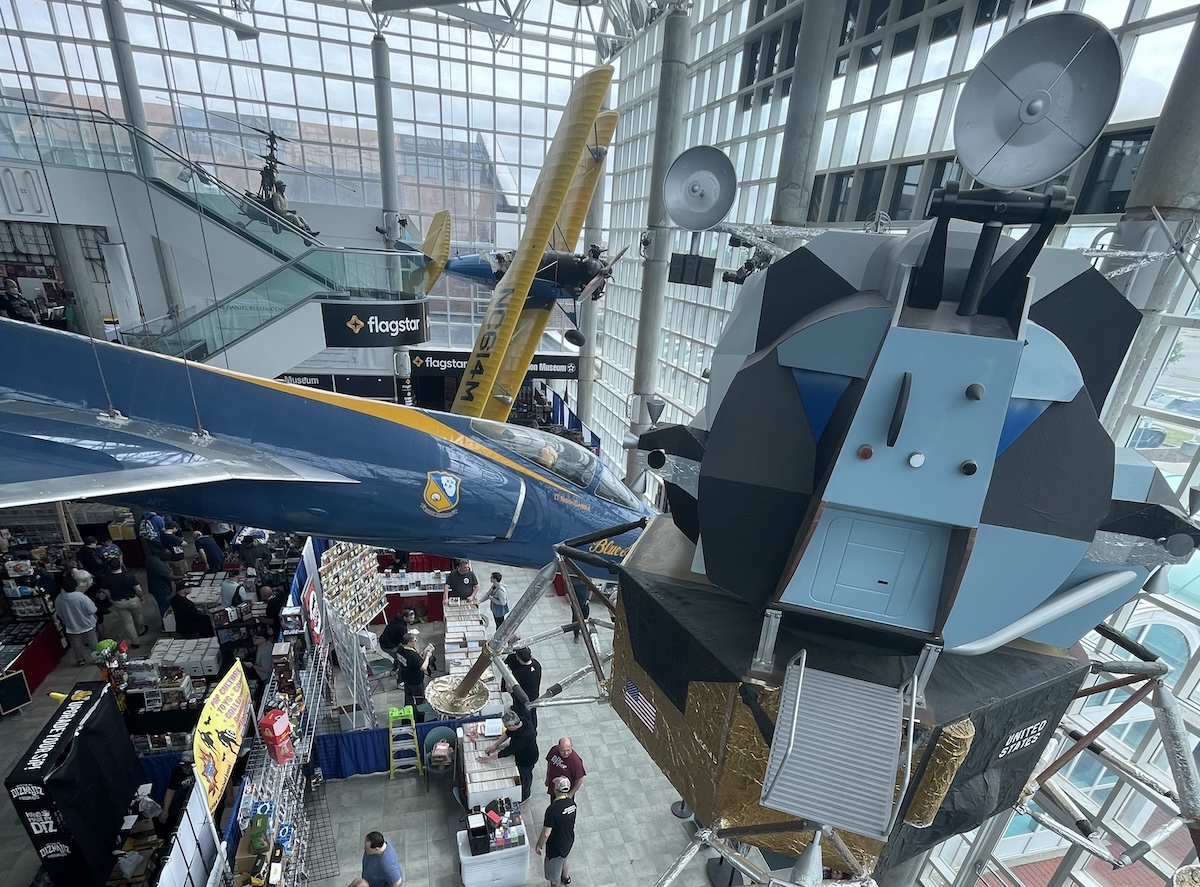
Long Island’s role is represented directly inside the Cradle of Aviation. The museum houses LM-13, the final Lunar Module produced by Grumman. It was intended for a later Apollo mission but never flew and is now on permanent loan from the Smithsonian Institution.
The museum also has the only Lunar Module Simulator built for the Apollo program. It operated at Kennedy Space Center from 1968 to 1972 and was used to train Apollo astronauts for lunar missions. More on the spacecraft and its unusual Long Island history can be found in Crazy Facts About the Grumman Apollo Lunar Module Built by Long Islanders.
That history gives the Cradle an unusually direct connection to this year’s “Rocket Revolution” theme. Visitors can see how American spaceflight progressed from experimental rocket technology to crewed spacecraft and lunar exploration, while also seeing where Long Island companies and engineers fit into that development.
World Space Week is recognized each year from Oct. 4-10 and has grown into an international celebration of space science and technology. The World Space Week Association says more than 50,000 events were held across more than 100 countries during the previous celebration.
The Cradle of Aviation Museum is located on Charles Lindbergh Boulevard in Garden City and is open Tuesday through Sunday from 10 a.m. to 5 p.m.