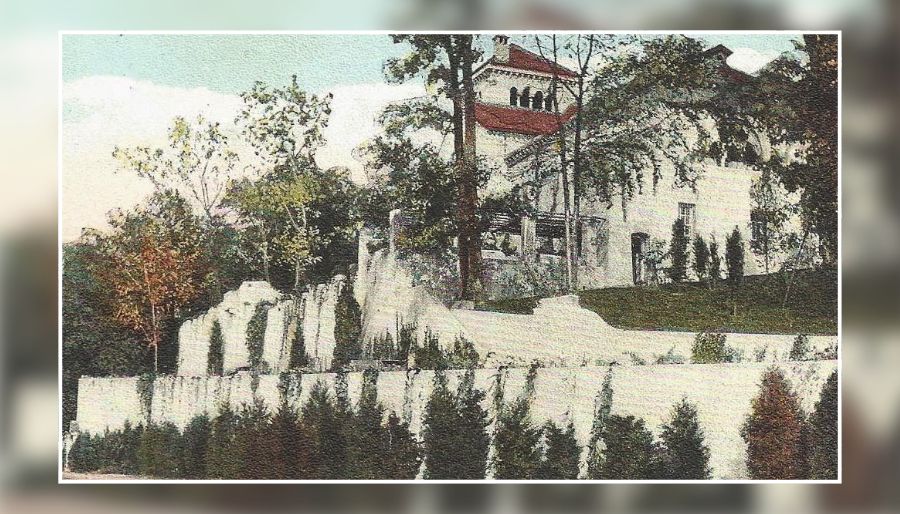
For much of the 20th century, a large, unusual estate stood on a hillside overlooking Huntington Harbor. Known first as The Monastery and later as Ferguson’s Castle, the house had about 40 rooms, a large tower, thick concrete walls, a chapel, cloisters and a collection of European art and architectural pieces.
The estate was built for Juliana Armour Ferguson, a member of the Armour meatpacking family, and her husband, Dr. Farquhar Ferguson. It later became a local landmark, a silent-film location and, after years of decline, a favorite place for generations of Huntington teenagers to explore. Residents tried to save it in the 1960s, but the house was demolished in 1970.
Parts of the estate still survive, and some objects once displayed there can now be found in major museum collections.
Juliana Armour Ferguson built Ferguson’s Castle
Juliana Armour Ferguson was the daughter of Herman O. Armour of the Armour meatpacking family. Some later accounts incorrectly identify her father as H. Ogden Armour, but contemporary and genealogical records point to Herman O. Armour.
She married Dr. Farquhar Ferguson in 1890. Ferguson was a physician and pathologist who studied at Long Island College Hospital and worked in medicine and public health in New York.
The Fergusons traveled in Europe and developed an interest in the monasteries and older buildings they saw there. They began planning a large home on Long Island, but Farquhar died before it was completed. Juliana continued with the project.
Property records later reviewed in a New York appellate court case show that Juliana began acquiring land along what is now East Shore Road in 1907. By 1908, she owned three adjoining parcels on the hillside above Huntington Harbor.
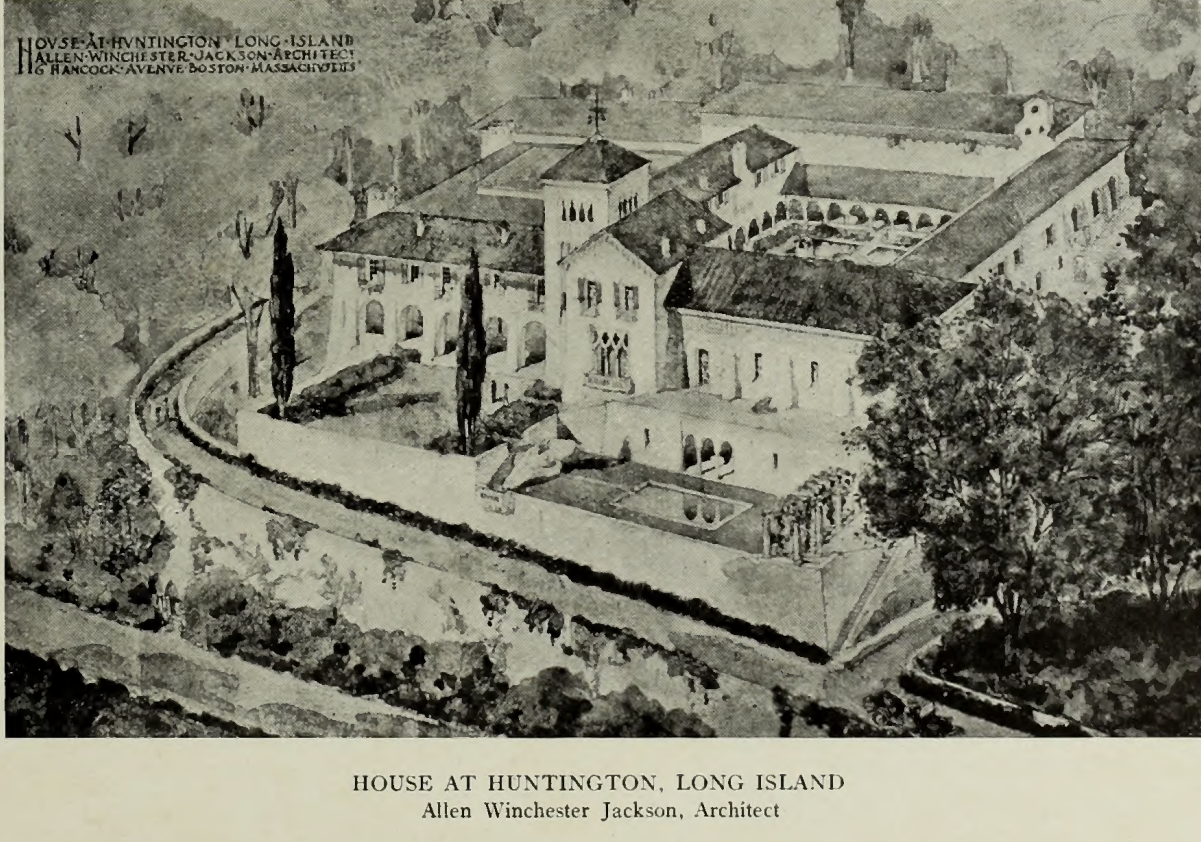
Architect Allen W. Jackson designed the house.
Ferguson’s Castle was originally called The Monastery
The Ferguson estate was originally known as The Monastery rather than Ferguson’s Castle.
Architectural records show the project by 1908, although some later sources give 1911 as the final completion date. The available evidence indicates that the house was substantially built and being presented in architectural publications by 1908, with work possibly continuing afterward.
A detailed article titled “A ‘Monastery’ on Long Island” appeared in the August 1917 issue of The Touchstone. Written while Juliana Ferguson was still living at the estate, it provides one of the best contemporary descriptions of the property.
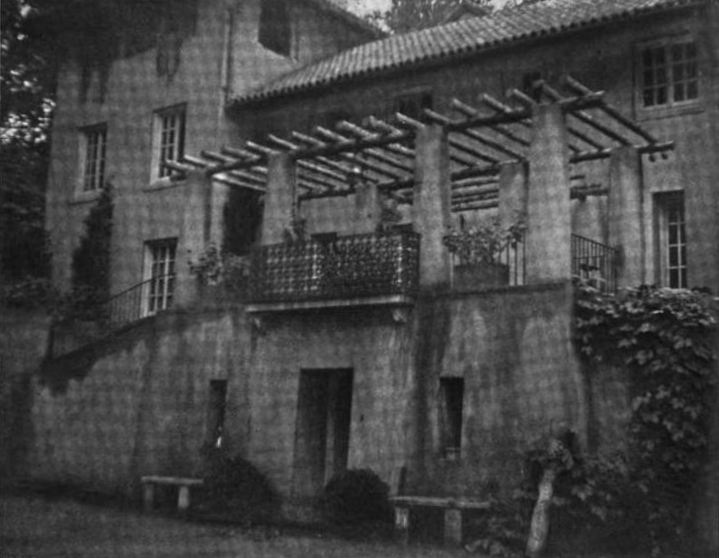
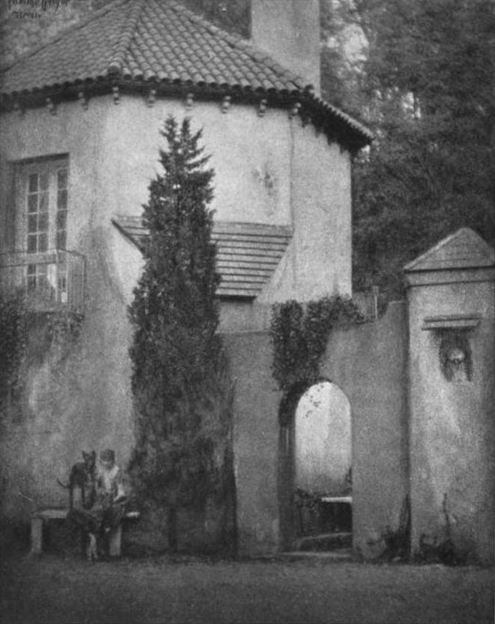
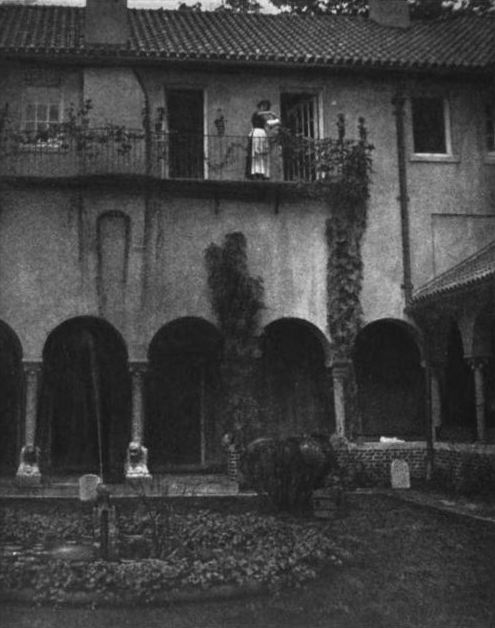
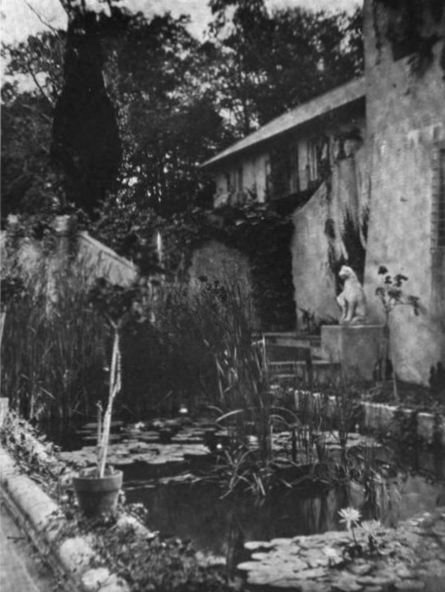
Jackson designed the house, while Juliana designed the gardens. The estate drew heavily from Italian and Mediterranean architecture and included cloisters, arches, tiled roofs, iron balconies, courtyards and fountains.
Some architectural pieces were imported from Europe, while others were designed specifically for the house.
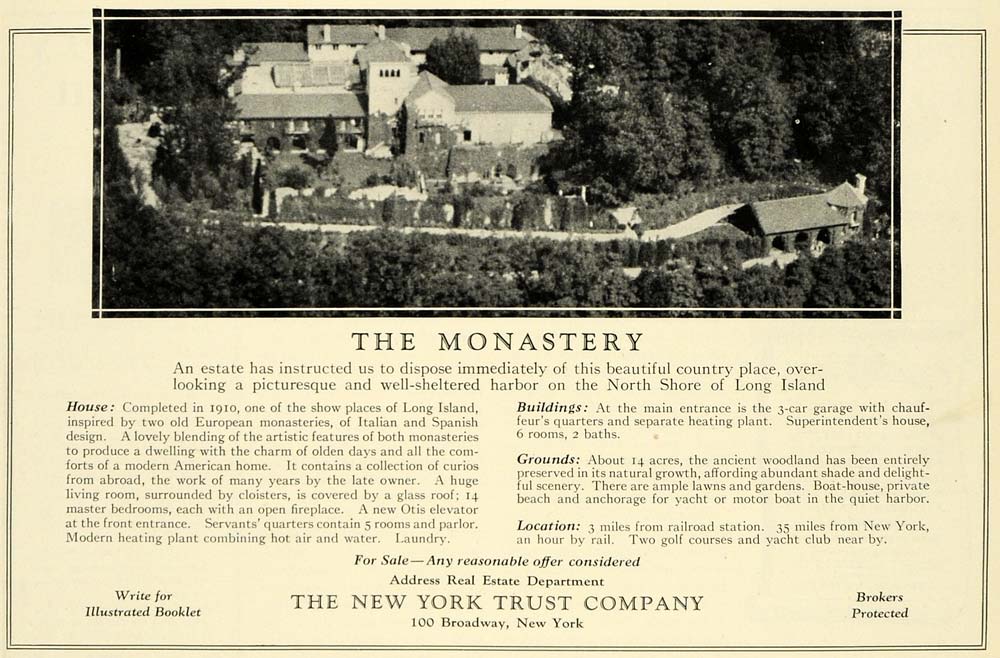
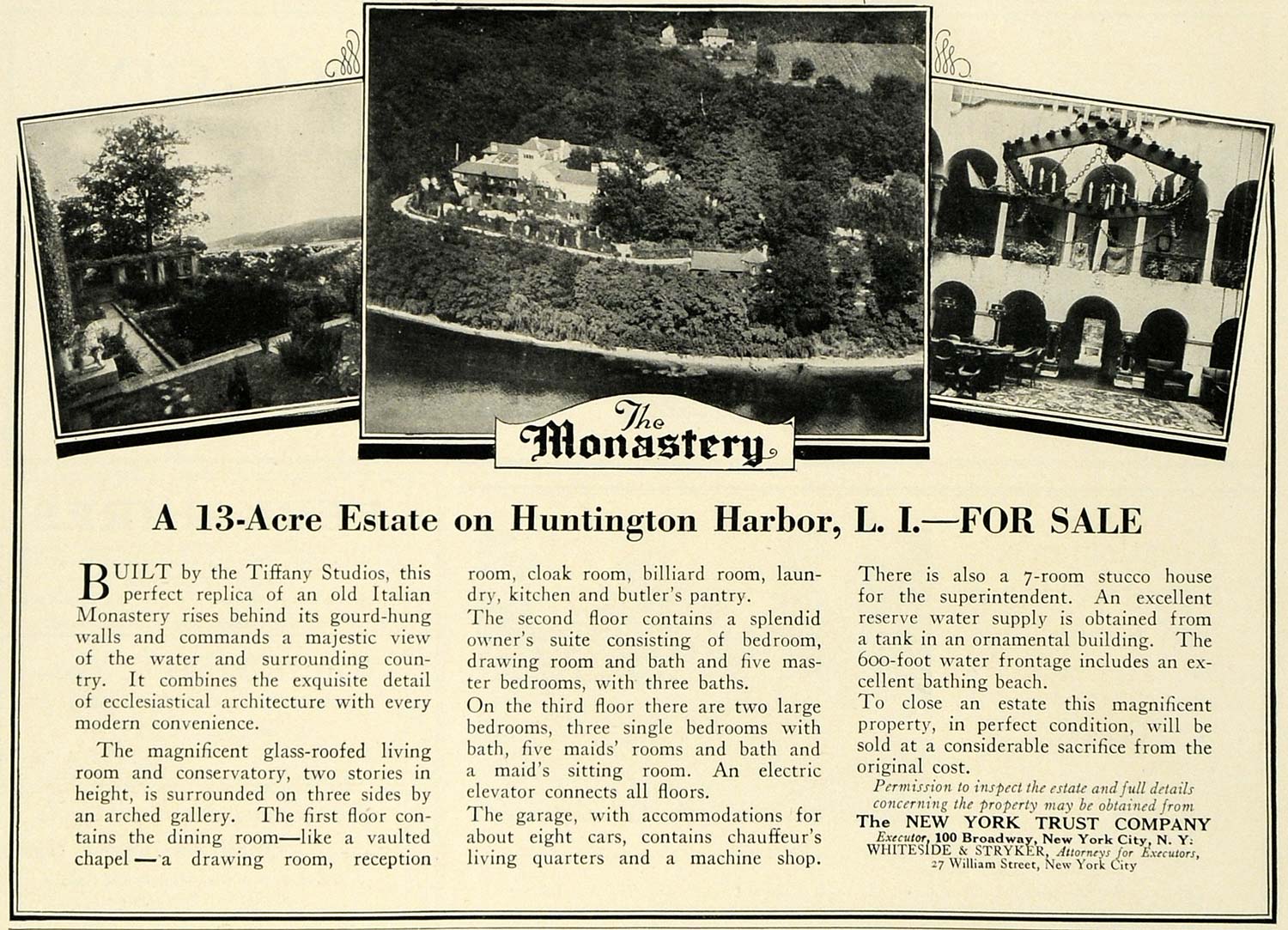
The estate included about 40 rooms, numerous bedrooms and fireplaces, servants’ quarters, a private chapel, an elevator and a three-car garage. Later accounts describe the great hall as approximately 64 feet long, 47 feet wide and three stories tall.
Despite its old-world appearance, the house itself was built largely of concrete and included several modern features for the period.
The tunnel was real
Stories about tunnels beneath Ferguson’s Castle became common after the estate fell into decline. Some later accounts connected them to Prohibition or rum running.
There was, in fact, a tunnel, but contemporary records give it a much less mysterious purpose.
The 1917 Touchstone article describes a stairway that passed beneath the driveway and through a tunnel toward East Shore Road and the waterfront. One of the original photographs was captioned as showing stairs leading through iron gates into a tunnel and out toward the highway.
There is no evidence that the tunnel was built for smuggling or had any connection to Prohibition. It appears to have been part of the original design of the hillside estate and provided access toward the road and harbor.
Ferguson’s Castle contained genuine medieval art
Juliana Ferguson collected European art, sculpture and architectural pieces and incorporated some of them directly into the house and gardens.
Later descriptions of the property mention marble lions, Persian tiles, Gothic religious art, tapestries and other antiques. Museum records confirm that at least some of the material was genuinely medieval.
The Cleveland Museum of Art owns a marble capital fragment depicting the Ox of Saint Luke that dates to roughly 1175 to 1200. The museum’s provenance lists Juliana Armour Ferguson of Huntington, Long Island, as a former owner.
The museum says the piece was once part of the same medieval structure as two other surviving capitals.
A Romanesque marble lioness has also been identified in published provenance records as having once belonged to Ferguson’s collection before eventually entering Cornell University’s Herbert F. Johnson Museum. It reportedly stood as part of a fountain on the Huntington estate.
These records help confirm that Ferguson was not simply buying reproductions to make a new house look old. She was collecting authentic European material and using it as part of the estate.
The Monastery was also a family home
Later stories about Ferguson’s Castle often focus on its ruins, supposed ghosts and unusual collections, but the earliest descriptions present a different picture.
The 1917 Touchstone article describes the estate largely in terms of family life, gardens, children and entertaining. The Fergusons had seven children, and later accounts say neighborhood children were frequently welcomed at the property.
Robert B. King’s 1978 book, Ferguson’s Castle: A Dream Remembered, includes stories of hayrides, sleigh rides and gatherings at the estate. King researched the house relatively soon after its demolition and drew on interviews and recollections from people who had known the property.
One small detail in the 1917 article gives some sense of Juliana Ferguson’s approach to the estate. When someone suggested adding something new to the property, she reportedly replied, “Let us wait a year and think about it.”
Later accounts also say the furniture in the large great hall was sometimes moved aside so the Ferguson children could roller skate there.
The house contained a private chapel, where Mass was reportedly celebrated for members of the family and staff.
Some of the stranger stories are harder to verify
Ferguson’s Castle accumulated a large body of local folklore, particularly after the house became vacant and deteriorated.
One of the most frequently repeated stories says Juliana collected old European gravestones belonging to children who had died young and placed them in floors, thresholds, gardens and benches around the estate.
The story appears in later accounts of Ferguson’s Castle. It is plausible in the sense that Ferguson was clearly acquiring old European architectural material, but we have not found the gravestone story in the contemporary 1917 description of the estate.
That does not mean it is false, but it should be treated as a later account rather than something confirmed by the earliest available source.
The same is true of one of the best-known Ferguson stories involving a wax figure of her dead son.
The Ferguson family suffered several losses
Juliana’s son Danforth Brooks Ferguson served in France during World War I.
Some later accounts say he was killed in the trenches. Military records instead show that he died of pneumonia in France on Oct. 20, 1918.
Danforth had also served as an ambulance driver in France in 1915, before the United States entered the war.
Another Ferguson son, Fearchar Ferguson, served as an aviator for France. He survived the war and received the Croix de Guerre with Palm after an incident in which his aircraft was reportedly struck by numerous bullets.
A later story claims Juliana was so affected by Danforth’s death that she had a life-sized wax figure of him made and placed it at the dining table.
The story has been repeated for decades, but we have not found contemporary documentation confirming it. It is best treated as part of the later Ferguson Castle legend.
Juliana Ferguson died in 1921 at age 56.
Ferguson’s Castle was used as a movie location
Local histories have long said the 1916 silent version of Romeo and Juliet, starring Francis X. Bushman and Beverly Bayne, was filmed at the Ferguson estate.
The surviving film documentation does not clearly confirm that claim. The American Film Institute lists production work for Romeo and Juliet at Brighton Beach but does not identify the Huntington estate as a location.
Another 1916 film can be connected to the house with much stronger evidence.
AFI records for The Brand of Cowardice, starring Lionel Barrymore, state that filming took place at “the country estate known as ‘The Monastery’ in Huntington, Long Island.”
So Ferguson’s estate was definitely used as a silent-film location, even if the long-repeated Romeo and Juliet connection remains uncertain.
The estate became difficult to maintain
After Juliana’s death, the enormous house became increasingly difficult and expensive to maintain.
Later histories describe several attempts to find new uses for it. The property was used for a time as a girls’ school, although the school was short-lived.
William J. Connors, a Buffalo newspaper publisher and politician, later acquired the property for his wife. After his death, there were efforts to find an institutional use for the building, including a proposal for a cancer research facility.
Over time, furnishings and art were removed and sold.
Later accounts describe valuable objects being sold at relatively low prices, including antique rugs, tapestries, furniture and artwork.
Charles Cords later came into possession of the estate. Accounts from the period describe him as living in only a small section of the enormous house while much of the rest deteriorated.
By the 1950s and 1960s, Ferguson’s Castle had become an aging and increasingly expensive property with no clear long-term use.
Its tower became a federal navigation landmark
Even while the estate was deteriorating, Ferguson’s Castle remained a visible landmark around Huntington Harbor.
The 1966 United States Coast Pilot used the tower of Ferguson’s Castle as a reference point when describing the boundary of an anchorage in Huntington Harbor.
Federal regulations issued around the same period also used the castle tower as a navigational reference.
The house was therefore still prominent enough in the 1960s to appear in official directions for vessels using the harbor.
Efforts to save the castle began years before demolition
The future of Ferguson’s Castle was being publicly discussed by at least 1966.
A Feb. 3, 1966 edition of The Long Island Advance reported that the Suffolk County Board of Supervisors had heard from another prospective purchaser interested in Ferguson’s Castle.
That contemporary account shows that Suffolk County was involved with the property several years before demolition and was considering possible buyers.
By 1969, local newspaper coverage shows that preservation of Ferguson’s Castle had become an organized issue in Huntington. Residents sought ways to preserve the building or find another use for it.
The main obstacle was the cost.
The house was extremely large, badly deteriorated and expensive to repair, heat and secure. Its concrete construction also made demolition unusually difficult.
The original source material for this story describes a long effort by residents to restore the building and find a practical use for it.
Those efforts were unsuccessful.
Ferguson’s Castle was demolished in 1970
The main house was demolished in 1970.
Later residents remembered seeing wrecking equipment working on the tower during that year. Some of the heaviest walls and foundations were left in place because removing them would have been difficult and expensive.
It would be misleading to simply say that the Town of Huntington demolished Ferguson’s Castle.
The available records show a more complicated situation. Suffolk County had become involved with the property and was considering prospective purchasers by 1966. Preservation efforts followed, and after the building was demolished, the former estate eventually passed into the hands of developers.
Development brought another fight
Demolition did not settle the future of the property.
In the early 1970s, developers proposed luxury condominiums on the former Ferguson estate. Huntington Bay residents opposed zoning changes needed for at least one version of the project.
By 1973, newspaper coverage identified Castle Associates as the owner of roughly 12.75 acres of the former Ferguson Castle property.
The ownership history later became part of a New York court case.
In Castle Associates v. Schwartz, decided in 1978, an appellate court traced Juliana Ferguson’s land purchases back to 1907 and stated that Castle Associates eventually acquired the Ferguson property for subdivision and development.
The hillside itself complicated those plans. The steep terrain toward East Shore Road made access to portions of the property expensive, leading to a dispute over an old right-of-way toward Bay Avenue.
Much of the former estate was eventually redeveloped.
Parts of Ferguson’s Castle remain
The main house is gone, but some physical remnants of the estate still survive around East Shore Road.
Sections of the large retaining walls remain, along with parts of the original estate infrastructure. A gatehouse structure also remains along East Shore Road, along with portions of the old estate walls and infrastructure.
Other pieces of the Ferguson story survive outside Huntington.
Medieval objects once owned by Juliana are now in museum collections. Her portrait by Spanish painter Joaquín Sorolla is held by Smith College. Other furnishings and architectural pieces were dispersed through sales and private collections.
The estate also remains unusually well represented in personal memories. People who grew up in Huntington during the 1950s, 1960s and early 1970s have described exploring the abandoned house and grounds, climbing its walls, entering the gatehouse and searching for tunnels.
Those recollections helped create much of the folklore that still surrounds Ferguson’s Castle. They are also part of the reason the property remains so well remembered more than 50 years after the main house was demolished.
Robert B. King collected much of that history in Ferguson’s Castle: A Dream Remembered, published in 1978. The book included a foreword by actor and art collector Vincent Price.
Today, Ferguson’s Castle is best understood as both a lost Gold Coast estate and a piece of Huntington history that survived in fragments. Its walls, gatehouse, photographs, museum objects, contemporary architectural records and the memories of people who knew the property provide a much clearer picture of the estate than the ghost stories alone.
Sources
- The Touchstone, “A ‘Monastery’ on Long Island,” August 1917
https://archive.org/details/touchstone-1 - Boston Architectural Club Year Book, 1908
https://upload.wikimedia.org/wikipedia/commons/0/01/Boston_Architectural_Club_year_book_1908-_published_in_connection_with_an_architectural_exhibition_held_in_the_gallery_of_the_Boston_Architectural_Club_November_7_to_November_28%2C_1908_%28IA_bostonarchitectu1908bost%29.pdf - The Long Island Advance, Feb. 3, 1966
https://www.nyshistoricnewspapers.org/?a=d&d=lia19660203-01.1.4 - The Long-Islander, Sept. 25, 1969
https://www.nyshistoricnewspapers.org/?a=d&d=lir19690925-01.1.6 - The Long-Islander, Dec. 21, 1972
https://www.nyshistoricnewspapers.org/?a=d&d=lir19721221-01.1.14 - The Long-Islander, Feb. 1, 1973
https://www.nyshistoricnewspapers.org/?a=d&d=lir19730201-01.1.1 - Castle Associates v. Schwartz, 1978
https://case-law.vlex.com/vid/castle-associates-v-schwartz-884526332 - American Film Institute, The Brand of Cowardice
https://catalog.afi.com/Film/13981-THE-BRAND-OF-COWARDICE - American Film Institute, Romeo and Juliet
https://catalog.afi.com/Film/16808-ROMEO-AND-JULIET - Cleveland Museum of Art, Capital with the Ox of Saint Luke
https://www.clevelandart.org/print/art/1972.22 - Smith College Museum of Art, Portrait of Juliana Armour Ferguson
https://5col-museums.campus.ads.umass.edu/info.php?id_number=SC+1983.1&type=ext - Biographical Directory of the State of New York, 1900
https://ldsgenealogy.com/NY/books/Biographical-directory-of-the-state-of-New-York-1900-part-41.htm - Robert B. King, Ferguson’s Castle: A Dream Remembered, 1978
https://openlibrary.org/works/OL4641605W/Ferguson%27s_castle - Old Long Island, “The Monastery”
https://www.oldlongisland.com/2012/03/monastery.html - Farmingdale Public Library Local History, “Ferguson Mansion”
https://farmingdalelocalhistory.blogspot.com/2020/02/ferguson-mansion.html - Gothic Horror Stories, “Huntington Bay, NY: The Rise and Fall of Ferguson’s Castle”
https://www.gothichorrorstories.com/true-ghost-stories/huntington-bay-ny-the-rise-and-fall-of-fergusons-castle/