Long before most locals started calling it the “Fish Church,” Trinity Evangelical Lutheran Church in Rocky Point was already being recognized as a local landmark.
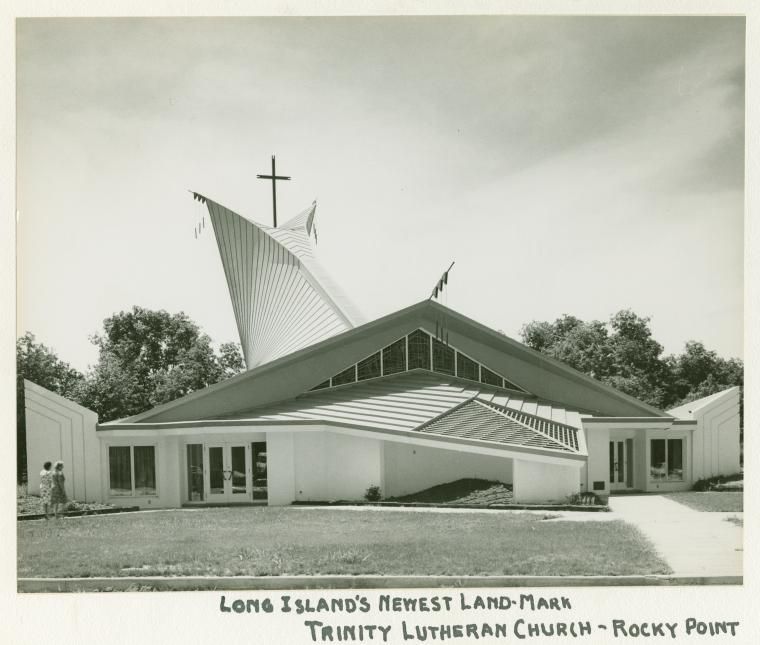
This New York Public Library image, cataloged as “Long Island’s newest landmark, Trinity Lutheran Church, Rocky Point,” documents the striking modern structure designed by architect Edward Slater. Groundbreaking for the building took place on Dec. 9, 1962, and the sanctuary was dedicated on June 28, 1964.
Trinity’s history in Rocky Point goes back even further. The congregation began in 1941 as an extension of St. Paul’s Evangelical Lutheran Church in Port Jefferson, when about 20 students gathered for Sunday School classes in a small building on Jefferson Street. By 1949, the “Rocky Point Annex” formally incorporated as Trinity Evangelical Lutheran Church.
As the congregation expanded in the postwar years, a new building became necessary. Slater designed the church in the shape of a phoenix rising, a dramatic mid-century design that later became locally associated with the appearance of a fish after the original fiberglass roof was replaced with copper in the late 1970s.
The building became well known beyond Rocky Point and appeared in architectural magazines and books during the 1960s. Over the decades, the church continued to grow, adding Witzmann Hall in the early 1970s, a nursery school in 1974, an expanded office wing and renovated sanctuary in 1998, and additional space in 2016.
The congregation also became involved in a number of community and humanitarian efforts, including sponsoring a Southeast Asian refugee family after the Vietnam War, participating in Habitat for Humanity projects beginning in 1988, operating a weekly community meal program since 1992, and sending mission teams to Gulf Coast and North Carolina rebuilding projects after major storms.
Photo: “Long Island’s newest landmark, Trinity Lutheran Church, Rocky Point,” photographed by C. Manley DeBevoise. From the collections of the Irma and Paul Milstein Division of United States History, Local History and Genealogy, The New York Public Library.