Grumman Aerospace Corporation manufactured aircraft, space hardware and other products from multiple Long Island locations over several decades.
About Leroy Grumman
- The company was created on December 6, 1929 by Leroy Grumman and Jake Swirbul
- Grumman was born January 4, 1895 in Huntington
- He died October 4, 1982 at age 87 on Long Island
- He was known as “Red Mike” because of his red-blond hair
- He was described as shy
- He served in the Naval Reserves during World War I
- Aircraft he designed were credited with destroying more than 60% of enemy planes in the Pacific, according to The New York Times
- He was inducted into the National Inventors Hall of Fame
About Jake Swirbul
- Swirbul lived in Sag Harbor
- He graduated from Pierson High School
- He was nicknamed “The Bullfrog”
- He served in the Marines during World War I
- He was credited with improving company efficiency and profitability through organization
- He developed methods to motivate employees
- He died in 1960 before the company entered the space program
Early Formation and Growth
- Grumman and Swirbul first met in 1924 at Loening Aeronautical Engineering Co. in New York City
- The company was formally organized on January 2, 1930
- Initial funding totaled $64,325 from investors, with Grumman and Swirbul contributing the largest shares
- The company took the Grumman name because he held the largest ownership stake
- Early work focused on aluminum truck body production
- The company also repaired small propeller-driven aircraft
- Its first Navy assignment involved prototype fighter aircraft
- The first aircraft produced was the XFF-1, a two-seat biplane
- The XFF-1 included retractable landing gear, described as the first of its kind in military aviation
- Operations expanded from Baldwin to Valley Stream (1931), Farmingdale (1932), and Bethpage (1937)
- The founders chose to share an office
- Both regularly worked directly on the factory floor with employees
- The original name was Grumman Aircraft Engineering Corporation before becoming Grumman Aerospace Corporation
- For much of its history, the company was Long Island’s largest employer
- Workforce numbers increased significantly during World War II
- Employment rose from about 700 workers in 1939 to over 25,000 by 1943
- Revenue grew from $4 million in 1940 to approximately 100 times that amount by 1943
- Training for new workers sometimes took place in Long Island high schools
- An incentive program promised employees half of any savings from improved production
- The program distributed $38 million in bonuses by the end of the war
- The company was listed in the Guinness Book of World Records for the largest company picnic
- Annual revenue reached $4 billion in 1990
- The end of the Cold War contributed to a decline in Long Island manufacturing operations
- In 1994, the company merged with Northrop Corporation to form Northrop Grumman
- The last aircraft left the Bethpage facility in 1995
World War II Aircraft Production
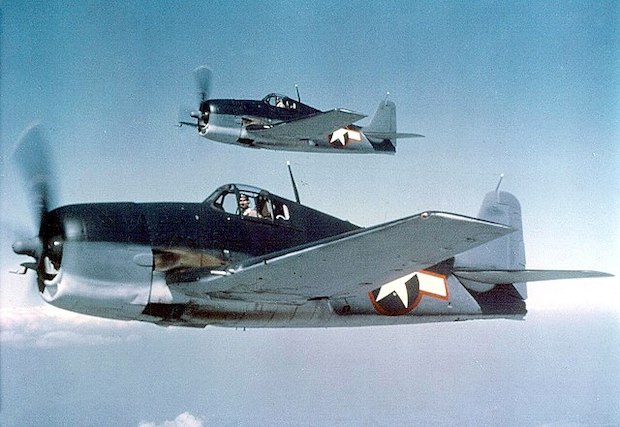
Photo: USN;, Public domain, via Wikimedia Commons.
- Grumman produced key aircraft used during World War II, including the F4F Wildcat and F6F Hellcat
- The company developed a folding wing system to allow more aircraft to fit on carriers
- This system, known as the STO-Wing, was first used on the Wildcat
- Leroy Grumman demonstrated the concept using an eraser and paper clips
- The F6F Hellcat was heavily used in the Pacific Theater
- Hellcats were the only fighter aircraft manufactured by the United States during World War II
- Production reached as many as 27 Hellcats per day
- Hellcats were credited with destroying 5,223 enemy aircraft, more than any other Allied naval aircraft
- The TBF Avenger torpedo bomber was used in the Battle of Midway
Experimental Designs and Pop Culture
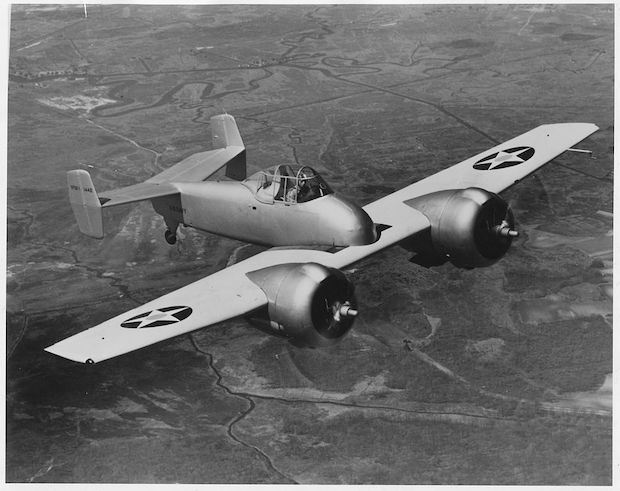
Photo: National Archives and Records Administration, Public domain, via Wikimedia Commons.
- The XF5F Skyrocket had a distinctive layout with its nose positioned behind the wing
- The aircraft was later depicted in DC Comics as the primary plane of the Blackhawk Squadron
Notable Aviation Incident
- The F-11 Tiger was introduced in 1955 as a supersonic Navy fighter
- In 1956, a test pilot flying an F-11 Tiger was struck by his own gunfire
- The pilot survived the incident
Entry Into Business Aviation
- Grumman introduced the Gulfstream aircraft for executive travel in the 1950s
- Its first flight took place on August 14, 1958 from Bethpage
Carrier Jets and Military Aircraft
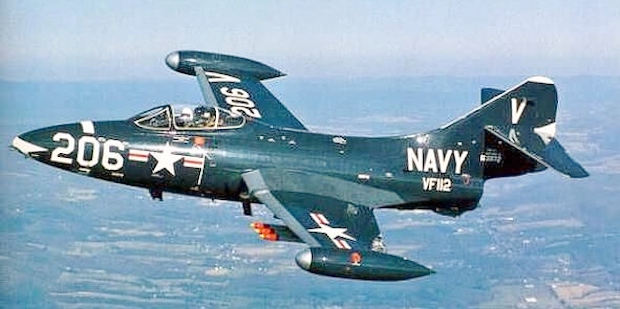
Photo: U.S. Navy, Public domain, via Wikimedia Commons.
- The company produced the F9F Panther, one of the first jets to land on an aircraft carrier
- The Panther was also the first jet used by the Blue Angels
- Grumman built amphibious aircraft including the G-21 Goose and HU-16 Albatross
- Both aircraft were capable of operating from land and water
- The E-2 Hawkeye served as an airborne early warning aircraft for the U.S. Navy
- The OV-1 Mohawk was used by the U.S. Army for reconnaissance during the Vietnam War
- The A-6 Intruder served as an all-weather attack aircraft in both the Vietnam War and Gulf War
Development of the F-14
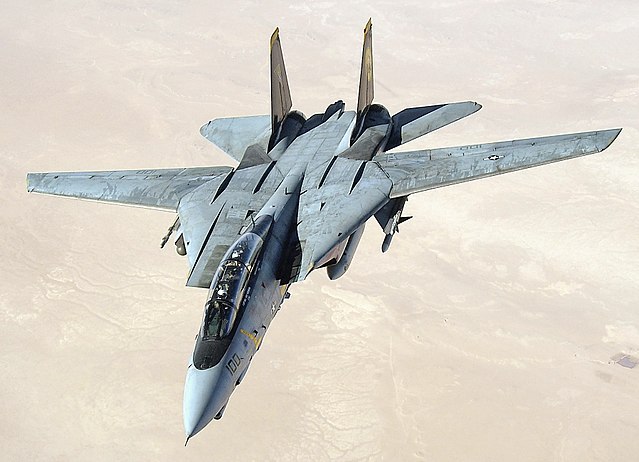
Photo: U.S. Navy photo, Public domain, via Wikimedia Commons
- The F-14 Tomcat was developed to replace the F-4 Phantom
- Its first flight took place on December 21, 1970 at the Calverton facility
- The aircraft became one of the most recognizable fighter jets produced in the United States
- The company also developed the X-29, which used forward-swept wing design
Space Program Contributions
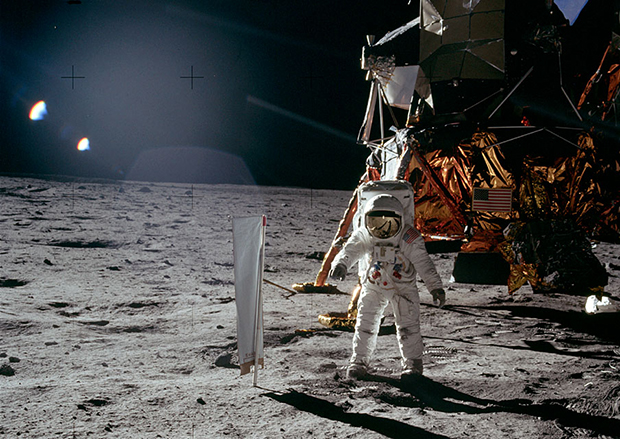
Photo: NASA.
- Grumman designed and built the Lunar Module used in NASA’s Apollo program
- In 1962, NASA invited 11 companies to submit proposals for a lunar landing vehicle
- Grumman was awarded the contract on November 7, 1962
- Early development models were constructed using wood and paper clips
- All Lunar Modules were built on Long Island
- The spacecraft is formally called the Lunar Module
- It is commonly referred to as the “LEM”
- The Lunar Module carried astronauts to the moon during the Apollo 11 Moon Landing on July 20, 1969
- Grumman engineers assisted during the Apollo 13 emergency in 1970
Other Products and Manufacturing
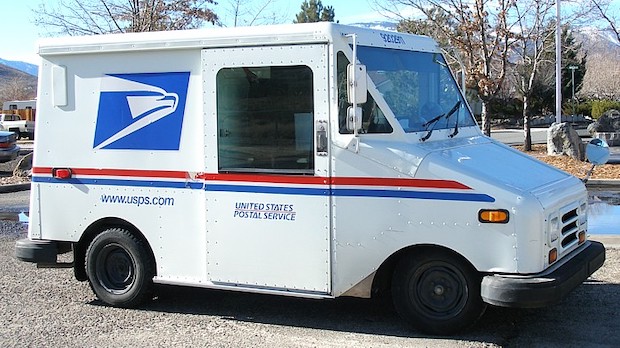
Photo: User Coolcaesar on en.wikipedia, CC BY-SA 3.0 <http://creativecommons.org/licenses/by-sa/3.0/>, via Wikimedia Commons
- Grumman produced aluminum canoes after World War II
- Executive William Hoffman adapted aircraft aluminum for canoe construction
- Through its ownership of the Flxible Corporation, the company manufactured the Grumman 870 bus
- The bus experienced defects that led to lawsuits
- The Grumman Long Life Vehicle (LLV) was built for the United States Postal Service
- The LLV has been in service since 1987 as a standard mail delivery vehicle
Environmental Impact in Bethpage
- Grumman was found responsible for groundwater contamination beneath its Bethpage facility
- The contamination affected Long Island drinking water
- A Newsday investigation reported the company was aware of the issue as early as the 1970s
- In 2022, Northrop Grumman and New York State agreed to a $104 million cleanup plan
- The plume measures approximately 4.3 miles long, 2.1 miles wide and about 900 feet deep
- The primary contaminant is trichloroethylene (TCE), used in aircraft cleaning
- The site is the largest groundwater contamination area on Long Island
Photo: Grumman logo