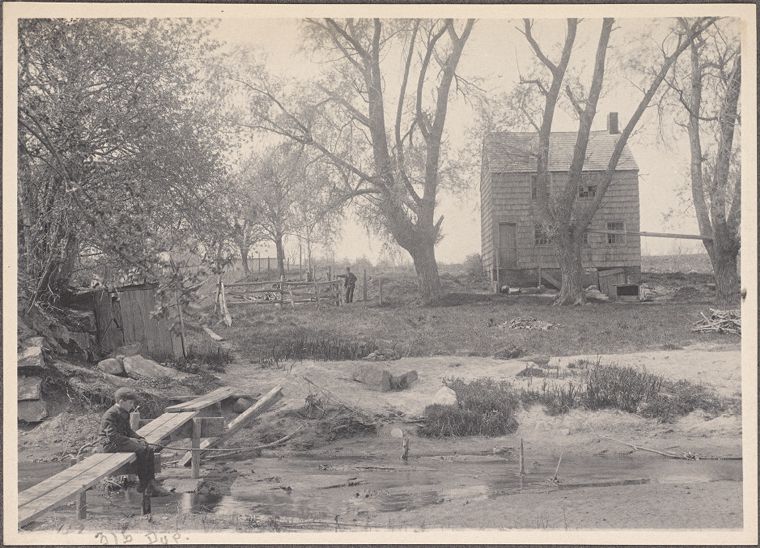
At first glance, it looks like a quiet, almost forgettable stretch of land. A small house, a narrow stream, a simple wooden bridge. But this 1902 photograph from Mill Neck captures something Long Island doesn’t really have anymore, an everyday landscape that feels completely untouched.
This image, titled “House on Indian field, Mill Neck, L.I.,” was taken in October 1902 (date inferred) and is part of a larger body of work documenting Long Island between 1885 and 1914. It places us in the Oyster Bay area, at a location identified in the catalog as Indian Field.
- In the foreground, a narrow wooden plank bridge crosses a shallow stream. A person, likely a child, sits at the edge, positioned just above the water.
- The stream appears calm and shallow, with visible stones and vegetation along the banks.
- To the left, a small, rough wooden structure sits near the water’s edge, possibly a shed or simple outbuilding.
- A fenced area stretches across the middle ground, separating the stream from open land beyond.
- The house itself sits slightly elevated, with a simple rectangular shape and minimal ornamentation.
- Several large trees frame the property, their bare or sparse branches suggesting late fall, consistent with the October date.
After taking in those details, the catalog notes begin to add context.
- The image includes a reference to “Cox’s Dam,” identifying a specific geographic feature tied to the location.
- A printed note on the back of the photograph reads: “Winfred on (bridge),” likely referring to the person seated at the edge of the footbridge.
- Subject classifications include fishing and leisure, suggesting the area may have been used for both work and recreation.
That small detail, “Winfred on bridge,” turns the image from a landscape into something more personal.
If you know Mill Neck or Oyster Bay today, this kind of open, undeveloped setting is hard to picture. What the photo preserves isn’t a landmark or a major event, it’s a routine slice of life:
- A modest house set back from the water
- A simple crossing instead of a built roadway
- Land that appears used, but not heavily altered
There are no signs, no infrastructure, no sense that this area is part of a larger network. It feels isolated, even though it sits in a part of Long Island that is now anything but.
The image is a platinum print measuring 12.5 by 17 centimeters, a format known for its detail and tonal range. It was taken by Daniel Berry Austin, whose work—along with Adam Dove—focused on documenting everyday scenes across Long Island and Brooklyn during this period.
It is now preserved by the Irma and Paul Milstein Division of United States History, Local History and Genealogy at The New York Public Library.