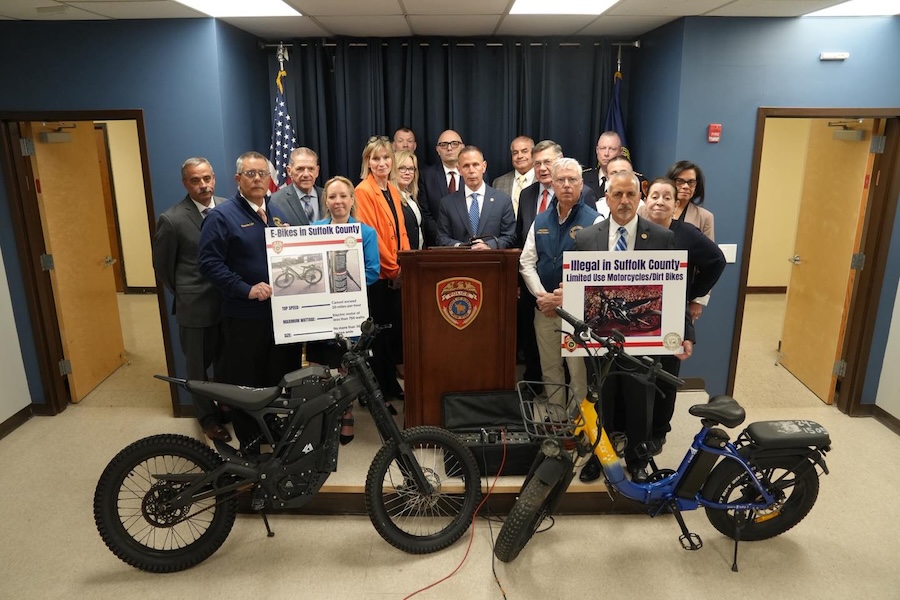
Suffolk County police are now enforcing new e-bike and e-scooter laws that require helmets, ban riders from sidewalks and allow officers to impound devices in certain cases, county officials said.
The rules were approved by the Suffolk County Legislature in December and signed by County Executive Ed Romaine on Dec. 30. Police said the department initially focused on education before shifting into enforcement.
Under the county law, anyone operating or riding as a passenger on an e-bike or e-scooter in Suffolk County must wear a helmet.
Riders also cannot operate e-bikes or e-scooters on sidewalks, county-owned off-highway property or roads with posted speed limits over 30 mph. Operators must follow traffic controls, ride with traffic and avoid reckless riding such as zig-zagging, trick riding or weaving around vehicles.
What Are the Three Classes of E-Bikes? New York law separates e-bikes into three classes, but Suffolk County officials say only Class 1 and Class 2 e-bikes are legal under the county’s new rules.
Class 1 E-Bike: A pedal-assist bike. The motor only helps while the rider is pedaling and stops assisting once the bike reaches 20 mph.
Class 2 E-Bike: A throttle-powered e-bike. The motor can move the bike without pedaling, but it cannot keep assisting once the bike reaches 20 mph.
Class 3 E-Bike: A faster throttle-powered e-bike that can assist up to 25 mph. Under New York law, Class 3 e-bikes are allowed only within New York City, according to the state DMV. Suffolk County officials said Class 3 e-bikes are not legal in Suffolk County.
Why It Matters: If an e-bike goes faster than the legal limit, lacks operable pedals or has been modified to exceed allowed speeds, it may not qualify as a legal e-bike. Suffolk County police said illegal or recklessly operated e-bikes and e-scooters may be impounded, and riders may face summonses or other penalties.
Police said only Class 1 and Class 2 e-bikes are legal under the county rules. Devices modified to exceed legal speed limits, or those that do not meet the definition of a legal e-bike or e-scooter, may be treated differently under state law.
The law also bars anyone age 15 or younger from operating an e-bike or e-scooter on public property or roadways. Devices operated by riders under 16 may be seized and impounded.
County officials said parents and legal guardians can be held financially responsible when minors violate the law, including fines and restitution for damage to county property.
Penalties can reach up to $500 for a first violation. A second conviction within five years can bring a fine of at least $1,500 and impoundment. A third or later violation within five years can carry a fine of up to $5,000 and up to one year in jail.
Police said enforcement can also apply to riders operating recklessly, riding while impaired by alcohol or drugs, fleeing police or carrying items that block their vision or ability to operate safely.
County officials said the goal is to reduce injuries as e-bike and e-scooter use rises across Suffolk, particularly among younger riders.
The Suffolk County Police Department is urging parents and riders to review the rules before using or purchasing an e-bike or e-scooter.
Photo: Suffolk County Executive Ed Romain’s Facebook page.