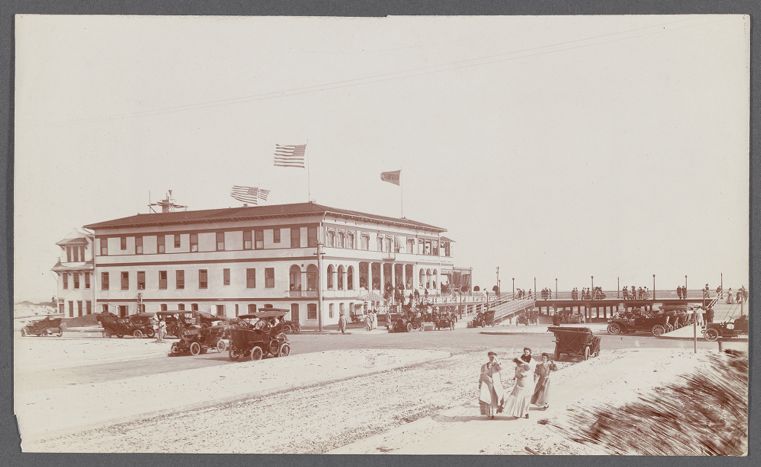
At first glance, this historic Long Beach building looks exactly like what you’d expect from the word “casino.” Large beachfront structure. Boardwalk crowds. Expansive ocean views. Early automobiles parked outside.
But despite the name, this “Casino and boardwalk” building in Long Beach was most likely not a gambling casino, at least not legally.
The image, preserved in the New York Public Library’s Eugene L. Armbruster Collection of Long Island photographic views, dates roughly between 1890 and 1930 and captures Long Beach during its rise as one of the region’s major seaside resort destinations.
Back then, the word “casino” often referred to entertainment and recreation buildings connected to resorts. These structures frequently hosted dining rooms, dances, concerts, social gatherings, and other attractions tied to beachfront tourism rather than gambling.
Still, decades later, Long Beach would seriously entertain the idea of bringing actual legalized casino gambling to the barrier island.
By the late 1970s, Long Beach was facing economic struggles far removed from its earlier resort glory years. A 1978 New York Times article described the city as a once-famous seaside destination trying to reclaim its identity after years of decline.
The article noted that Long Beach had once been known as the “Queen City of the Atlantic,” attracting wealthy visitors arriving from New York City by train, trolley, and steamboat.
But tourism patterns had changed dramatically.
Many former summer visitors had shifted to air-conditioned resorts, airline travel, and other vacation destinations. Long Beach’s seasonal tourism economy no longer resembled the bustling resort community it had once been.
According to the Times report:
- Long Beach’s year-round population had grown to roughly 36,000 residents by 1978.
- Nearly one-third of residents were age 65 or older.
- The city’s unemployment rate was significantly higher than Nassau County’s average.
- Summer population growth was no longer reaching the levels seen during Long Beach’s peak resort decades.
Some local leaders believed casino gambling could reverse the decline.
The proposal envisioned casinos operating alongside new resort hotels, entertainment venues, and tourism infrastructure similar to Atlantic City or Las Vegas.
Hannah Komanoff, who represented Long Beach on the Nassau County Board of Supervisors, argued at the time that the city was uniquely positioned for such a revival because of its beachfront location and direct rail access from New York City.
The article also noted that Nassau County Executive Francis T. Purcell supported efforts to legalize casino gambling in certain parts of New York State, including Long Beach.
Supporters believed casinos could bring private investment, jobs, tourism, and renewed development to the city’s aging waterfront economy.
Others warned the opposite could happen.
Critics feared that outside investors would benefit most while Long Beach residents continued dealing with economic hardship, aging infrastructure, poverty, and social problems already affecting the community.
The proposal never materialized.
Long Beach never became New York’s version of Atlantic City, and the historic “casino” seen in this image remained tied to an earlier era of Long Island resort culture rather than legalized gambling.
Still, for a brief period during the 1970s, actual casino gambling in Long Beach was not just speculation. It was openly discussed as a serious economic redevelopment strategy.
Photo:
“Casino and boardwalk. Long Beach”
Eugene L. Armbruster Collection of Long Island Photographic Views
New York Public Library Digital Collections
Image ID: 58808467
Source:
New York Times, March 12, 1978
“Faded Long Beach Feels It’s Ripe For Renewed Glory With Casinos” by John T. McQuiston