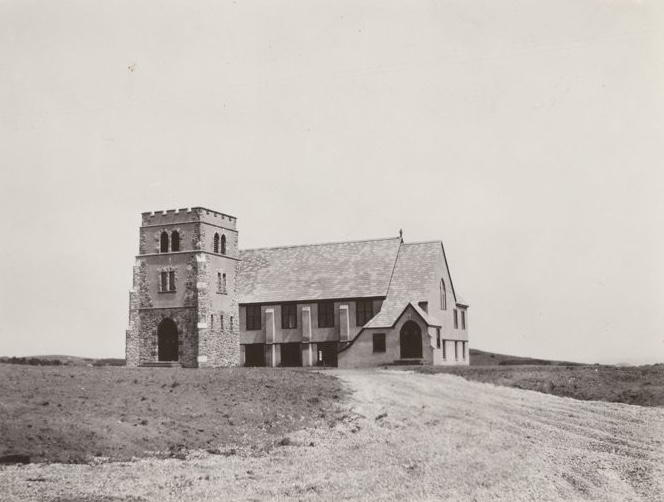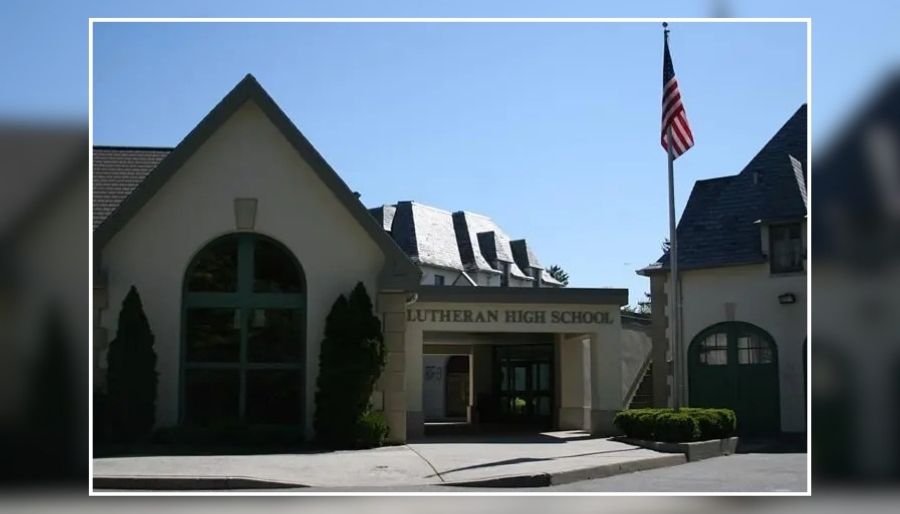
Long Island Lutheran Middle & High School is best known today as a Brookville school, but the property has a much older identity. At the heart of the campus is Highpool, a 1920s Gold Coast estate built for William Deering Howe, a grandson of industrialist William Deering and later Brookville’s first mayor.
The mansion, designed by Carrère & Hastings, was not demolished when the property became a school in 1960. Instead, it was incorporated into the expanding campus and remains part of Long Island Lutheran today.
The estate was known as Highpool, with the name also appearing historically as “High Pool.” Built during Brookville’s Gold Coast era, the former Howe residence became the centerpiece of a school campus that would continue to grow around it over the following decades.
Highpool was built in the 1920s
The Jericho Public Library dates Highpool to 1926 and describes it as a French manor-style estate home built for William Deering Howe on 19 acres in Brookville.
Architectural records provide additional documentation of the house. Columbia University’s Avery Architectural & Fine Arts Library holds the papers of Carrère & Hastings, and its collection lists the “Deering Howe, William, House” as a project dated from 1926 to 1928.
Click here for more stories about Long Island’s historic landmarks.
The Architectural League of New York’s 1927 records also list a “W. Deering Howe Residence” on Long Island among the firm’s projects.
Carrère & Hastings was one of the most prominent American architectural firms of the period. In New York, the firm is best known for designing the New York Public Library’s main building at Fifth Avenue and 42nd Street.
The Deering family fortune
William Deering Howe was born in 1900 to Richard Flint Howe and Abby Marion Deering Howe.
His mother was the daughter of William Deering, whose agricultural machinery business helped create one of the major American industrial fortunes of the late 19th century.
William Deering established the Deering Manufacturing Company in Chicago. In 1902, the Deering operation, McCormick Harvesting Machine Company and several smaller manufacturers were combined to form International Harvester.
Howe’s father also had a direct connection to the company. Vizcaya Museum and Gardens, which preserves the history of the Deering family, identifies Richard Flint Howe as a secretary, treasurer and director of International Harvester.
William Deering Howe grew up in a family closely connected to the agricultural machinery business that became International Harvester.
Highpool was part of a larger Howe family property
William Deering Howe was not the first member of his family to establish a large estate in Brookville. His father, Richard Flint Howe, owned nearby Linden Hill, which was built earlier in the 20th century.
According to the Jericho Public Library, William built Highpool in 1926 on the northern part of the family property. Both Linden Hill and Highpool were associated with the architectural firm Carrère & Hastings.
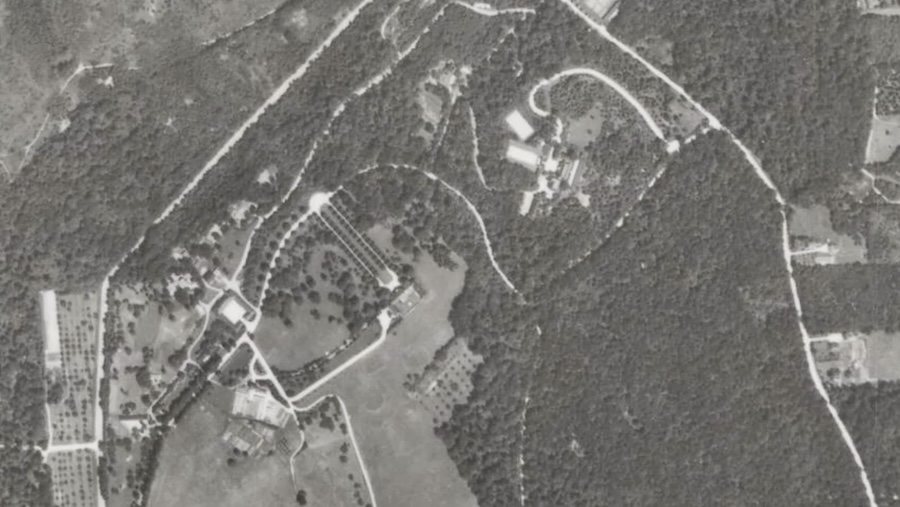
A 1938 aerial photograph preserved in Stony Brook University’s digital collections shows the two estates together, with Linden Hill to the south and Highpool to the north. Linden Hill later became part of the Tam O’Shanter Club property and was destroyed by fire around 1970, while Highpool survived and became part of Long Island Lutheran.
Howe became Brookville’s first mayor
Howe was also an attorney. A 1928 federal court decision lists William Deering Howe of Shearman & Sterling as counsel for National City Bank of New York.
He also played a role in the early municipal history of Brookville. The village was incorporated in 1931, and the Village of Brookville’s official history identifies W. Deering Howe as its first mayor.
Brookville was already developing into one of the North Shore communities associated with Long Island’s Gold Coast. According to the village, approximately 22 large estates stood in the area by 1923 as wealthy New Yorkers acquired former farmland and built country homes there.
Highpool was built for Howe in 1926, during this period of estate development and five years before Brookville’s incorporation.
Life at High Pool
Some details about life at the estate survive through the photographic diary of Ellen Glendinning Frazer.
A 2011 New York Social Diary article by Augustus Mayhew, drawing on Frazer’s photographs and diary material, records her staying at “High Pool, Deering and Polly Howe’s house” from July 1 through July 6, 1937.
William Deering Howe and Polly Brooks later divorced. Federal court records concerning Howe’s estate state that the couple entered a separation agreement in August 1941 and later divorced in Nevada.
The estate becomes a school
William Deering Howe died on November 7, 1948. A later federal court case concerning his estate identifies him as a Brookville resident at the time of his death.
In the late 1950s, pastors and members of 17 Lutheran congregations came together to establish a Lutheran high school serving Long Island. The Lutheran High School Association of Nassau and Suffolk Counties purchased the former Deering Howe estate, with the Jericho Public Library dating the acquisition of Highpool to 1959.
Long Island Lutheran Junior/Senior High School opened on the property in 1960.
The former Howe residence became part of the new school rather than being replaced. A Village of Brookville publication states that Long Island Lutheran opened with the William Deering Howe home serving as the school’s centerpiece building and notes that the former residence underwent numerous changes as the campus developed.
The mansion remains part of Long Island Lutheran
Long Island Lutheran’s own historical photographs document the continued use of the former estate house.
One photograph from the 1960s shows students standing on what the school identifies as the “High Pool steps.” Another, dating from the early 2000s, shows students standing on stairs identified by the school as being “in the mansion.”
As Long Island Lutheran expanded, additional facilities were constructed around the original estate property. According to the school, these eventually included classroom wings, two gymnasiums, a chapel and performing arts center, dining facilities, a ministry center, a performing arts wing, a fitness center and upgraded athletic fields.
The result is the campus seen today, where the former Howe residence is incorporated into a much larger school complex.
The historic and modern acreage figures also differ. The Jericho Public Library describes Highpool as a 19-acre estate, while Long Island Lutheran describes its current campus as approximately 32 wooded acres. The present school campus therefore extends beyond the acreage associated with the historic Highpool estate as described by the library.
A surviving piece of Brookville’s Gold Coast history
Highpool’s history reflects a pattern found throughout Long Island’s former Gold Coast communities. During the 20th century, many large estates were demolished and their properties subdivided, while others survived because they were adapted for new uses as schools, colleges, religious institutions, museums and public facilities.
The former Howe estate became part of that transition when Long Island Lutheran opened on the property in 1960. The school expanded substantially over the following decades, but the original mansion remained incorporated into the campus.
William Deering Howe had built the Brookville residence during the 1920s and later became the village’s first mayor. The house was designed by Carrère & Hastings, the architectural firm also responsible for the New York Public Library’s main building in Manhattan.
Today, most people know the property simply as Long Island Lutheran. The former Highpool mansion remains part of the school and provides a surviving architectural link to Brookville’s Gold Coast period.
Sources
- Long Island Lutheran Middle & High School, History
https://www.longislandlutheran.org/leadership/history/ - Jericho Public Library, Jericho-Pedia
https://www.jericholibrary.org/jericho-pedia - Columbia University Libraries, Carrère & Hastings Architectural Drawings and Papers
https://findingaids.library.columbia.edu/pdf/cul-3460615.pdf - Village of Brookville, History of Our Village
https://www.villageofbrookville.gov/history - Village of Brookville newsletter, Long Island Lutheran and the William Deering Howe home
https://ww.villageofbrookville.com/uploads/3/4/0/0/34003344/fall_newsletter_1.pdf - Vizcaya Museum and Gardens, Deering Family Tree
https://vizcaya.org/launchpad/deering-family-tree/ - Vizcaya Museum and Gardens, Abby Deering Howe Photograph Collection Finding Aid
https://vizcaya.org/wp-content/uploads/2020/11/Abby-Deering-Howe-Photograph-Album-Finding-Aid.pdf - Case IH, company history
https://www.caseih.com/en-us/unitedstates/company/about-case-ih - New York Public Library, Stephen A. Schwarzman Building Facts
https://www.nypl.org/about/locations/schwarzman/facts - Philadelphia Architects and Buildings, Carrère & Hastings project list
https://www.philadelphiabuildings.org/pab/app/ar_display_projects.cfm/23495 - Justia, Lowry & Co. v. National City Bank, 1928
https://law.justia.com/cases/federal/district-courts/F2/28/895/1502472/ - Justia, Chemical Bank New York Trust Company v. United States, concerning the Estate of William Deering Howe
https://law.justia.com/cases/federal/district-courts/FSupp/249/450/1457619/ - New York Social Diary, photographic diary material documenting stays at High Pool in 1937 and 1938
https://www.newyorksocialdiary.com/philadelphia-in-palm-beach-part-iii-1935-1938-cont/ -
Old Long Island, “Linden Hill”
http://www.oldlongisland.com/2013/07/linden-hill.html -
Old Long Island, “Linden Hill and Highpool Aerial”
http://www.oldlongisland.com/2014/01/linden-hill-and-highpool-aerial.html