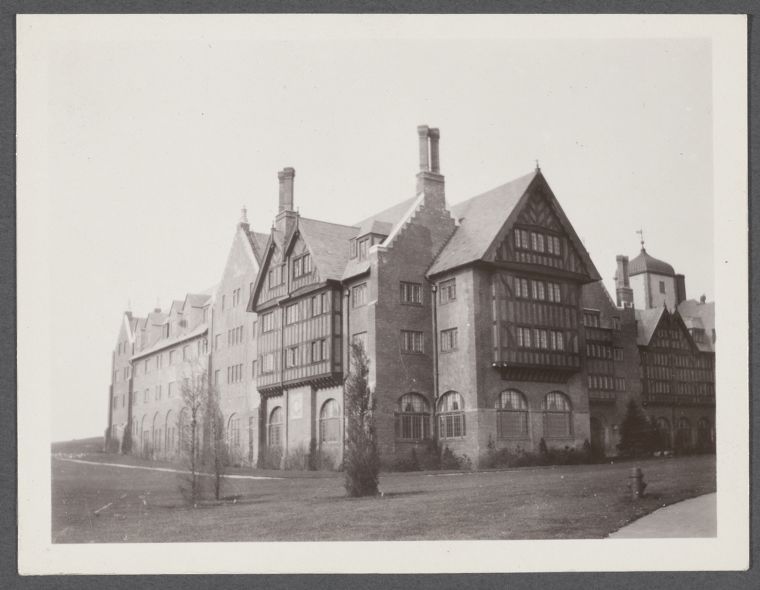
If you’ve spent any time out in Montauk, you’ve probably seen the Manor sitting up on Signal Hill. It has a way of feeling permanent, like it has always been there, separate from everything around it.
But when it was built, it wasn’t meant to stand alone at all.
In the mid-1920s, Carl Fisher, who had already transformed Miami Beach, turned his attention to Montauk. His plan was to build something on a scale that Long Island had not seen before: a full resort community stretching across roughly 10,000 acres at the very end of the island. The Manor was designed to anchor it.
Fisher’s vision extended well beyond a single hotel. What he was attempting was closer to building an entire destination from scratch.
The plans included a beach club, a yacht club, polo fields, and a golf course. There were to be enclosed tennis courts, a ranch, and a health spa. Even a boardwalk running more than half a mile along the ocean was part of the design.
At the center of all of it, rising above the rest, would be a 200-room English Tudor hotel built on Signal Hill.
When Montauk Manor opened in 1927, that central piece was finally in place. For a brief period, the rest of the vision seemed within reach.
By the late 1920s, the Manor was operating as intended. It drew a well-to-do crowd, and the activity around the property reflected the kind of place Fisher had imagined.
Ballrooms were in use, meals were served at a level meant to compete with other major resorts, and the front lawn was active with leisure games like croquet. Guests spent time on the veranda, looking out over land that was still being shaped into something larger.
It worked, but only for a moment.
The broader plan did not survive the economic changes that followed. The large-scale development Fisher had envisioned stalled, and much of what was supposed to surround the Manor either never materialized or did not last.
The building itself endured, though not without interruption.
During World War II, the property was taken over by the Navy. By 1964, it had closed altogether. For nearly twenty years after that, it sat in declining condition, a large and increasingly isolated structure overlooking a very different Montauk than the one it was meant to serve.
Its survival is tied to what came next.
The Manor was eventually placed on the National Register of Historic Places and, in the mid-1980s, redeveloped into 140 condominium units. That transition is largely what preserved it.
Long before any of this, Signal Hill had its own history.
In the 17th century, the area was the site of a violent conflict between the Narragansett and Montaukett tribes. The attack led to significant loss of life and gave rise to the name Massacre Valley for part of the surrounding landscape.
There are accounts suggesting that Montaukett burial grounds existed on or near the hill. Later, some of Theodore Roosevelt’s Rough Riders who died while in quarantine were buried there as well, though those remains were eventually moved.
Construction of the Manor altered the site. Contemporary accounts suggest that burial markers and ground features were disturbed during development, changing a landscape that had already carried a long history.
Click here to check out this pic of the Montauk Lighthouse comparing then and now erosion of the point.
Over time, the building developed a reputation that reflects that layered past.
There have been recurring reports from guests and staff describing unusual experiences, particularly on the upper floors. These include doors closing on their own, objects being moved, and unexplained sounds such as footsteps, banging, or what some have described as a child crying.
Some accounts go further, describing figures or shapes, including what witnesses believed to be Native American apparitions. Many of these stories are associated with the fourth floor.
There have also been more dramatic claims, including furniture shifting or people feeling physically pushed or touched.
Whether taken as folklore or something more, those stories have become part of how people understand the Manor.
Today, Montauk Manor still stands above Montauk, but it reads differently once you know the context. It is not just a historic hotel, and not simply a condominium conversion, but a hybrid of both. It is the most visible piece of a much larger plan that was never completed.
Most of what Fisher set out to build is gone or was never fully realized. The Manor remains, largely because it was adapted rather than abandoned.
Photo Credit: Eugene L. Armbruster, Montauk Manor Hotel, Montauk, East Hampton, May 1928. Courtesy of The New York Public Library Digital Collections.