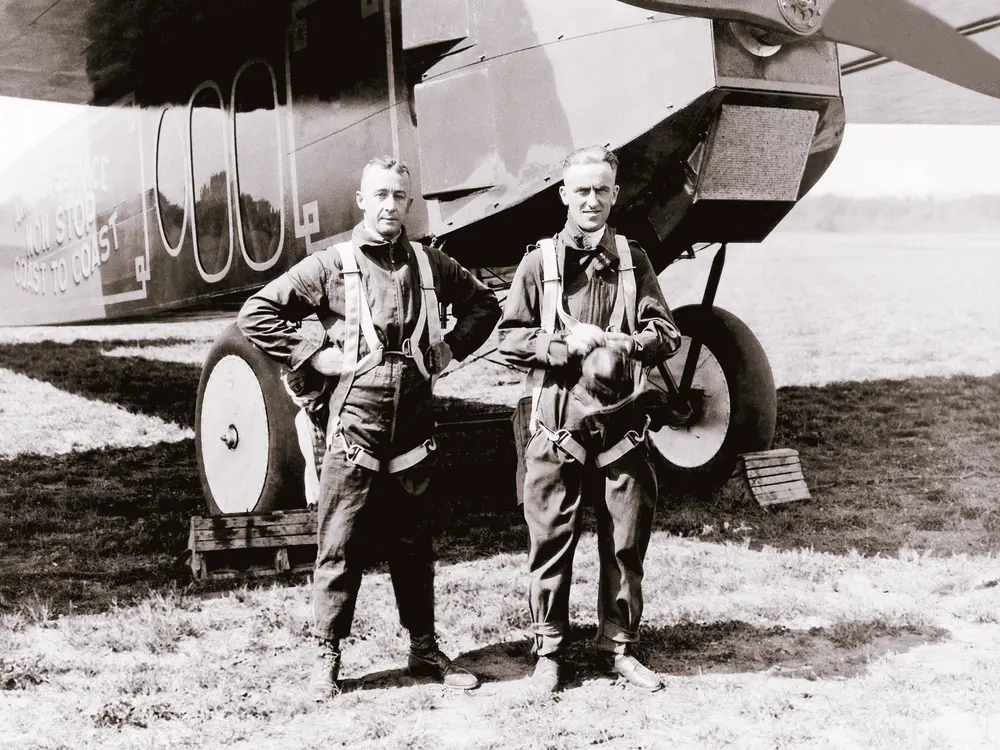
On May 2, 1923, two U.S. Army pilots took off from Roosevelt Field on Long Island and completed the first nonstop flight across the continental United States. Their journey to San Diego, California, took nearly 27 hours and covered approximately 2,470 miles, establishing an important milestone in American aviation history.
What makes the flight particularly remarkable is how primitive the flying conditions were by modern standards. Lieutenants John A. Macready and Oakley G. Kelly navigated using railroad maps and a magnetic compass, communicated by passing handwritten notes along a string, and crawled through a narrow passageway inside their airplane whenever they needed to exchange flying positions.
The flight was also their third attempt to accomplish the feat, following two unsuccessful efforts to cross the country in the opposite direction.
Roosevelt Field and the Early Days of Aviation
Long before Roosevelt Field became the site of one of Long Island’s best-known shopping malls, the Garden City airfield was an important center of American aviation. Its relatively open surroundings made it a suitable location for aircraft testing, exhibitions and record-setting flights during the early 20th century.
The airfield is perhaps best remembered as the departure point for Charles Lindbergh’s historic solo flight to Paris in May 1927. Four years earlier, however, Roosevelt Field had already been the starting point for another aviation first.
Macready and Kelly were experienced pilots serving in the U.S. Army Air Service, the predecessor of the U.S. Army Air Corps and eventually the independent U.S. Air Force. Their objective was to demonstrate that an aircraft could travel from one American coast to the other without stopping for fuel, mechanical repairs or rest.
The achievement would represent a major advancement over previous cross-country flights. In 1911, Calbraith Perry Rodgers became the first person to fly across the United States, but his journey required numerous stops for fuel and repairs. By comparison, Macready and Kelly intended to complete the entire crossing in a single flight.
A Specially Modified Airplane
The pilots used a Fokker T-2, a single-engine transport aircraft developed by Dutch aircraft manufacturer Anthony Fokker and designer Reinhold Platz. The airplane was originally manufactured as a Fokker F-IV before being purchased by the U.S. Army Air Service in June 1922 and redesignated the T-2.
Military technicians at McCook Field in Dayton, Ohio, modified the aircraft for the planned transcontinental flight. The changes included increasing its fuel capacity, reinforcing its structure to accommodate the additional weight and installing a second set of flight controls so the two pilots could alternate responsibilities during the long journey.
The airplane was powered by a Liberty engine and had a wingspan of approximately 80 feet. Although it was considerably larger than many aircraft of the period, accommodations for the pilots were limited.
The unusual arrangement of the flight controls would become one of the most memorable aspects of the journey.
The Pilots Had to Crawl Through a Tunnel to Switch Positions
Macready and Kelly knew that neither man could reasonably be expected to fly continuously for nearly 27 hours, so they planned to take turns operating the airplane.
Both flying positions were equipped with controls, but only the pilot seated in the forward cockpit had a clear view of the route ahead. Switching positions required the men to crawl through a narrow internal passageway while the aircraft remained in flight.
According to the Smithsonian National Air and Space Museum, the pilots exchanged positions five times during their journey across the United States.
Click here for more stories about Long Island’s aviation history.
The arrangement was a practical solution to a problem that would be handled very differently in later generations of aircraft. The pilots had to coordinate their movements inside a heavily loaded airplane while one of them maintained control of the flight.
Communicating With Handwritten Notes and a String
The airplane’s engine presented another difficulty. The forward cockpit was positioned beside the powerful Liberty engine, which produced so much noise that the pilots could not communicate by speaking to each other.
Instead, they used a simple system involving handwritten notes and a string running between the flying positions.
When the pilot in the forward cockpit felt the control stick move between his knees, it was a signal that his partner had sent a message. He would then look for a note attached to the string connecting the two cockpits.
This allowed the pilots to communicate instructions and information without relying on spoken conversation. It was an improvised but effective method of communication during a flight that lasted more than an entire day.
The combination of cramped quarters, engine noise and limited communication illustrates how different long-distance aviation was in the early 1920s.
The First Two Attempts Were Unsuccessful
The historic flight from Long Island was not Macready and Kelly’s first attempt to cross the country nonstop. Their previous two attempts had begun in San Diego, with the pilots traveling eastward in hopes of benefiting from prevailing westerly winds. They also planned around the availability of suitable aviation fuel in California.
The first attempt ended when fog in the mountains east of San Diego forced the pilots to turn back. During the second attempt, the airplane reached Indianapolis before a cracked engine water jacket caused the engine to seize, ending the flight.
Rather than abandon the project, the pilots made additional adjustments to the airplane and changed their approach.
For their third attempt, they decided to fly westward from Long Island. Although this meant traveling against prevailing winds, it offered other advantages as the aircraft gradually consumed its substantial fuel load. By the time they reached the mountainous western portion of the country, the airplane would be considerably lighter than it had been at takeoff.
Crossing America With Railroad Maps and a Compass
On May 2, Macready and Kelly departed Roosevelt Field in the heavily loaded Fokker T-2 and began their flight toward California. Their principal navigation equipment consisted of a magnetic compass and railroad maps. Rather than following directions from modern navigation systems, the pilots used dead reckoning, estimating their position from known locations, their heading, speed and elapsed time.
They also used recognizable features on the ground to help determine their route. Railroad lines were particularly useful because they provided identifiable paths across large sections of the country.
Weather complicated the journey considerably. According to the Smithsonian, the pilots encountered storms and rain for more than half the flight, including periods of poor visibility and nighttime flying.
Crossing the Continental Divide in Arizona presented another important challenge. As the airplane consumed fuel and became lighter, it gained the performance needed to negotiate the higher terrain. Despite these difficulties, the pilots continued west without landing.
A Historic Landing in San Diego
At 12:26 p.m. local time on May 3, 1923, Macready landed the Fokker T-2 at Rockwell Field in San Diego, completing the first nonstop transcontinental flight in American history.
The Smithsonian records their official flight time as 26 hours, 50 minutes and approximately 39 seconds. The distance covered was 2,470 miles, giving the airplane an average ground speed of approximately 92 mph.
The accomplishment was widely celebrated as a major advancement in aviation. Macready and Kelly received a hero’s welcome in San Diego, and their achievement was recognized with the 1923 Mackay Trophy and Distinguished Flying Crosses.
Beyond establishing a record, the flight demonstrated that airplanes could travel substantial distances without stopping. It helped establish the practical possibilities of long-distance military and commercial aviation at a time when scheduled passenger air travel was still in its infancy.
The Historic Airplane Still Exists
The Fokker T-2 survived its record-setting journey and was transferred by the Army Air Service to the Smithsonian Institution in January 1924.
The aircraft underwent an extensive restoration between 1962 and 1964, followed by additional preservation work in 1973 and 2009. It remains part of the Smithsonian National Air and Space Museum’s collection, although it is not currently on public display.
Macready and Kelly’s flight occupies an important place in the history of American aviation, demonstrating what was possible with the technology available just two decades after the Wright brothers’ first powered flight in 1903.
For Long Islanders, it is another reminder of Roosevelt Field’s remarkable aviation legacy. Before the airfield became a shopping destination, it was the departure point for flights that helped change the course of aviation history.
Photo: U.S. Army Air Service pilots John A. Macready and Oakley G. Kelly with the Fokker T-2 used to complete the first nonstop transcontinental flight from Roosevelt Field on Long Island to San Diego, California, on May 2–3, 1923. Photo: Smithsonian National Air and Space Museum.
Sources
- Smithsonian National Air and Space Museum, “5 Surprising Facts About the First Nonstop Transcontinental Flight”:
https://airandspace.si.edu/stories/editorial/5-surprising-facts-about-first-nonstop-transcontinental-flight - Smithsonian National Air and Space Museum, Fokker T-2 collection:
https://airandspace.si.edu/collection-objects/fokker-t-2/nasm_A19240003000 - National Museum of the U.S. Air Force, “First Transcontinental Nonstop Flight”:
https://www.nationalmuseum.af.mil/Visit/Museum-Exhibits/Fact-Sheets/Display/Article/197378/first-transcontinental-nonstop-flight/