It sounds like something out of science fiction, but it happened right here on Long Island. In 1961, while most Americans were still getting used to the idea of space travel, engineers in Farmingdale were already testing a futuristic engine designed to take humans far beyond Earth.
And yes, it involved plasma.
A Scene Straight Out of the Future
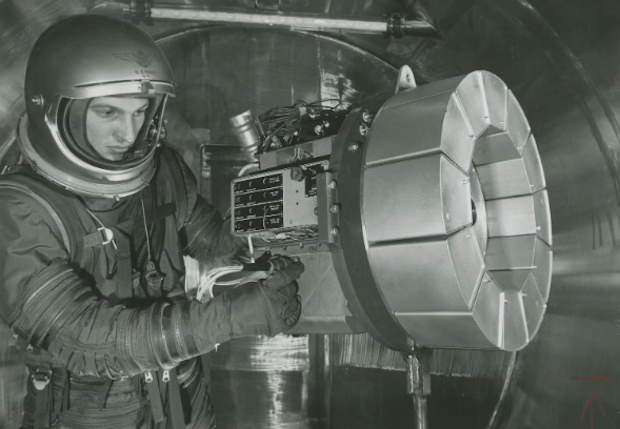
If you had walked into the facility at Republic Aviation Corporation in September 1961, you wouldn’t have seen rockets on a launchpad. Instead, you would have found a technician carefully making final instrumentation adjustments on a device that looked more like a laboratory experiment than a spacecraft engine.
- The photograph captures a technician preparing a test run of a plasma space engine
- The test took place in September 1961 in Farmingdale
- The moment shows the final adjustments before firing up the experimental system
This wasn’t just theoretical work. It was a real attempt to push propulsion technology into entirely new territory.
What Exactly Was a “Pinch Plasma Engine”?
According to reporting from The New York Times at the time, the engine being tested was known as a “pinch plasma engine.”
- The design used plasma, an energized state of matter, instead of traditional fuel combustion
- The “pinch” concept involved compressing plasma using magnetic forces
- The goal was to create propulsion powerful enough for interplanetary travel
In simple terms, this was Long Island experimenting with a propulsion system that could theoretically carry spacecraft between planets, years before humans even set foot on the Moon.
Why Farmingdale?
There’s a reason this kind of work was happening here.
Republic Aviation Corporation wasn’t just any company, it was one of the major players in American aviation at the time.
- Originally founded as the Seversky Aircraft Company
- Based in Farmingdale, a hub for aerospace innovation on Long Island
- Responsible for designing and producing numerous important military aircraft
By the early 1960s, the company was already deeply involved in advanced aerospace research, making it a natural place for cutting-edge experiments like plasma propulsion.
Long Island’s Quiet Role in the Space Race
When people think about the early days of space exploration, they usually picture Florida launch sites or Houston control rooms. But moments like this tell a different story.
- Long Island engineers were actively working on technologies for deep space travel
- Experimental propulsion systems were being tested locally decades ago
- The work happening here helped push the boundaries of what was considered possible
You’ve probably driven past Farmingdale countless times without realizing that, at one point, it was home to experiments that aimed to send humanity across the solar system.
The Takeaway
Long Island’s history isn’t just about beaches, suburbs, and commuter rails. It’s also about bold ideas, some of them far ahead of their time.
And in 1961, inside a Farmingdale facility, one of those ideas was glowing with plasma, pointed toward the planets.