The Long Island Rail Road dates to 1834, but the railroad system that developed across Long Island during the 19th century was considerably more complicated than a single company extending its tracks eastward.
The LIRR was joined by competing and connecting railroads including the Flushing Railroad, North Shore Railroad and Central Railroad of Long Island. Some eventually became part of the larger LIRR system. Their histories include ferry transfers, real estate speculation, severe winter disruptions, unusual accidents and passenger volumes that were already substantial by the 1870s.
Passengers needed a train and a ferry to reach Manhattan
One of the most important differences between rail travel then and now was the lack of a direct railroad connection to Manhattan. Early trains terminated on the Queens waterfront, requiring passengers heading into Manhattan to transfer to ferries.
When the Flushing Railroad established its Hunter’s Point terminus in the 1850s, there was not yet a ferry operating from Borden or Jackson avenues. The railroad acquired two small steam ferryboats, Enoch Dean and Island City, to transport its passengers to New York. Hunter’s Point effectively operated as a transfer point between trains and boats.
The combination could be surprisingly efficient. During an 1854 test, a train traveled nonstop from Flushing to the Hunter’s Point dock in 11 minutes. Passengers transferred to the boat in 4½ minutes, followed by a 12-minute trip to Fulton Ferry in Manhattan. The entire journey took 27½ minutes.
Railroads helped create new neighborhoods
The early railroads played a direct role in creating some of the communities they served. In 1853, much of what is now Corona was farmland. The West Flushing Land Company purchased five farms, divided the property into building lots and laid out streets.
Special railroad excursions subsequently carried prospective buyers to the area. Winfield, in what is now Woodside, was another developers’ project, and its station was built in 1854 to accommodate real estate excursion trains.
Snow and ice could shut down the entire trip
A major snowstorm in January 1856 filled railroad cuts with snow and brought service to a halt. More than 100 men with shovels worked with the railroad’s two locomotives, which were equipped with nose plows, to clear the line.
Reopening the tracks did not solve the problem. The ferry Island City was unable to navigate the heavy ice in the East River, forcing the railroad to make alternative arrangements to move passengers toward Brooklyn ferries. At the time, Hunter’s Point had few facilities, leaving stranded passengers with little protection from the winter weather.
Click here for more stories about the LIRR and Long Island railroads.
Even before that storm, ice had demonstrated how vulnerable the railroad’s connection with Manhattan could be. In February 1855, Island City broke its shaft in drift ice while Enoch Dean was already undergoing repairs. With both ferryboats unavailable, the railroad’s connection with New York was interrupted until an emergency boat could be found. Later that month, Island City became frozen so firmly in a Manhattan slip that its crew reportedly needed five hours to free it.
Early railroad accidents could be unusual and deadly
The physical operation of the early railroads presented considerable hazards. Railroad historian Vincent F. Seyfried records a series of accidents involving the Flushing Railroad’s locomotives during the 1850s and 1860s.
In 1855, a locomotive’s cowcatcher struck a cow and became entangled with it, nearly derailing the engine. The following year, a locomotive ran through a misplaced switch, crossed a turntable and continued onto the ground beyond it.
More serious accidents followed. A Flushing Railroad passenger train collided with an LIRR freight train at Winfield Junction in 1862, killing the Flushing Railroad engineer. In 1863, an engine and tender ran through an open switch and into a turntable pit, killing a fireman. An engine and tender plunged into Jack’s Creek in 1864, and in 1865 an entire train was derailed by a broken rail, with one car rolling down an embankment.
Another unusual accident occurred in December 1865, when a night freight train lost a car and left it behind on the railroad in darkness. The next passenger train struck the abandoned car at full speed, destroying the freight car and damaging the locomotive.
The Flushing Railroad had an extraordinarily bad week in 1864
Fire was another recurring problem. In October 1864, about 40 feet of the Flushing Meadows trestle burned, interrupting service for two days. Three days later, the Flushing depot caught fire. The flames spread to the train sheds, where six passenger cars and three freight cars were stored.
The railroad was left with only three passenger coaches. In an unusual coincidence, four new passenger cars being built for the Flushing Railroad in Jersey City were also destroyed by fire during the same week. The LIRR loaned passenger cars to the company so it could continue operating.
One railroad carried 20,000 passengers in a single day
Despite the difficulties of early railroad operations, passenger traffic expanded rapidly. By the late 1860s and early 1870s, the Flushing and North Side Railroad was carrying large numbers of passengers, particularly during the summer.
On June 26, 1870, about 4,500 people used the railroad. One 12-car train pulled by two locomotives carried 1,000 German excursionists home from College Point.
The figures were even larger on July 4, 1871. The railroad operated 67 trains, with departures from each terminal every half hour throughout the day. Seyfried reported that 20,000 passengers were carried without a single accident and that the railroad collected more than $5,000 in revenue that day. By the following summer, ten-car trains were common on warm Sundays.
Brooks Brothers made railroad uniforms
Railroad employment was becoming more formalized by the 1870s. In October 1870, following a new state law, the Flushing and North Side Railroad adopted uniforms for its employees.
Principal operating trainmen wore blue, while other employees wore gray. According to Seyfried, the uniforms were supplied by Brooks Brothers of New York.
A new Hempstead railroad began with two passengers
Not every new railroad began with enormous crowds. The Central Railroad of Long Island, built by department store owner and Garden City developer Alexander Turney Stewart, opened regular passenger service to Hempstead on Jan. 8, 1873.
The first regular train left Hempstead at 6:30 that morning while it was still dark. The locomotive Farmingdale pulled a single passenger car carrying just two passengers. The second train, departing at 7:45 a.m., carried 13. Patronage increased as the day continued and residents learned that regular service had begun.
Long Island’s railroads helped reshape the Island
The early railroads did more than transport people between existing communities. Rail service helped determine where new communities developed, allowed real estate operators to market previously rural land to New York residents and gradually made regular travel between Long Island and the city practical.
The rail network continued to consolidate and change during the remainder of the 19th century. By the early 20th century, the Pennsylvania Railroad controlled the LIRR and undertook the project that finally gave Long Island trains direct access to Manhattan. LIRR service through the new East River tunnels and into Pennsylvania Station began in 1910, eliminating the ferry transfer for passengers using the new route.
By then, Long Island’s railroads had already spent more than half a century helping transform the Island’s communities and the way residents traveled.
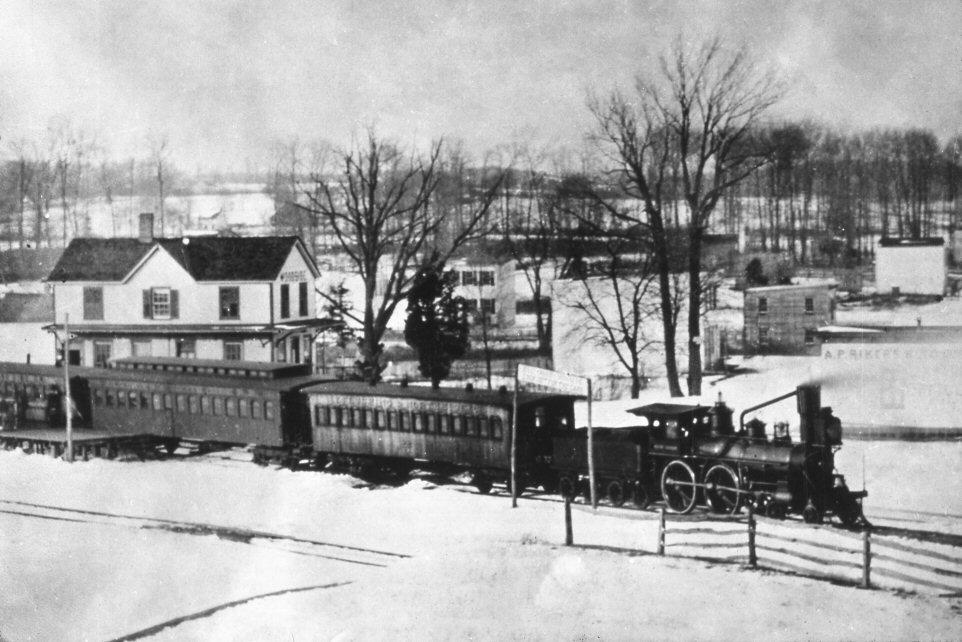
PHOTO: A Flushing & North Side Railroad train led by the locomotive New York at Woodside Station, at 58th Street and 38th Avenue, circa 1872. The Flushing & North Side was one of several early railroads that eventually became part of the Long Island Rail Road system. Photographer unidentified.
SOURCES:
- Vincent F. Seyfried, The Long Island Rail Road: A Comprehensive History, Part Two: The Flushing, North Shore & Central Railroad.
- Queens Public Library Digital Archives
https://digitalarchives.queenslibrary.org/