
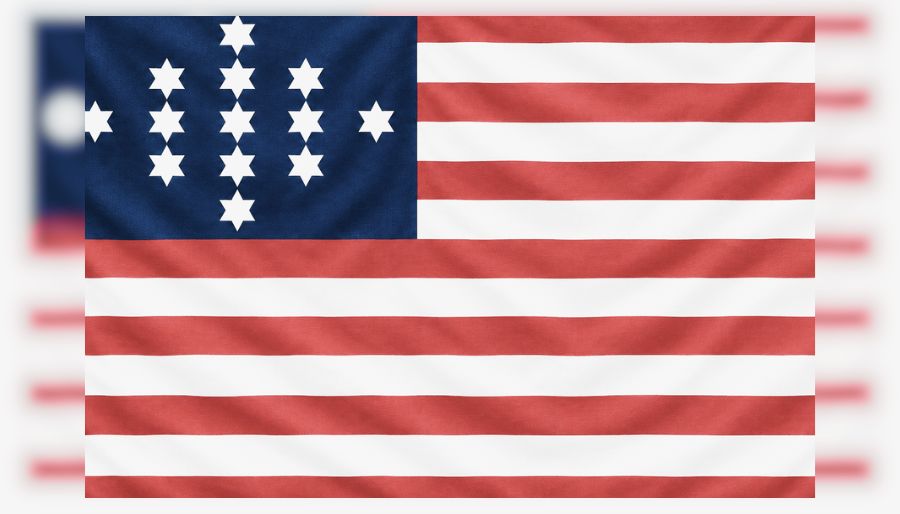
In 1926, a tattered American flag was discovered among Revolutionary War documents in the rafters of an old Bridgehampton barn. The flag featured 13 red-and-white stripes and 13 white stars, a design strikingly similar to the Stars and Stripes officially adopted by Congress in 1777. According to a longstanding historical tradition, it had belonged to Captain John Hulbert, a Bridgehampton militia officer who traveled to Philadelphia in 1775, where his flag may have influenced the design of the American national flag.
The artifact, known as the Hulbert Flag, has been debated by historians and textile experts for nearly a century. Some believe it genuinely dates to the American Revolution, while others argue that it was produced decades later. The surviving flag is now part of the Suffolk County Historical Society’s permanent collection in Riverhead, where it remains one of the museum’s best-known and most controversial objects.
What makes the story particularly interesting is that Captain Hulbert’s appearance before the Continental Congress is not merely local legend. His visit to Philadelphia on November 20, 1775, is recorded in the official congressional journals, providing a documented historical connection between a Bridgehampton militia officer and the nation’s revolutionary leadership. What remains uncertain is whether he brought the flag with him.
Captain John Hulbert and the Bridgehampton militia
John Hulbert was born around 1739 and lived in Bridgehampton, where he worked as a shoemaker, saddler and storekeeper. He also served as a magistrate and notary public and conducted business associated with the Custom House in Sag Harbor.
In 1775, growing tensions between Great Britain and its American colonies led New York’s Provincial Congress to organize militia companies throughout the colony. Long Island communities were particularly concerned about possible British military activity and raids along the coast.
That summer, Hulbert, then approximately 36 years old, received a captain’s commission and was instructed to raise a company of soldiers. His Bridgehampton company was part of the 3rd New York Regiment, one of ten companies organized within the regiment.
Sixty-eight men and boys from Bridgehampton, Southampton and East Hampton enlisted for six months of service. They trained on the Triangle Commons in the center of Bridgehampton, near Hulbert’s home and barn, learning military drills and preparing for service beyond Long Island.
In the autumn of 1775, Hulbert and his men traveled north to Fort Ticonderoga, which American forces under Ethan Allen and Benedict Arnold had captured from the British the previous May. The fort had become an important military position as Continental forces attempted to secure the Champlain Valley and launch an invasion of British-controlled Canada.
According to accounts of the company’s service, Hulbert’s men subsequently escorted captured British officers south toward Trenton, New Jersey. The prisoners had been taken at Fort Chambly, a British stronghold near Montreal captured by American forces on October 18, 1775.
That assignment brought Hulbert to Philadelphia and into direct contact with the Continental Congress.
A Bridgehampton captain appears before Congress
On November 20, 1775, Captain John Hulbert appeared before the Continental Congress in Philadelphia to report on the prisoners his company had escorted from Fort Chambly.
The official congressional journal records:
“Capt. John Hulbert, who was sent by General Schuyler to conduct the officers, who were taken prisoners at fort Chambly, to Trenton, attended and made report of his proceedings and the disposal of the prisoners.”
This entry establishes that Hulbert personally appeared before Congress in November 1775, nearly two years before the Stars and Stripes became the official American flag. The record is particularly important because his supposed visit to Congress is central to the story of the Hulbert Flag.
Three days later, on November 23, Congress authorized Hulbert to take a 14-day leave of absence after stationing his men at the American fortifications along the Hudson River. The authorization was communicated in a letter from John Hancock, then president of the Continental Congress.
The letter instructed Hulbert to return to his post after the leave, confirming that he remained in active military service. Accounts of the company’s movements indicate that the men subsequently served at Fort Constitution, later associated with Fort Lee, before returning to Long Island.
Hulbert’s company was discharged on January 18, 1776, ending its six-month enlistment. Some historical accounts also describe Hulbert’s later involvement in privateering, although that portion of his service is less firmly documented in the sources examined.
The records of Congress establish Hulbert’s military assignment and his presence in Philadelphia. They make no mention of a flag.
Did Hulbert make a flag at Fort Ticonderoga?
The story traditionally associated with Hulbert claims that he carried a distinctive American flag during his company’s military service in 1775.
One version suggests that Hulbert made the banner while stationed at Fort Ticonderoga, combining 13 alternating red-and-white stripes with 13 white stars on a blue field. Another version places the flag’s creation on Long Island before the company departed for the northern campaign.
Both accounts would place the flag’s creation before the adoption of the Stars and Stripes on June 14, 1777. There is also a more specific theory connecting the design to the capture of Fort Chambly in October 1775.
According to this interpretation, Hulbert may have created his flag in response to a British military banner captured at the fort. The banner reportedly belonged to the Seventh Regiment of Foot, known as the Royal Fusiliers. The theory suggests that Hulbert’s flag was intended to provide an American counterpart to the captured British colors.
Although the explanation connects two documented elements of the 1775 campaign, the capture of Fort Chambly and Hulbert’s subsequent escort of prisoners, no contemporary evidence establishes that he created a flag for this purpose.
The claim that the flag inspired America’s national banner
The most consequential part of the Hulbert Flag tradition concerns what supposedly happened when the captain and his men arrived in Philadelphia.
According to the account promoted by Long Island historian Morton Pennypacker, Hulbert’s company entered the city carrying its distinctive 13-star flag. Members of the Continental Congress reportedly saw the banner, and its design may have influenced later discussions about a national flag.
One version of the story suggests that Francis Hopkinson, a New Jersey delegate to the Continental Congress, made a sketch of the flag after seeing it. That sketch supposedly contributed to the design eventually adopted by Congress.
Another variation connects the banner to Betsy Ross, the Philadelphia flagmaker traditionally credited with sewing the first American flag. Pennypacker suggested that a drawing inspired by Hulbert’s flag could have reached Ross and influenced her work.
These accounts have an important weakness. No known contemporary record confirms that Hulbert carried the flag to Philadelphia, that Congress examined it or that Hopkinson or Ross copied its design.
Hopkinson is independently associated with the creation of the Stars and Stripes. He later sought compensation from Congress for designing the American flag, although the government did not recognize him as its sole designer.
The evidence connecting Hopkinson to flag design is separate from the Hulbert story. No surviving record establishes that Hopkinson obtained his ideas from a Bridgehampton militia captain.
A mysterious discovery in a Bridgehampton barn
The Hulbert Flag attracted widespread attention following its rediscovery in 1926, approximately 150 years after the American Revolution.
That year, William T. Halsey, a banker and local historian, acquired a historic Bridgehampton property from the estate of Dr. John Lyon Gardiner. The property included a house and barn formerly associated with Captain Hulbert.
While examining the old barn, Halsey reportedly discovered a dust-covered parcel tucked into the rafters near the chimney. Inside were military orders, enlistment papers and fragments of red, white and blue fabric.
The documents were associated with Hulbert’s Revolutionary War service, making the accompanying material especially intriguing. The fragments were subsequently identified as the remains of a flag bearing 13 stars and 13 stripes.
The surviving artifact measures approximately 41.5 inches long and 28.5 inches high. It features seven red stripes and six white stripes, with 13 six-pointed white stars arranged in a distinctive crosslike pattern against a blue canton.
The flag was constructed primarily from homespun wool, with cotton muslin used for the stars. Its materials, hand stitching and unusual proportions became central to later debates about its age.
Halsey’s discovery drew the attention of Morton Pennypacker, an influential collector and historian of the Revolutionary period who maintained a particular interest in Long Island history. Pennypacker publicized the flag, including through coverage in The New York Times, and promoted the possibility that it represented an early version of the American national flag.
The artifact attracted considerable public attention and was displayed at the New York State Fair. Archival records also document its exhibition at the 1939 New York World’s Fair.
The barn where the discovery reportedly occurred survived until 2012, when it was dismantled during development of additional accommodations at the Topping Rose House property in Bridgehampton. According to former Southampton Town historian Henry Moeller, portions of the building were initially stored near the Nathaniel Rogers Mansion, but their subsequent whereabouts became uncertain.
The Smithsonian examination that challenged the flag’s origins
For decades after its discovery, the Hulbert Flag was widely associated with the Revolutionary War. That identification faced a serious challenge in 1972.
Grace Cooper, a textile specialist at the Smithsonian Institution, examined the artifact and identified cotton thread that she believed could not have been manufactured before approximately 1840. Her findings suggested that the flag had been made long after Hulbert’s military service.
If the thread were original to the flag, its presence would rule out an origin in 1775.
However, the flag had undergone significant stabilization following its discovery in the 1920s. Contemporary cotton thread was reportedly used to reinforce the fragile material, and it remains uncertain whether Cooper knew the extent of those repairs.
This introduced an important complication. If the later thread had been added during conservation, it would not necessarily establish when the original flag was constructed.
In 1999, historic textile specialist Rabbit Goodie of Thistle Hill Weavers examined the flag and reached a different conclusion. Goodie found that its materials and construction were consistent with textiles produced on Long Island during the 18th century.
When contacted for a January 2022 investigation published by The East Hampton Star, Goodie reaffirmed her assessment.
Other specialists have remained skeptical. Antique flag expert Jeff Bridgman, after reviewing photographs of the artifact, suggested that it might date from the War of 1812 through the 1830s. He acknowledged that examining the flag in person could alter his opinion.
The competing assessments leave the artifact’s precise age unresolved. An 18th-century origin is possible, but it has not been conclusively established, and even such a date would not prove that the flag was made in 1775.
Was the flag actually used to summon militia soldiers?
Another explanation for the Hulbert Flag’s unusual appearance comes from Henry Moeller, a former Southampton Town historian who spent decades studying the artifact.
Moeller identified an August 1775 New York militia measure concerning flags displayed at the homes or barns of commanding officers. Such flags could serve as signals to summon local militiamen when their services were required.
Under this interpretation, the Hulbert Flag may originally have been an alarm flag displayed at the captain’s Bridgehampton property rather than a military standard carried to Fort Ticonderoga and Philadelphia.
Several physical characteristics make the theory worth considering. The flag is relatively small and lacks the conventional sleeve or heading generally used to attach a military banner to a pole.
Hulbert’s barn was also close to the Triangle Commons, where his company trained before departing for military service. A flag displayed at the property would have provided a recognizable rallying signal for local soldiers.
The theory offers a practical explanation for the flag’s dimensions and construction. However, there is no surviving record demonstrating that this particular banner was used as an alarm flag.
Would a 13-star flag have made sense in 1775?
Some historians have questioned the Hulbert Flag’s supposed date for reasons extending beyond its fabric and stitching.
In 1775, the American colonies were still subjects of the British Crown. Although armed conflict had begun at Lexington and Concord in April, the movement for complete independence had not yet achieved universal support.
The Continental Congress continued pursuing reconciliation with Britain during part of that year, including through the Olive Branch Petition sent to King George III in July.
The flag commonly known as the Grand Union Flag, which emerged during the Revolutionary period, reflected those circumstances. It featured 13 alternating red-and-white stripes but retained the British Union flag in its canton.
The Hulbert Flag, by contrast, replaced the British emblem with 13 white stars, a design much closer to the national flag adopted after independence.
Historian David Eggenberger, author of Flags of the U.S.A., argued that the Hulbert Flag’s appearance was consistent with the Revolutionary era but questioned whether it actually preceded the 1777 flag resolution.
His interpretation emphasized the political implications of the design. A flag displaying 13 colonies united under a new constellation of stars might appear more appropriate to the independence movement after July 1776 than to the earlier period when many Americans still sought reconciliation.
That argument is not conclusive. Revolutionary symbols developed unevenly, and local military units could adopt designs reflecting political positions more radical than those officially endorsed by Congress.
Nevertheless, the issue adds another dimension to the historical debate. Determining when the flag was made involves not only examining its physical materials but also considering whether its symbols fit the circumstances of 1775.
What do historians actually know about the first American flag?
The formal history of the Stars and Stripes begins on June 14, 1777, when the Continental Congress approved a resolution establishing a flag with 13 alternating red-and-white stripes and 13 white stars on a blue field.
The resolution did not identify the flag’s designer, specify the arrangement of its stars or establish how many points each star should have.
As a result, early American flags appeared in numerous variations, with different star arrangements and proportions. Some featured five-pointed stars, while others displayed six or even eight points.
The familiar story that Betsy Ross created the first Stars and Stripes at George Washington’s request is based largely on family tradition. It was first publicly presented by her grandson William Canby in 1870, nearly a century after the supposed event.
Although Ross is known to have made flags during the Revolutionary period, historians have not established that she designed the first national flag.
Francis Hopkinson, a signer of the Declaration of Independence, has a stronger documentary association with the flag’s design. His later request for compensation provides evidence that he claimed responsibility for work on the American flag, although it does not settle every question about its origins.
The uncertainty surrounding the flag’s original designer explains why the Hulbert Flag has attracted so much attention.
If the Bridgehampton artifact could be conclusively dated to 1775, it would provide remarkable evidence that a flag combining 13 stars and 13 stripes existed before Congress officially approved that design. Establishing that it directly influenced the national flag, however, would require additional documentation connecting the artifact to the congressional decision.
The Hulbert Flag today
The Hulbert Flag remains part of the Suffolk County Historical Society’s permanent collection at its museum in Riverhead. The society has publicly acknowledged the competing interpretations of the flag’s history and the uncertainty surrounding its supposed Revolutionary War origins.
The artifact has been exhibited as part of the museum’s Long Island in Conflict exhibit, alongside other objects associated with the region’s military history.
Nearly a century after its discovery, the flag continues to present historians with several unanswered questions. Its materials may be consistent with 18th-century production, but experts disagree about its age. Its association with John Hulbert rests on the circumstances of its discovery and historical tradition, rather than a continuous documentary record reaching back to 1775.
Captain Hulbert’s military service, however, is firmly established. The official journals of the Continental Congress place the Bridgehampton officer in Philadelphia on November 20, 1775, reporting on British prisoners captured during the American campaign in Canada. Three days later, John Hancock authorized his temporary leave from military duty.
Those documents provide a direct connection between a Long Island militia captain and the Continental Congress during the first year of the Revolutionary War.
Whether the flag discovered in his former barn was carried on that journey, displayed outside his Bridgehampton home or made decades after his death remains unresolved. Until stronger evidence emerges, the Hulbert Flag’s place in the history of the Stars and Stripes remains an intriguing possibility rather than an established fact.
Sources:
- Suffolk County Historical Society – Official museum account of the Hulbert Flag, its disputed origins, connection to Captain John Hulbert and preservation in the Riverhead collection. https://aaqeastend.com/bulletins/update-schs-photo-of-the-week-may-30-2022-controversial-hulbert-flag-1775/
- The East Hampton Star, “Capture the Flag,” January 20, 2022 – Detailed investigation by Colette Gilbert McClain covering Hulbert’s background, the 1926 discovery, the flag’s construction, historical interpretations and conflicting textile examinations. https://www.easthamptonstar.com/east-magazine/2022120/capture-flag
- Library of Congress, Journals of the Continental Congress, Volume 3 – Primary-source record confirming Captain John Hulbert’s appearance before Congress on November 20, 1775, to report on British prisoners captured at Fort Chambly. https://tile.loc.gov/storage-services/service/ll/llscd/lljc003/lljc003.pdf
- Naval Documents of the American Revolution, John Hancock to Captain John Hulbert, November 23, 1775 – Primary-source correspondence authorizing Hulbert’s 14-day leave and directing him to resume duty at the Hudson River fortifications. https://www.navydocs.org/node/14093
- American Flag Stories, “Hulbert Flag” – Secondary account of the traditional Fort Ticonderoga origin, the possible Philadelphia connection and conflicting assessments of the flag’s age. https://www.americanflagstories.net/flags/hulbert-flag
- SR California, “Hulbert (1776)” – Historical overview of Hulbert’s military service, January 1776 discharge, Fort Chambly banner theory, Francis Hopkinson connection and objections to the flag’s supposed 1775 date. https://www.srcalifornia.com/flags1/hulbert.htm
- Morton Pennypacker, “Capt. John Hulbert and His Flag of 1775,” New York History, Volume 14, Number 4, 1933 – Original published historical argument linking the Bridgehampton captain’s flag to the early Stars and Stripes. Bibliographic record verified; full article not independently reviewed. https://www.jstor.org/stable/24470465
- Library of Congress, “Today in History: June 14” – Official adoption of the Stars and Stripes in 1777, the congressional flag resolution and background on the national flag’s origins. https://www.loc.gov/item/today-in-history/june-14/
- Colonial Williamsburg, “What Was the First American Flag?” – Historical explanation of the Grand Union Flag, the 1777 flag resolution and the disputed Betsy Ross tradition. https://www.colonialwilliamsburg.org/discover/moments-in-history/making-a-nation/what-was-the-first-american-flag/
- Smithsonian Institution, “Facts About the United States Flag” – Official flag resolutions and historical variation in star arrangements and proportions. https://www.si.edu/spotlight/flag-day/flag-facts
Photo: Digital recreation of the Hulbert Flag, a controversial early American flag associated with Captain John Hulbert of Bridgehampton. The original artifact, discovered in a barn in 1926, is preserved in the Suffolk County Historical Society’s collection in Riverhead. Its alleged 1775 origins remain disputed.


